



Air support technology to be tried on wind farm vessel
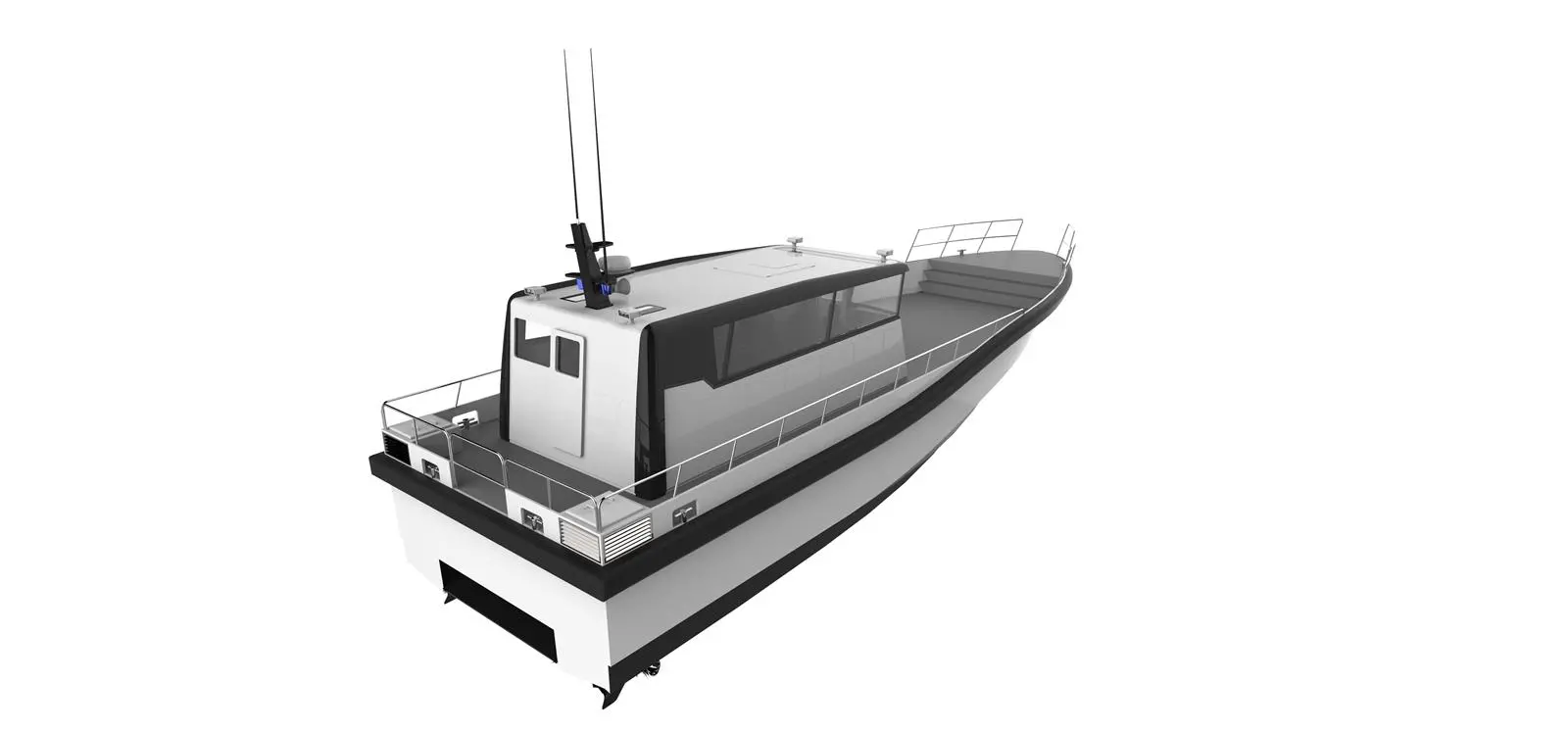
This new design is thought to be the first application of the ASV technology to a newly built commercial vessel. By using a hull mould the construction will allow for series production of a design that should have many other commercial applications.
With the ASV hull, much of the weight of the hull when afloat is supported by the air cushion formed under the hull. The benefit of the patented ASV design is that this air cushion is contained inside the rigid structure of the hull rather than having to use flexible skirts, as was the case with earlier air supported hovercraft designs. This reduces costs and maintenance requirements, both of which are important for commercial vessel applications.
The construction work is taking place at the Tuco yard in Denmark. At this stage work is progressing on making the hull mould. It is planned to make extensive use of carbon fibre sandwich laminates in the hull construction to reduce weight. One of the partners in this project is Diab, which specialises in advanced composites and foam sandwich materials.
The hull design has been extensively tank tested to ensure performance. The air chamber is contained within narrow side walls, and at the bow there is a fine entry with a fine bulbous bow that has been designed to improve the performance in a head sea. When running at speed, this bulbous bow rides just clear of the water, but in waves it contributes buoyancy whilst at the same time it is fine enough to cut through the waves to reduce pitching
The hull of this trial vessel will be 18m in length with a beam of 5.4m. The air cushion is powered by a diesel or electric powered fan which supports around 70% of the weight of the hull, reducing the wetted surface area of the hull and thus the resistance. This should result in high speeds with relatively low installed power. The fan output would range between 20kW to 50 kW depending on the sea state, and it could be powered either by a separate diesel engine or by electric power from the vessel’s on-board genset.
The prototype will be powered by a Volvo Penta IPS drive, with the units mounted at the sides aft where they will be clear of the air chamber. The first units will use a pair of Volvo Penta Series 1 diesels, each producing 435bhp. This relatively low power output is calculated to offer a maximum speed in the region of 40 knots, which will allow a cruise speed in the low thirties.
The fuel consumption with this power installation and running at 30 knots has been calculated to be around 4 litres/naut mile, and this includes the power of the lift fan. When higher speeds are required the ASV can be fitted with larger engines from the Volvo Penta range, using the Series 2 or 3 diesel engines depending on the application.
At this stage of the development the focus is mainly on the hull design but a variety of basic layouts will be possible. For wind farm servicing the layout will have the wheelhouse aft and a cockpit deck forward for light cargo. In this format the wheelhouse can house up to 12 passengers although a larger wheelhouse could be capable of housing up to 20 passengers. An alternative version could see the wheelhouse located forward leaving a long cargo deck aft.
Alternative versions of the ASV design could have applications in patrol and pilot boat operations and a wide variety of workboat duties. The combination of good fuel economy and soft riding efficient hull form could make this concept attractive in a wide variety of commercial and military roles.
In addition to Tuco Marine, the partners in this project are Effect Ships International and Diab, while the project is supported by the Norwegian Research Council and the Danish Market Development Fund. Also planned as part of this project, under a later phase, is a scheme focusing on a 45m version of the same hull concept, which will be designed as a fast offshore support vessel, but could prove equally attractive in the high speed ferry sector.
Related Articles
 PROPULSION
 GENERAL NEWS
 HYDROGEN