



Royal Caribbean’s quantum leap
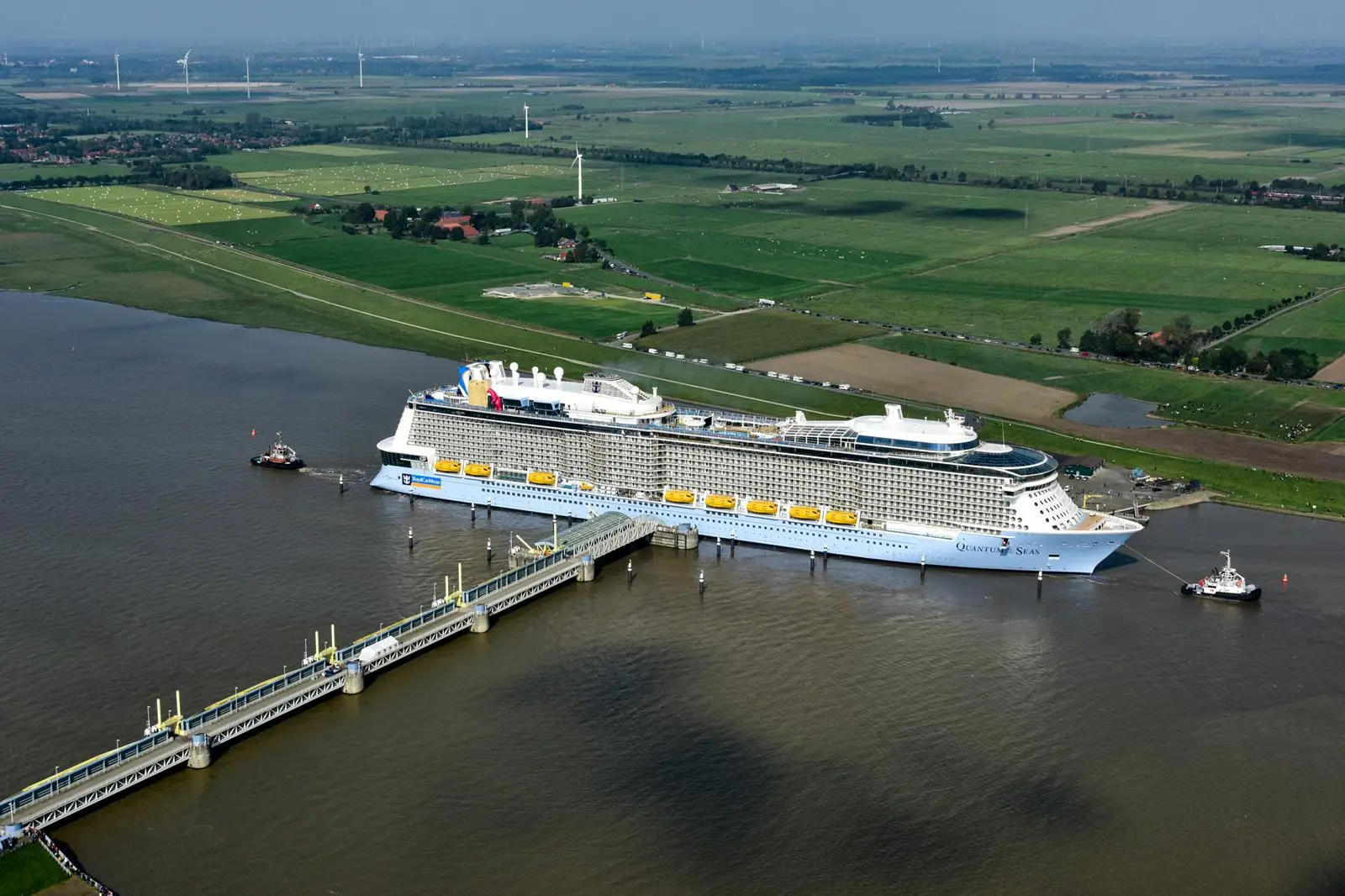
German yard Meyer Werft has reported that it will be ready to deliver Royal Caribbean Cruises’ second Quantum-class vessel, Anthem of the Seas, to the cruiseline in March. The 168,600gt vessel, one of the largest cruise ships in the world, will build on new heights reached with Quantum in sustainability, efficiency and passenger comfort.
In The Motorship’s February edition, we examine the features that made Quantum such a groundbreaking vessel – features that will have been refined and enhanced onboard its new classmate Anthem. David Tinsley reports.
Leading a class of three ordered from Meyer Werft, the 168,666gt
Quantum of the Seas
gives form to the much-vaunted Project Sunshine, hosting advances in energy-saving technology including an under-hull air bubbling system and new generation of Azipod electric propulsors, as well as unprecedented activity and entertainment features.
Bringing the New York- and Oslo-listed owning group’s design concept to realisation, the latest addition to the Royal Caribbean fleet is testament to sustained European prowess in the engineering, construction and outfitting of technically-complex, luxury passenger vessels, and at a time when Chinese shipbuilding is gearing up to break into the market. With 2,090 passenger cabins, or staterooms, the vessel offers a double-occupancy capacity for 4,180 guests, although the arrangements allow for highly flexible configurations that can accommodate a significantly larger number of passengers.
Under-hull efficiency
New solutions and refined technologies, along with fastidious attention to every aspect of power needs and usage, mean that the Quantum class is reckoned to achieve a unit efficiency gain of at least 15% relative to preceding vessels. A large portion of this advance can be attributed to the hydrodynamic benefit conferred by an under-hull air bubbling system.
Air lubrication technology honed and tested over a period of three years by Royal Caribbean in cooperation with Meyer Werft and Finland-based companies Foreship and Process Flow Solution has its first full-scale application on Quantum of the Seas. The air lubrication system generates a stream of micro-bubbles under the hull, reducing friction to the extent that a net reduction of some 7-8% is anticipated in fuel consumption at speed. The air layer also dampens excitation from the propellers, cutting noise and vibration levels in the ship’s after part.
The power station-type plant in Quantum of the Seas is based on four main generators embodying Wartsila wide-bore, medium-speed diesel prime movers. Two of the aggregates have 16-cylinder Wartsila 46-series vee-type engines, and two are driven by 12-cylinder vee models, making for a total power concentration of 67,200kW. ABB was contracted to supply the integrated electrical power and propulsion system, including the generators, switchboards, transformers, propulsion drives, podded electric propulsors and controls, plus the thruster motors.
In fact, Quantum of the Seas is the first vessel to use the larger Azipod XO2300 propulsion units. The increased hydrodynamic efficiency of the design, the successor to the V23 type, derives from the new, ABB-developed X-tail and asymmetric fin. The revised fin structure receives water flow from the propeller at a less acute angle, with the curved design redirecting the flow in a more beneficial manner, while the X-tail pod cap structure straightens the water flow on ejection from the Azipod, minimising water swirl. A stainless steel propeller has been employed as a fuel efficiency measure; fabricating in stainless steel enables the propeller blades to be cast thinner than would otherwise be the case.
A large and complex exhaust gas purification system has been adopted in the shape of two Wartsila open-/closed-loop hybrid scrubbers, enabling the vessel to meet requirements in all areas and ports imposing a 0.1% sulphur cap. The scale and scope of the plant affords both flexibility and redundancy, ensuring the requisite standard of environmental compliance whether operating in the open sea, or in waters with low alkalinity, or in port.
Bow thrusters
The requirement for a very high level of manoeuvrability to meet the demands of working in and out of tight berths, confined channels and exposed harbours, and to be able to dispense with the need for tug assistance in all but the most challenging circumstances, is reflected in an outfit of four, extremely powerful bow thrusters. The entire suite is based on Brunvoll FU115 LTC3000 models, each rated for up to 3,500kW.
The staterooms as a whole are the most spacious in the Royal Caribbean fleet, larger than those of the Oasis-class ships by an average of 9%. Considerable flexibility and choice is conferred by the nature of the different categories. These include family-connected staterooms – geared to families of two or more generations or to groups of friends –with balconied exteriors and also interior studio staterooms created for single travellers, as well as inside cabins equipped with large TV screens displaying the view outside the ship in real time (described as ‘virtual balcony staterooms’).
New passenger facility and entertainment elements introduced by Quantum of the Seas include RipCord by iFLY, the first (simulated) skydiving experience at sea; the North Star, something of an engineering marvel that uses a glass-walled capsule to lift guests 300ft(91m) above the sea; and the Two70 lounge, spanning three decks at the stern of the ship. As its name implies, Two70 affords 270-degree panoramic views through the floor-to-ceiling windows. These are also used as projection surfaces during the evening shows.
Bionic bar
The vessel also houses what is claimed to be the largest indoor activity space at sea, known as SeaPlex. By day, guests can experience a circus school and full-size basketball court, with the space being given over at night to bumper cars and roller skating. Elsewhere, novelty is conferred by the world’s first robotic bartenders in the Bionic Bar.
Quantum of the Seas is described as a ‘smart ship’, in the sense that she has pushed the frontiers in terms of communication facilities. The level of connectivity offered to passengers, measured by bandwidth, is claimed to be unrivalled throughout the world’s cruise fleet. Should they wish, guests can be on-line and connected ‘24/7’, with super-fast wireless speeds matching broadband connections ashore.
Satcoms specialist O3b Networks provided the system, which works by pairing a new generation of medium-Earth-orbit (MEO) satellites with sophisticated shipboard antenna arrays. RFID (radio frequency identification) technology speeds up the boarding process and allows guests to track their luggage, and is particularly useful given the very large passenger complement entailed, as well as the operational and customer service requirement for efficient turnarounds.
Meyer Werft has succeeded in marrying product quality with high productivity, through constant refinement of production processes and the technological tools employed, building on the logistical benefits of fully undercover, in-dock construction at the Papenburg yard.
- For more detail, including principal particulars, read the full report in The Motorship’s February issue, out now. Click here to subscribe.
Related Articles
 PROPULSION
 GENERAL NEWS
 HYDROGEN