



LNG projects gain momentum
According to a recent BofA Merrill Lynch Global Research report, the medium term outlook for oil prices is expected to show a wide trading range of between US$70 and US$80 per barrel with a central average for Brent of around US$60 to US$90 over the next five years. Resulting from the recent huge fall in crude, bunker prices are now (March 2015) averaging between US$300 and US$350 per ton depending on the port, down from around US$600 per ton just a few months ago. LNG prices have also fallen, although not to the same degree. But the smaller price differential has done little to stem the growing number of LNG projects.
Ever more vessel types are adopting LNG as a fuel for main or auxiliary machinery. Rolls-Royce recently signed a collaboration agreement with Spanish energy company Gas Natural Fenosa to develop and install a pure gas engine aboard the Baleària-operated ferry Abel Matutes. This will be Rolls-Royce’s first reference for a pure gas engine installation on a European-flagged ferry operating outside of Norwegian waters.
The 29,670tonne ro-pax ferry, built in 2010 by Hijos de J Barreras in Vigo, Spain, will use the LNG-fuelled Bergen C26:33 L6 AG auxiliary engine to generate 1,560kW of clean power, dramatically reducing emissions during port stays in Barcelona and Palma de Mallorca.
When Abel Matutes is in port, the gas engine will be connected to the distribution infrastructure ashore or the onboard LNG tank. The ferry will also consume natural gas during approach and departure manoeuvers to generate electricity, replacing the heavy fuel oil previously used for this purpose. Use of the Bergen gas engine will, it is claimed, lead to an annual saving of almost 4,000 tonnes of CO2, over 60 tonnes of NOx and six tonnes of SOx.
Baleària is Spain’s leading shipping company with a fleet of 20 vessels operating between the Iberian peninsula, the Balearic Islands, the Strait of Gibraltar and the Bahamas, and is committed to developing LNG as a marine fuel. Group President Adolfo Utor describes the new development as “a very important milestone that will enable us to be pioneers in the use of natural gas on ferries and, at the same time, be more sustainable. Besides reducing CO2emissions by 40%, it also enables us to reduce fuel costs. Abel Matutes may well find herself deployed on a route in an Emissions Control Area (ECA) sometime in the future.”
Rolls-Royce, President – Commercial Marine, John Knudsen, adds: “Spain has the potential to be a significant player in the LNG market. The agreement with Gas Natural Fenosa is a giant step forward in emissions reduction in advance of the entry into force of future emissions legislation.”
Baleària and Rolls-Royce will carry out pre-installation work early this year, prior to the vessel’s scheduled dry docking later in the year. The new engine will be fully integrated into the electricity plant on the vessel, enabling operation with any of the onboard auxiliaries. Testing and implementation work is expected to take place towards the end 2016.
As already reported, late last year United European Car Carriers (UECC) signed a contract for the construction of two LNG-powered Pure Car/Truck Carriers (PCTCs). A single MAN B&W 8S50ME-GI dual-fuel engine will power each newbuild. The PCTCs will be capable of operating on LNG, heavy fuel oil or marine gas oil, providing greater flexibility and efficiency. They represent the first such vessels globally to be fitted with an LNG propulsion system. When in service, they will be capable of completing a 14-day round trip in the Baltic operating solely on LNG, including main engine and auxiliary power generation. The vessels will be constructed at the NACKS shipyard in Nantong, China, a joint venture between Kawasaki Heavy Industries (KHI) and China Ocean Shipping (Group) Company. Delivery for both vessels is scheduled for the second half of 2016
UECC has also signed an exclusive contract for the supply of LNG fuels to the vessels in the port of Zeebrugge using a dedicated LNG ship-to-ship bunker vessel.
LNG bunkering facilities in Northwest Europe will be boosted with the entry into service of a new specialised LNG bunker vessel to be built at STX Offshore & Shipbuilding in South Korea on behalf of Shell. The new barge will have a capacity to carry 6,500 cubic metres of LNG fuel, and will be able to load from big or small terminals and to bunker a broad variety of vessels. It will be powered by Wärtsilä DF dual-fuel engines, and has been contracted in direct response to the increasing acceptance by the shipping industry of LNG as a marine fuel.
The new Shell vessel will be based at the port of Rotterdam in the Netherlands, and will load from the new break bulk terminal and jetty to be constructed by the Gas Access to Europe (Gate) terminal. It will also be sea-going and able, therefore, to bunker customers at other locations. It will be powered by three 8 cylinder Wärtsilä 20DF dual-fuel engines capable of operating on either gas or diesel fuels. The engines are scheduled for delivery in spring 2016.
Aaron Bresnahan, Vice President, Sales, Wärtsilä Ship Power, comments: “This new specialised vessel is an important step towards LNG becoming the fuel of choice for shipping in Europe, and Wärtsilä is pleased and honoured to cooperate with Shell and STX in this project. LNG eases compliance with both the new and anticipated future IMO environmental regulations.”
Following Shell’s bunker barge order, a US company, Conrad Orange Shipyard, has now signed a contractwith WesPac Midstream, of Irvine, California, to build the first dedicated LNG bunker barge for the marine market in North America. Plans call for the 2,200m3 capacity barge to be delivered in the first half of 2016, initially operating in Tacoma, to service Totem Ocean Trailer Express’s (TOTE) Orca class ro-ro vessels, in addition to other LNG-powered vessels. The Orca Class vessels are being converted to burn LNG, as well as marine diesel, with Wärtsilä dual fuel engines.
The barge will then be relocated to Jacksonville, to serve TOTE’s 3,100 TEU Marlin Class container ships being built by GD-NASSCO in San Diego and also equipped with dual fuel engines. The barge is expected to service other LNG-powered vessels that call at the port.
The barge will feature a tank equipped with Mark III Flex membrane containment technology, supplied by GTT (Gaztransport & Technigaz) that will be built by Conrad Orange Shipyard under a GTT licence. The barge will also incorporate the innovative bunker mast design, REACH4 (Refueling Equipment Arm, Methane CH4) developed by GTT, to ensure a simple and safe transfer of LNG fuel to a vessel. The barge is being designed by the Bristol Harbor Group and will be classed by ABS. WesPac worked with its affiliate Clean Marine Energy, on developing the project.
This initial bunker barge for TOTE is part of WesPac/CME’s plans to provide an integrated LNG solution for engine conversion, infrastructure, supply, and delivery logistics to the shipping industry and the pair intend to exercise options with Conrad to construct additional LNG bunker barges to serve other North American ports. Pace Ralli, CEO of CME, explains: “A comprehensive LNG supply and distribution network for the marine market in North America is critical for the shipping industry. This order shows that WesPac/CME is taking the necessary steps to complete the LNG supply chain so ship owners can be assured LNG will be available when and where it is needed.”
US company Harvey Gulf Int Marine recently made maritime history in North America by being not only the first owner/operator of a dual fuel offshore support vessel to bunker LNG as a marine fuel but to also successfully complete the first truck to vessel transfer of LNG and to power the Harvey Energy on LNG.
The Harvey Energy is one of six offshore support vessels being built at Gulf Coast Shipyard Group (GCSG) in Gulfport. Its design is based on the Vard Marine 1 311 design and is powered by three Wärtsilä 6L3 4DF dual fuel gensets providing 7.5MW of power and fueled by a WärtsiläLNGPac system. With a deadweight of 5,150 tons, the vessel is capable of carrying 253,000 US gallons of fuel oil, 18,000 barrels of liquid mud, 1,600 barrels of methanol, 10,250 cubic feet of dry cement and 78,000 US gallons of LNG fuel.
The bunkering operation took place at a shore-based terminal owned by a subsidiary of Martin
Midstream Partners, in Pascagoula, MS. Participating in the activities alongside the crew of theHarvey Energy were the US Coast Guard, ABS, Wärtsilä, Martin Energy Services, state and local agencies and the ship’s builder. The cool-down process took approximately 12 hours to achieve the desired tank temperature and pressure using 3,800 gallons of nitrogen. The LNG bunkering was successfully completed within a few hours of cool-down. The Harvey Energy has now moved on to LNG trials before delivery entry into its long term charter role. In mid February, Harvey Gulf marked another milestone by receiving the first ABS Classification Certificate and the first USCG Certificate of Inspection for a vessel fueled by LNG.
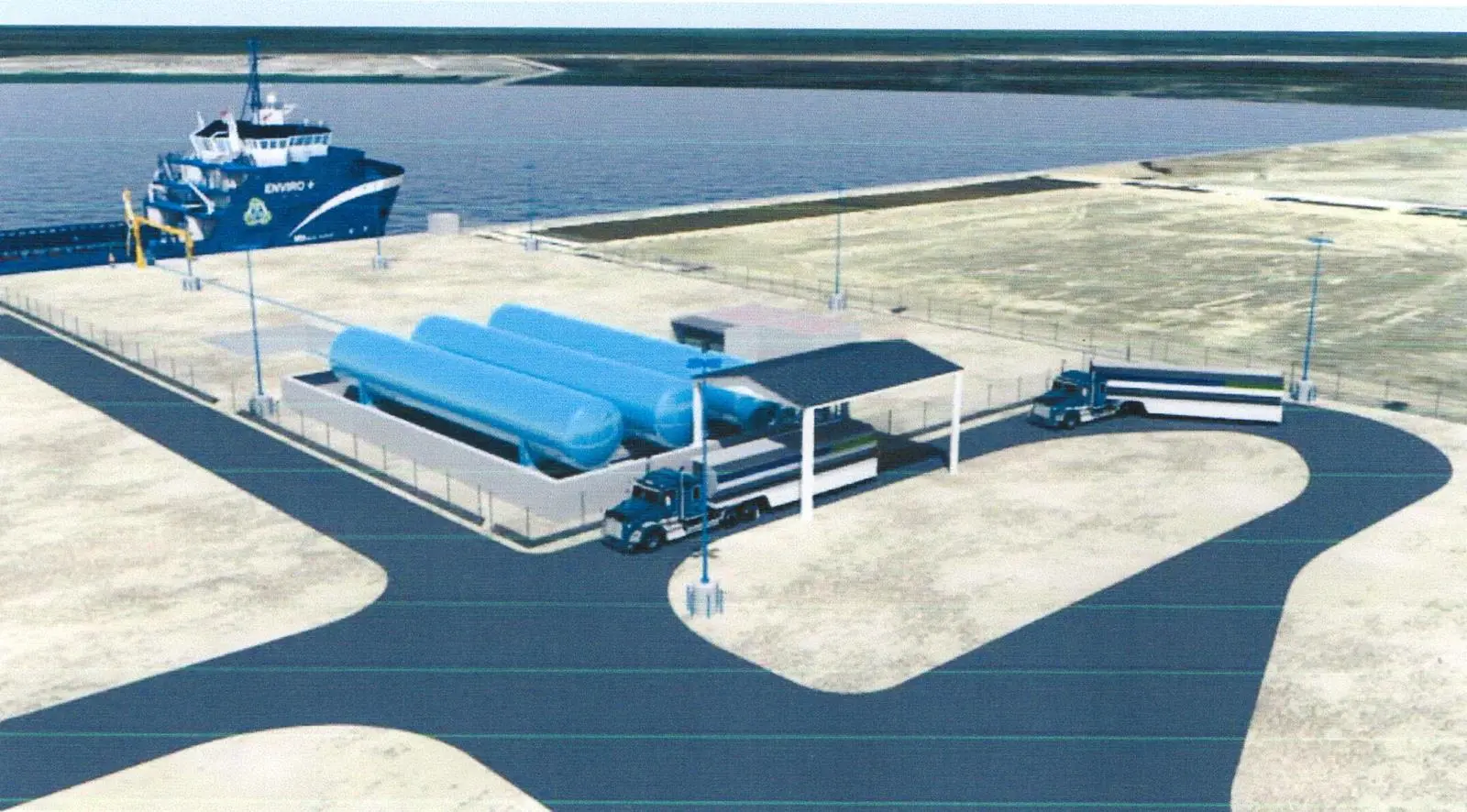
In concert with the Harvey Energy, Harvey Gulf is preparing to operate the first LNG marine fueling facility in the United States, located at its vessel facility in Port Fourchon, Louisiana. The fueling facility will be a significant addition to the growing national LNG supply infrastructure, supporting critical operations of the oil and gas industry’s offshore support vessel fleet operating on clean burning LNG.
Related Articles
 ALTERNATIVE FUELS & LUBRICANTS
 FUELS & LUBRICANTS