



An ongoing evolution: The PX121
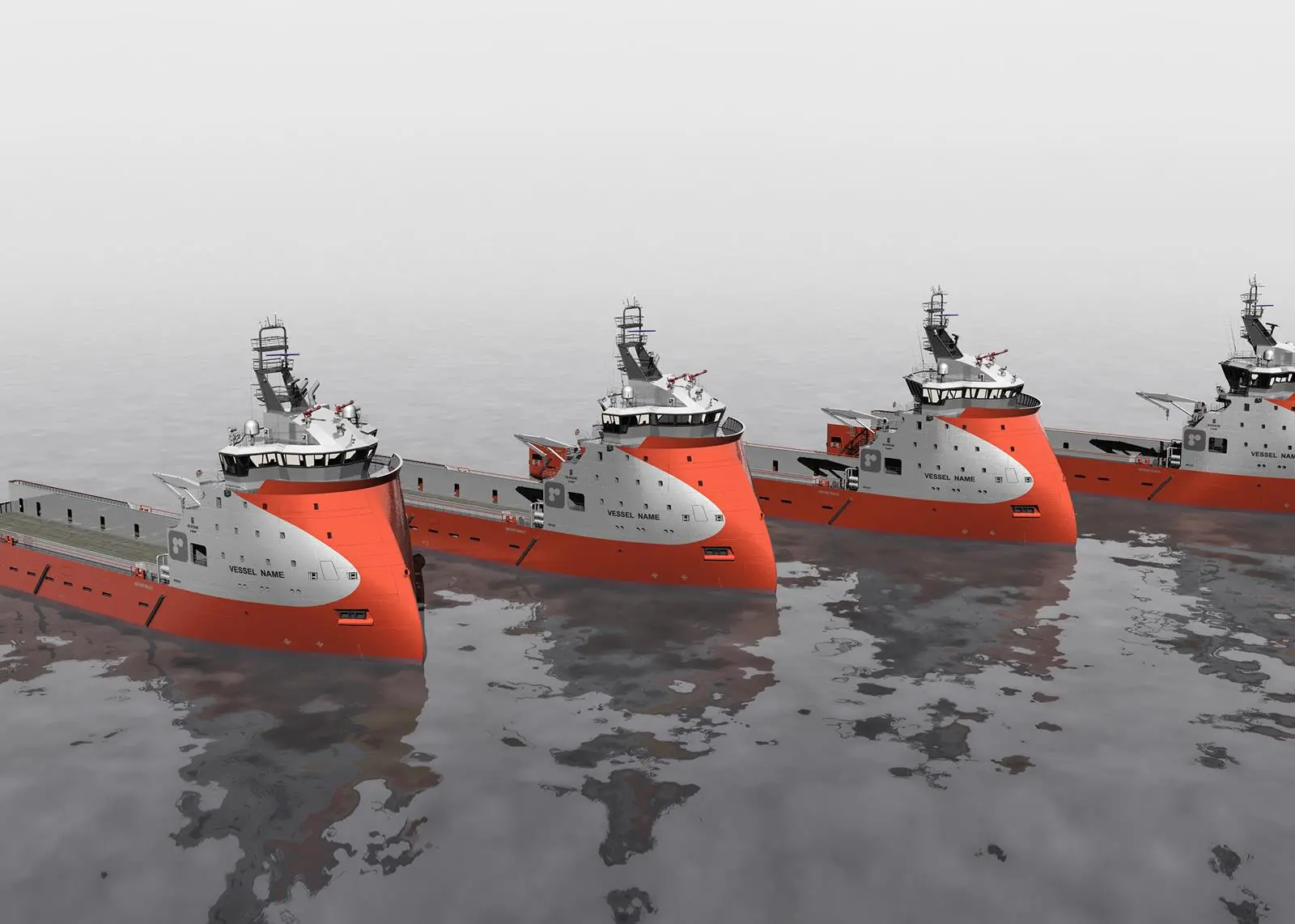
Developed by Ulstein on the back of its own collected intelligence, the first few 83.4m PX121 vessels – starting with Blue Fighter back in 2010 – were built on spec for another Ulstein company, Blue Ship Invest, and floated out for sale to a willing market. There’s over 30 now with around two thirds of these still under build, so recent forecasts for an upturn in oil price will be a relief. However, the squeeze on both investment and operating costs won’t simply vanish.
As a result, the PX121 has a useful ability to “provide capacity and performance close to the largest larger PSVs while still being good value for money”, says Vidar Eikrem of Ulstein.
“It’s got one of the largest deck areas – 850m2 – for its class, and the cargo capacity is close to that of a larger PSV,” he says. This value has been accomplished partly through modularised thinking, “and although the idea of modularisation was something of a focus before then, I’d say with the PX121 we really achieved it”.
It’s therefore no surprise that configurations within the distinctive X-Bow hull can vary widely: the recent Vroon vessels will have just two 1,550kWe gensets plus a pair of 900kWe gensets while the original ‘Blue’ series had around 6,380kWe of installed power in total. Eikrem adds: “You do have to think about automation levels and cargo solutions, all this has a price tag that needs to be configured to the area of operation.” There’s a big difference between the top-end, North Sea vessels and less arduous requirements which can amount to added cost of between US$3m and US$4m – or around 15% of the price says Eikrem.
So, with what seems like a very broad remit, how can tying down the minutiae of integration between hull and propeller actually pay off? The answer is that it seems fairly large gains can still be had, even with very small changes. Until recently, a lot of the PX121’s hull efficiency has been gained through the X-Bow’s ability to take on a wide range of seas and drafts, but a collaboration between Ulstein and ABB showed more could be done.
Ulstein got involved with ABB just at the point where computational fluid dynamics (CFD) were being introduced into the business. “ABB wanted a ship to put in front of a propeller, and we wanted a propeller to put behind a ship as part of our wider strategy for benchmarking our CFD and validation work with an industrial case,” says Karl Randle of Ulstein, “We wanted to look at how we could use it to improve hull form and propeller interaction as well of course as seeing how the new product performed.”
“Because it was a proven design, the PX121 was an ideal candidate,” he explains, and he admits to getting excited when ABB unveiled its recently unveiled Azipod DO1100 idea: “ABB was talking about variable strut heights, reviewing the head boxes, more powerful motors and potentially larger propellers – giving us the ability to interactively rearrange this area.”
Further, high torque, permanent magnet motors were also part of ABB’s new thruster design as they generally yield higher power for the same dimensions and have better efficiency even under part loads. Randle reflects a point initially made by Eikrem: “It is not just the maximum power that’s interesting, we want to look at the total impact, vessels are rarely operating at the maximum load design point.”
The Ulstein team used CFD to look at propeller direction and to experiment with the toe and tilt angle, this last being “much harder to do in a tank”, with model tests confirming the results. However, it also turned up a small, fish-shaped surprise.
Ulstein’s focus on seakeeping tends toward deeper V-shaped lines and quite an angle to the aft of the ship. This results in the thruster necessitating a head box, (or ‘fisk’ in Norwegian) partly for positioning, partly for streamlining the overall shape of the strut.
However the CFD showed when it came to the fisk “size actually matters”, explains Mr Randle. After investigating quite a few different designs a relatively tiny amendment was introduced. “It doesn’t look like much, and in fact you might not be able to spot it unless it’s pointed out, but this 150mm change actually gets rid of the remaining vortices completely and reduces drag by around 1.5%. Taking this with the tilt and toe angle we expect something like a 5% reduction in fuel consumption,” he says. Further, the whole study underscored the Azipod’s open water performance – very useful in a competitive market.
“We pushed the limits of the mesh generation and CFD code for the relative differences, to good effect,” says Randle. The project brings home the point to anyone who might suggest that small manufacturing changes are worthwhile on a well-established design.
Related Articles
 PROPULSION
 GENERAL NEWS
 HYDROGEN