



Composites in ship building
Composites offer considerable potential in weight saving and in developing complex shapes. Combined with their non-corroding finish and sheer versatility, they appear to be a natural material for use in ship building. However ship designers and builders have been slow to adopt this material in a widespread way, and the use of composites tends to be restricted to specialised areas of ship building.
This contrasts with the leisure and military sectors, where the use of composites has expanded considerably both in the size of vessels being built and in sheer numbers. One of the main reasons for this is the number of vessels that are built to a single design – potentially running into the hundreds in the smaller leisure sectors and for smaller patrol boats. Composite hulls first of all require the use of an expensive mould for their construction. This only becomes viable when these mould costs can be amortised over several vessels, with the break even point probably being around five or six.
With larger hull sizes, many ships are still being built to a one-off design and composites are not really a viable material for one-off construction. Even when ships are built to a standard design, it would mean a dramatic change in shipyard work processes to make the change from steel construction to composites. Virtually the whole existing workforce would be redundant as well as much of the infrastructure of the yard. This would be a step too far for most shipyards.
Sizing up
But the size of hulls being built in composites has steadily increased. One of the early drivers of larger composite hulls was the naval requirement for minesweepers that contained the minimum of metal in the structure. Special shipyards and construction techniques were developed to build minesweepers with lengths up to 60m. Like many naval applications, cost was a secondary factor compared with performance gains.
The
largest naval ship constructed in composites is thought to be the Visby class corvettes built by Kockums, which were 73m in length.
The
leisure sector has adopted composites much more widely, with designs of up to 75m in length being constructed in composites. Here solutions for creating temporary moulds for the composite construction have been developed to make the composite construction economically feasible. Several builders have found it viable to invest in a re-useable mould of up to 50m when they can anticipate a production run of perhaps five or six yachts.
Last year American super yacht builder Palmer Johnson launched the world’s largest carbon composites superyacht, their 48m
Super Sport
.
The
hull and superstructure for this yacht were built by the Norwegian sub-contractor Brodrene. who build their own 37m fast ferries. and the company claims that the use of composites has enabled them to reduce the structural weight by two thirds. This saving is reflected in increased performance, fuel savings and improved stability.
Super yacht construction comes under the requirements of the MCA rules rather than the more stringent IMO SOLAS rules for construction standards. It is the combustibility of composites that has been quoted as being a major obstacle to the structural use of composites in ships. Composites are not banned specifically but the SOLAS regulations require structural materials in ships to be non-combustible. For composites, “equivalence” has to be demonstrated – does the material have the same fire resistance as steel, for example. This is claimed to be a complex process which can act as a deterrent to the use of composites.
Heat resistance
Some experts claim that the excellent thermal insulating properties of composites could in many situations reduce the spread of fire.
The
y quote the use of composites to protect steel structures from fire in some offshore installations. This resistance comes from the heat insulation properties of composites which mean that, unlike steel, the side of the panel away from the fire does not get hot and thus does not spread the fire. However composites structure could be more prone to collapse in a fire that a steel structure. Thus suggestions have been made to IMO committees as to how to allow for the use of composites with appropriate assessment
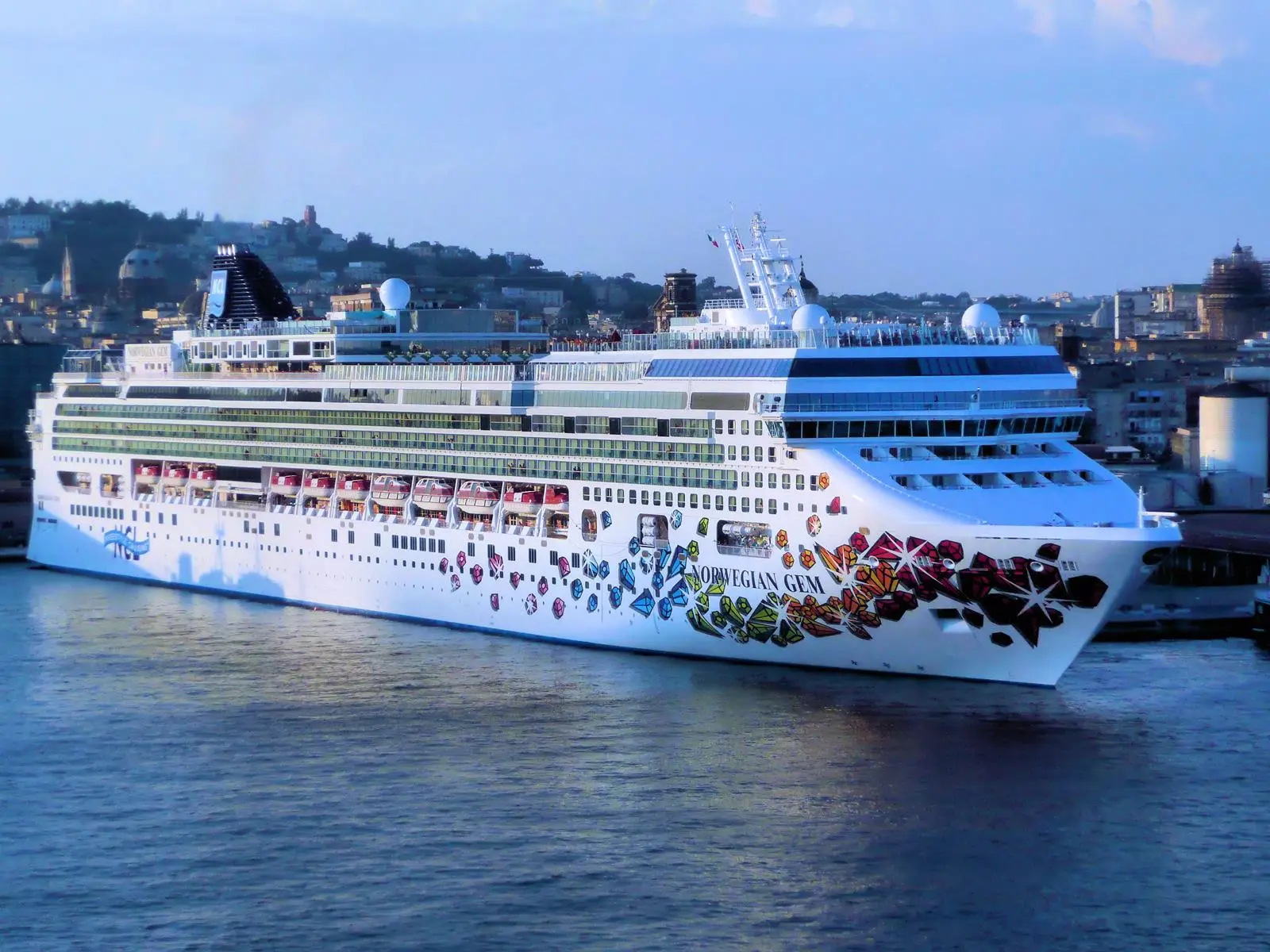
Cruise ships could be a major beneficiary of using composites. Superstructures are getting ever taller, which can develop stability issues. Any weight saving in the superstructure would improve stability. A Swedish research project, LASS-C, looked at replacing the superstructure of the cruise ship
Norwegian Gem
in composites.
The
payback period for the extra structural cost, if you took the fuel savings gained from the weight reduction, was 5.9 years. But the payback from income from the extra cabins you could build for the same overall weight was 2.5 years. For naval ships, the flexibility of the platform, the potential for extra weaponry and increased speed are all attractions which can be gained through topside weight reduction, as well as reduced fuel consumption or increased range.
Composite materials also have excellent fatigue properties and do not corrode as steel does. Thus through life maintenance costs can be significantly reduced where steel is replaced with composite material.
The
re have been proposals to use composites in ballast and other tanks as structural components and composites are increasingly being used in valves and pipework.
Composite hatch covers have been approved for fitting to a 225m bulk carrier.
The
concept was developed by Hansen Engineering with approval being received from Panama Maritime Authority late last year. Richard Hansen says: “
The
se 17m x 8m hatch covers offer several benefits.
The
y reduce weight (typically 35-40% of steel), resulting in easier crane handling and lighter motors. No corrosion means better seal performance, reducing the risk of damage to cargo.”
Hansen worked with classification society DNV GL and fire experts at SP Technical Research Institute of Sweden to provide the design and risk assessment for the conversion project specification developed by Oshima Shipbuilding Co.
Container breakthrough
“
The
IMO SOLAS regulations are based on steel and require structural materials to be non-combustible, although an alternative design approach with risk analysis has been possible since 2002. This is the first time a composite part has been approved using the alternative design approach,” says Hansen.
The
Taiko Maru
, a 499 GT chemical tanker owned by Sowa Kaiun YK, recently became the first merchant vessel to have a composite propeller installed. During sea trials, the propeller required nine percent less horsepower to operate compared to conventional aluminium-bronze propellers.
The
propeller was developed and produced by Nakashima Propeller with support from ClassNK, which granted approval for the design and manufacturing process of the propeller, and provided research and funding support for the project as part of the ClassNK Joint R&D for Industry Program.
Composite propeller shafts have also been used on several high speed ferries to reduce weight and the need for support bearings. Developed by Centra, they have been in use for many years.
Shipping containers are another application for composites. Stephan Lechner of the European Commission’s Joint Research Centre in Italy has studied this application. “A composite container is 42% lighter than aluminium and although composites can be a little more expensive than their aluminium or steel counterparts, there are other costs to be considered such as their weight.
The
cost difference is around US$5,000 but with current diesel prices, the new containers would only need to travel 75,000 miles to break even. In addition, composite containers are resistant to corrosion and can be scanned with a low power x-ray”
Cautious approach
Stella Job, consultant at Composites UK, sums up the situation with composites in ships. “Why are composites not more widely used in ships? Because the industry uses steel. Full stop. Shipping is highly risk-adverse, for good reasons:
The
oceans are dangerous places and ships are very expensive. Upfront costs of composites are usually higher than steel and there is surprisingly little consideration of through life costs, though that is beginning to change.”
It appears that many ship owners have separate budgets for newbuildings and for through life costs. An experienced naval architect and composites expert comments: “
The
biggest problem is when the customer cannot get his initial build budget and his through life budget in the same place.
The
financial structures are often wrong. From the regulators’ perspective there seems to be considerable reluctance to be first to approve structural composites, perhaps because of a substantial lobby at IMO which resists change in this area.”
Related Articles
 PROPULSION
 GENERAL NEWS
 HYDROGEN