



More done out back
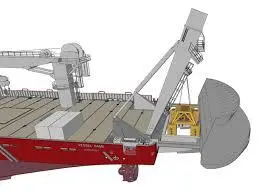
This intriguing vessel ‘add-on’ is a direct descendent of Ulstein’s X-Stern: this gives support vessels a more hydrodynamic rear, allowing them to turn and present a better form to weather and waves while also improving both vessel motion and fuel consumption. But the shape also results in a few limitations when it comes to operations over the aft end.
However, Øyvind G Kamsvåg of Ulstein explains when the market started to respond to oil price downturn “with a lot of boats coming off charter and sitting around”, the company spotted an opportunity: an extension that could be tailored for a wide range of platform support vessels (including retrofits or newbuilds). This would allow the benefits associated with the tapered X-Stern to play out alongside rearward crane or A-frame deployments, making for a more able, rate-competitive vessel.
The addition follows the same ‘line’ as the original hull, and while drawn up and inward to maintain efficiency during transits, it will extend out to around 8m from the back of the vessel to create a moonpool.
It promises a lot: A-frames and cranes would now have a nice drop in front of them and CFD analysis shows a halving of the water motion inside the moonpool compared to the waves outside – helped by the integration of the wave motion damping grid into the unit’s extending ‘arms’. This, says Mr Kamsvåg, results much less rolling than encountered working over the ship’s side and much better margins when it comes to challenging conditions.
However, the vessel’s original designation could not be changed as this would involve major issues with things like stability rules, so Ulstein has been careful that it is not ‘structurally’ part of the original vessel and so can’t be measured in with the vessel’s total length, at least as far as class is concerned. “There were several constructive meetings” with classification societies says Mr Kamsvåg.
“The point is that it’s made of an alternative material to the original hull. We started to explore using GRP (Glassfibre Reinforced Plastics) and other alternative materials, not just because steel is much heavier but because although you can manufacture GRP to be robust it also fulfils the necessary safety requirement; in a worst-case scenario this extension needs to be able to break away so that the structural integrity of the vessel will be maintained.” In fact, Mr Kamsvåg adds that a big focus has been introducing connection points that would be tough enough to handle North Sea operations while still not ‘locking up’ under the extreme stresses of an incident.
Interestingly, the class societies accepted the idea as it is a principle already established by, for example, the Volvo IPS drives that sit in pods underneath a boat but which detach leaving a watertight hull if the vessel grounds.
How big will the resulting moonpool be? Well, it rather depends on the size of the original vessel: “Since it’s made of GRP, if a client wants to introduce it to one of his boats the unit can be easily customised for that hull.”
At the moment it’s still a conceptual study, but potentially it means even smaller vessels could carry out limited subsea deployment operations while still keeping their day rates down.
There’s no doubt the Extender idea is out of the ordinary. However, if the oil major’s ambitions to keep cutting costs wins out over conservative sentiments then the ability to increase a vessel’s operational ability in this way will be very useful in a market that’s proving to be as challenging as the North Sea itself.
By Stevie Knight
Related Articles
 PROPULSION
 GENERAL NEWS
 HYDROGEN