



North America LNG first for Québec ferry
Canadian shipowners and operators have demonstrated a new dynamism in fleet modernisation and development over recent years. In addition to meeting the challenges imposed by operating in extremely tough climatic conditions, a common thread in the various projects is a considered, and often bold, approach to increasingly exacting environmental regulations.
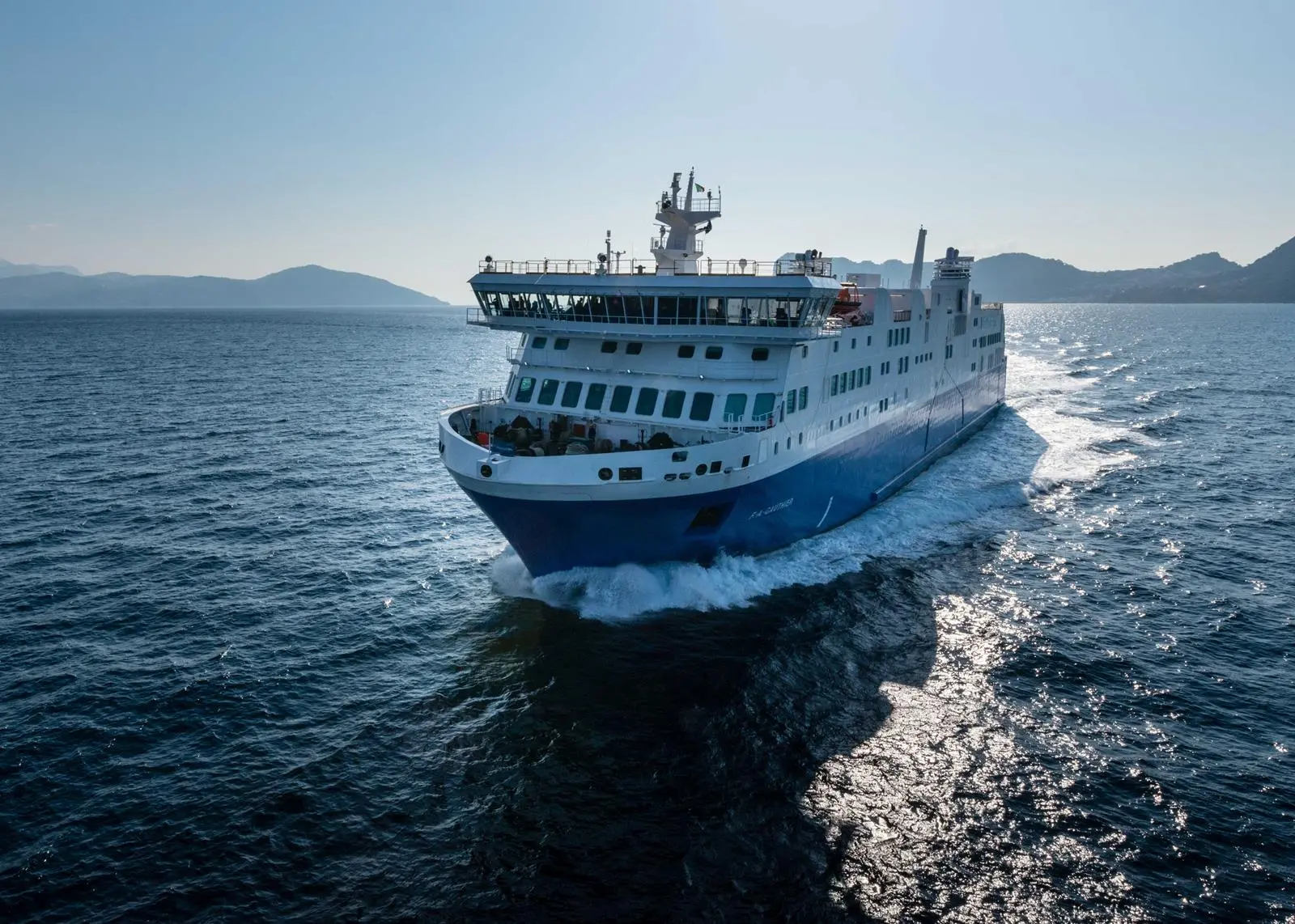
The recently delivered St Lawrence ferry FA Gauthier, engineered to run on LNG fuel and designed to maintain vital, year-round services across the lower reaches of the ice-prone river, is testament to the Canadian industry’s willingness to grasp new opportunities and set higher standards through circumspect investments.
Arranged to carry 800 passengers and 180 vehicles, FA Gauthier denotes a milestone in the industry’s uptake of alternative fuels as the first LNG-powered ferry in North America. Owner Societe des traversiers du Québec (STQ), a Québec crown corporation, exemplifies the role that publicly-owned organisations can play in backing environmentally-led technical design solutions, driving the technology forward and laying the ground for potential long-term economic and infrastructural as well as societal benefits.
In conjunction with the dual-fuel electric power and propulsion system, the ship employs main azimuth thrusters equipped with contra-rotating propellers. The ferry is ice-hardened to the highest degree to cope with year-round duties entailing crossing times of about two hours across the broad St Lawrence estuary. The bow and stern have been formed to ensure the essential ice-going performance. The Lloyd’s Register notations for the vessel include 1A ice class for the hull and 1A Super ice class for the propulsion.
FA Gauthier ranks as the first ferry to have been ordered abroad by STQ. The fact that the vessel is Italian-built expresses the greater tonnage sourcing freedom enjoyed today by Canadian owners, compared with the days when Canadian-flag operators were subject to heavy tariffs on imported newbuilds, to promote ordering at home yards. The waiving of import charges has given a fillip to tonnage renewal under the Canadian flag.
The latest project was fulfilled by Fincantieri at its Castellammare di Stabia yard in Naples Bay, and has taken the Italian group into a new sphere of LNG-fuelled vessel construction and engineering. The ferry is a showcase for Italian shipbuilding’s capabilities in bespoke production.
While responding to the growing demands on ferry services arising from the economic expansion under way in northern Québec, STQ’s investment strategy is also coloured by its operations within a designated sulphur Emission Control Area(ECA) and by the provincial government’s ‘green’ agenda and aim to reduce the environmental impact of its transport infrastructure. Canadian waters are encompassed by the North American ECA, wherein a 0.1% sulphur limit has been in force since the outset of 2015.
The transportation industry as a whole is the biggest greenhouse gas(GHG) emitter in Québec, accounting for 42.5% of the province’s total emissions in 2010. Natural gas is seen as an ideal energy solution, due to clean-burning properties relative to fuel oil, considerably reducing CO2, NOx, SOx and particulate matter(PM) emissions, together with its competitive cost and high calorific value.
The dual-fuel plant employed in the 16,200gt ferry ensures compatibility with the sulphur cap when running in gas mode, while safeguarding service dependability by allowing operation on marine diesel oil if there is a hold up in road delivered-LNG bunkers due the rigours of the winter.
Moreover, the DF machinery affords flexibility and efficiency in allowing the vessel to be deployed elsewhere in the STQ service framework and beyond her regular operating area, if required. The latter is salient to the public service requirement for the ship to be available to act in a relief or emergency capacity in the event of weather-induced disruptions on the road system.
FA Gauthier has been assigned to daytime operations out of Matane, on the south bank of the river, plying a V-shaped route whereby crossings are made alternately to Godbout and Baie-Comeau on the northern side. The distance between Matane and Baie-Comeau is 62km, and between Matane and Godbout is 55km, and scheduled transit times are 2h 20min and 2h 10min, respectively. The Matane-Baie Comeau/Godbout operations entail two to six daily crossings over the course of the year, according to the different schedules for each season. Annual liftings are around 180,000 passengers and 85,000 vehicles. The river routes offer travellers an alternative to road journeys of almost 900km.
The ferry has replaced the 1974-built Camille-Marcoux, which would have been required to reduce passenger and crew capacity in order to meet the new Transport Canada stability standards taking effect on 1 January 2016. Making crossings at 20 knots during summer and 18 knots on the winter schedule, the new ship is faster than her 17-knot predecessor, and can take about one-third more passengers and 50% more vehicles. The bulbous bow has been formed for both ice-going and efficient open-water navigation.
Finnish technical consultancy Deltamarin and Québec City-based Navtech worked in consortium to prepared the outline design and contract design in conjunction with, and on behalf of, STQ. Engine and propulsion equipment supplier Wartsila was also involved at an early stage, while Lloyd’s Register provided principal approvals for the design and undertook safety assessments for the hazardous systems.
FA Gauthier is installed with four Wartsila 12V34DF engines, each rated to deliver 5,220kW at 720rpm, and coupled to GE 5,010kW/5.5MVA alternators. The four aggegates are located in pairs in two main engine room compartments. All engines can be seamlessly switched to operation on MDO, should gas not be available, ensuring full redundancy.
The main gensets supply electricity at 3.3kV to the two parts of the interconnected main busbar. Power is then delivered to the two 7MW electric propulsion motors and the two variable-speed tunnel thrusters forward, and distributed to other shipboard consumers through medium-voltage and low-voltage transformers.
The installation on the new STQ ferry is exceptional in its use of pulse width modulated(PWM) converters without propulsion transformers, thereby saving space and reducing electrical losses. The four PWM frequency converters are directly fed from the switchboard. Furthermore, the main propulsion converters drive the bow thrusters, yielding further savings in weight and space.
Through a Z-drive configuration, the asynchronous propulsion motors drive two Steerprop azimuthing thrusters, incorporating contra-rotating, stainless steel propellers fitted at both ends of each pod nacelle. The model SP120 ECO CRP propellers are each rated for the requisite 7,000kW, and designed and built to Finnish-Swedish 1A Super ice class.
The arrangements meet the requirement for a maximum service speed of 20 knots, with four engines running at 85% maximum continuous rating(MCR). The main CRP thrusters, augmented by the two 1,500kW Rolls-Royce bow thrusters, confer the requisite berthing manoeuvrability, and hence schedule-keeping, in the demanding sea and wind conditions characteristic of the operating area. Berthing has to be achieved in wind speeds of up to 45 knots, without tug assistance. Dynamic positioning in accordance with the LR class notation DP(CM) is realised through the adoption of a Nav DP4000-series system from the Finnish company Navis Engineering.
The overall main power concentration of 20,880kW, in relation to the vessel’s modest size, is indicative of the arduous, year-round operating environment and the requirement to sustain speeds up to 20 knots. While the latter calls for all four engines to run at 85% maximum continuous rating(MCR), the winter timetable at 18 knots can be achieved with three engines, leaving one on standby. In the interests of passenger comfort, motion control is exerted by a pair of Rolls-Royce fin stabilisers.
Besides the four main gensets, Wartsila supplied its LNGPac system, encompassing onboard LNG bunkering, storage and handling equipment, as well as the related safety, control and automation systems.
The ferry is claimed to be the first of its kind worldwide to have the LNG fuel tanks protectively located under the main deck. This arrangement has conferred improved stability and reduced vulnerability in line with risk mitigation, and required the closest consideration of regulatory requirements during the design process. The double-walled bunker tanks, positioned inboard of the ship’s B/5 longitudinal bulkheads, are comparatively large in relation to the vessel’s volume. These provide a combined capacity of 500m3 when filled to 90%, allowing for 14 days’ operation. However, refuelling takes place more frequently.
STQ has entered into an agreement with Gaz Metro covering purchases of LNG for the FA Gauthier, which is bunkered in Matane from road tankers hauling the LNG along the highway system on the southern bank of the river from a liquefaction facility in Montreal. Gaz Metro’s contract also encompasses the provision of LNG fuel for the two ‘double-enders’ due to be introduced to the north bank Saguenay River crossing this autumn.
Formed in 1971 when a number of Québec ferry companies and their assets were brought together under the ownership of the provincial government, STQ is responsible for 13 routes along the river and Gulf of St Lawrence. The two smaller ferries in its current fleet development programme, each designed for 432 passengers and various ro-ro permutations up to 115 cars or 16 trucks, have been specified with LNG dual-fuel machinery of the Wartsila 20DF type.
The two 92-metre double-enders are nearing completion at Chantier Davie’s yard at Levis, on the south bank of the river facing Québec City, and are intended for the Tadoussac-Baie St Catherine route across the mouth of the Saguenay River at its confluence with the St Lawrence. This link effectively forms part of Highway 138, and the 10-minute crossing obviates the need to make a 250km road journey.
PRINCIPAL PARTICULARS–FA GAUTHIER
|
Length overall |
133.2m |
|
Breadth, moulded |
22.4m |
|
Draught, design |
5.4m |
|
Draught, maximum |
5.6m |
|
Passengers |
800 |
|
Vehicles |
180 |
|
Deadweight |
1,885t |
|
Gross tonnage |
16,200t |
|
Main engines |
4 x 5,220kW |
|
Propulsion motors |
2 x 7,000kW |
|
Fuel |
LNG/MDO |
|
Speed |
20 knots |
|
Class |
LR |
|
Class notations |
100A1 Passengers and Vehicle Ferry, ShipRight(SDA, CM), movable decks, CR, Ice Class 1A, FS, *IWS, PCAC(3.3), LMC, CCS, UMS, ICC, GF, PSMR, IBS, DP(CM), ECO(A, GW, NOx, SOx, IHM), PL |
|
Flag |
Canada |
Related Articles
 PROPULSION
 GENERAL NEWS
 HYDROGEN