



Imbari unveils eco-mega containership
The ‘eco-mega’ ship incorporates a number of innovative features that together the yard claims will lead to significant fuel savings. The first eco-mega ship, the Millau Bridge is currently operating on the Asia to Europe routes and the construction of this vessel is being followed by a further four vessels of the same design in this contract.
These ships will operate under the ownership of the Japanese company Kawasaki Kisen Kaisha (K line). The ships are designed with a container capacity of 14,000teu, which sounds small by recent containership contracts for 20,000teu ships, but represents a practical size of ship that can access many ports that cannot cope with the new breed of super container ships. These ships will have a deadweight capacity of 145,000dwt.
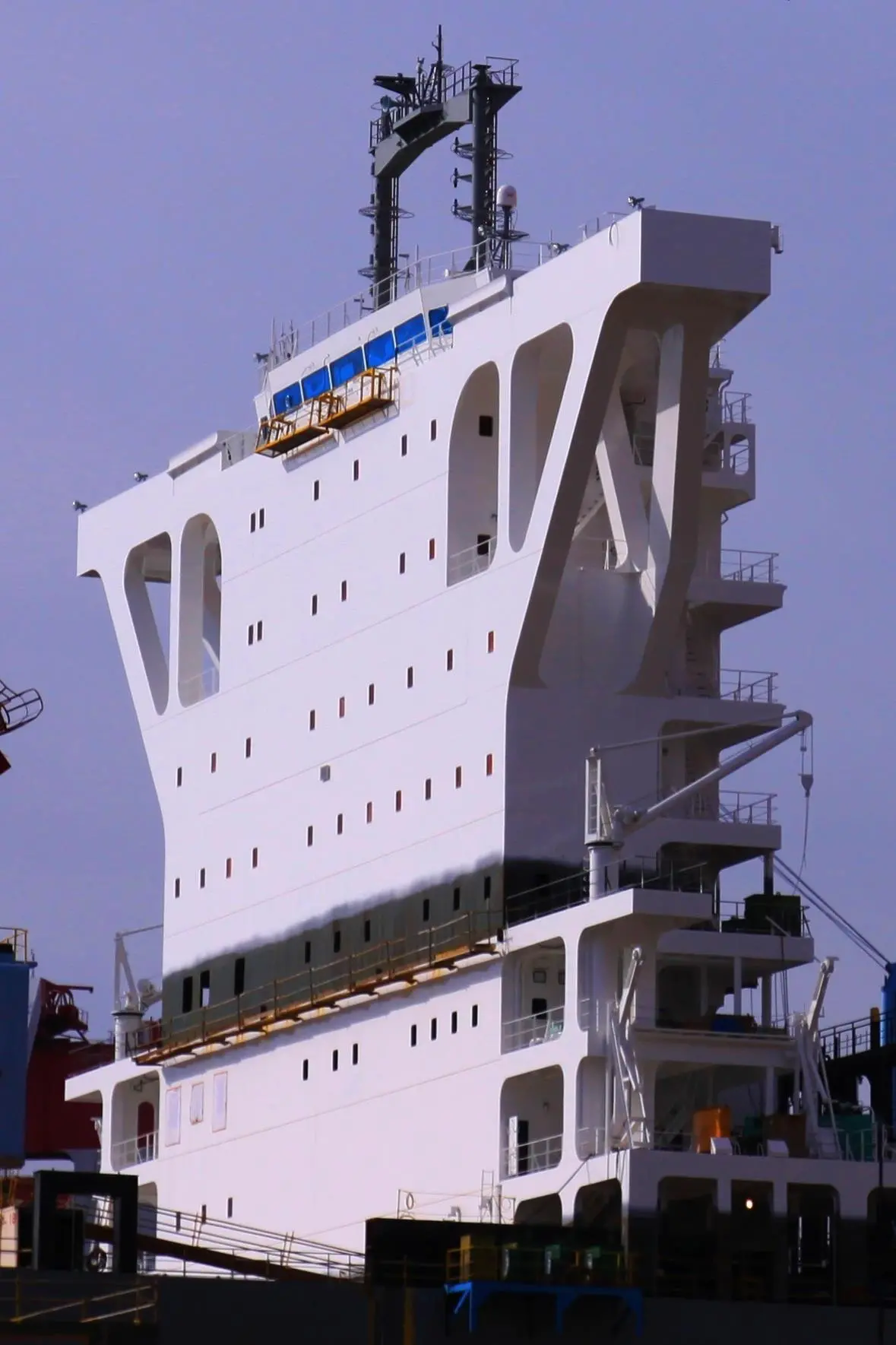
With an overall length of 365.9m the design of the Millau Bridge follows the modern style of having a two island layout. This puts the slim bridge structure and accommodation roughly amidships where it can offer much better forward visibility from the bridge. The funnel is mounted on an equally slim superstructure unit aft directly above the engine room space which still leaves a further container stowage area aft. The lifeboats are accommodated at the base of the bridge structure where launching them could be a safer operation than from the conventional location right aft.
Apart from the superstructure layout, the most notable feature of the Millau Bridge is the bow shape. A great deal of work has been done on fine tuning the shape of bulbous bows but the designers of Millau Bridge have focussed just as much attention on the shape above the main deck line. Here there is a distinctive reverse angle shield which the designers are calling the Bow Cover.
There have been many attempts in the past to develop an above-deck shape that would reduce the wind resistance of the square box presented by the container stacks on deck. These have tended to involve large streamlined covers that extended to the top of the container stack. The sheer size and weight of these covers were sufficient to reduce the container capacity and tended to negate any advantage gained from the reduced wind resistance. These larger structures were also vulnerable to wave impact damage in rough seas.
Extensive tunnel testing
The designers of Millau Bridge carried out extensive wind tunnel tests to develop a bow cover shape that would add minimum weight to the hull structure whilst at the same time reducing the wind resistance. The result is a relatively low structure that extends upwards to about the level of the container guides on deck but which the tests have shown is adequate to deflect the wind upwards and over the container stack.
The wind tunnel tests demonstrated that this design of bow cover reduced the wind resistance by up to 5% and there is no sacrifice in container capacity. The bow cover has been carefully shaped to deflect the wind from ahead just the right amount and the cover also extends around the sides to the point of the first container stack so that it can also be effective when the apparent wind is not directly ahead.
In addition to the bow cover, energy efficiency has been incorporated into all parts of the vessel. The air supply volumes are under automatic control and this has led to a 50% saving in the electric power consumption of the fans. The seawater pumps also use the same inverter mechanism which has led to an even greater saving in electric consumption of up to 70% maximum.
Exhaust gas economisers have been fitted to both the main engine exhaust as well as those of the four electric generators. This leads to the fuel consumption of the boilers being reduced and the boilers are also equipped with water emulsion fuel devices to achieve more efficient combustion. These all represent small savings but the cumulative effect is claimed to be quite significant and this has to be balanced against the extra cost of installing the additional equipment.
Millau Bridge is powered by an eleven-cylinder MAN B&W long stroke diesel engine that produces 63,910kW. This is a direct drive unit of the manufacturer’s compact range, type 11S90ME-C9.2 and it features their long stroke version. This engine gives the Millau Bridge a top speed of 22 knots but in normal operation the vessel operates at a couple of knots below this speed.
Vortex free hub
Detail improvements have also been made to the propulsion system to improve efficiency. Notable amongst these is the hub vortex free cap, which is an extension of the aft end of the propeller shaft that is fitted with spiral grooves. This is designed to free the propeller from hub vortexes which leads to an increase in the thrust and it works in combination with a twisted leading edge rudder. This rudder design features one half of the rudder blade offset slightly from the other and is used to reduce the rotational flows from the propeller, again to improve efficiency.
The hull is coated with a low friction anti-fouling paint that works by having a surface gel that helps to smooth the flow of water over the hull and thus reducing friction between the water and the hull. Whilst the larger length of the hull will inherently reduce the fuel consumption per teu when compared with a smaller container vessel this new 14,000teu is claimed to show a significant reduction in fuel per teu when compared with a smaller container ship which it is claimed to be mainly due to the design and propulsion improvements. The shipyard puts this reduction at around 35% when comparing the Millau Bridge with an 8,100 teu container ship when both are running at 22 knots.
Following the incident with the MOL Comfort containership that broke in half in the Indian Ocean there has been particular concern about the structural strength of container ships as they have grown in size. To meet this concern the Imbari Shipyard has given, what they quote, “utmost attention has been paid to increasing the reliability of structural strength and our analyses assumed severer conditions that is usual for the stowage of containers.”
A larger number of longitudinal hull girders have been used in the structure of the hull and perhaps equally important are the fatigue analyses that have been carried out. The design rules from the classification society required that these are based on an expected 20 year hull life but Imbari has extended this out to 25 years to ensure that there is an adequate safety margin built into the hull structure. This has inevitably added weight to the hull structure but combined with the detail efficiencies that have been achieved with the hull and propulsion of this vessel there is still an overall improvement in the efficiency of Imbari’s Eco-Mega ships.
The first vessel in this class, the Millau Bridge was delivered earlier this year and the remaining five sister ships will be delivered during 2015. It would appear that these first ships have proved themselves in operation as the contract from K-Line has now been increased to 10 ships of this class.
At the time of delivery the Millau Bridge was the largest container ship ever built in Japan but that record will not last as larger ships are on the stocks. Imbari Shipyard itself in under-going an extensive development programme that will see a new dry dock added to its facilities to allow it to build container ships in excess of 20,000 teu and they already have a contract to build eleven 20,000 teu ships. It is anticipated that the new dock will be in operation by next year and this will provide competition for the South Korean and Chinese shipyards that have dominated the mega containership sector.
Related Articles
 PROPULSION
 GENERAL NEWS
 HYDROGEN