



German yards report varied repair sector
Lloyd Werft Bremerhaven (LWB) has been surprisingly busy with repair and maintenance ahead of what will presumably be a switch to cruise ship newbuilding in the wake of its acquisition by Genting.
Newbuilding is expected to bring production and facility changes at LWB, which has been geared to repair and conversion for some years. As of late autumn however there was little evidence of any repair slowdown
A visit by the 8,378gt Hanseatic pointed up continuing LWB work in cruise ship repair. Unusually, LWB reported no details of that or other recent repair jobs. Hanseatic reportedly underwent extensive round-the-clock overhaul lasting three weeks which is said to have included stabiliser drive conversion to eco-friendly bio-petroleum and a complete overhaul of the ship’s two MaK 8M453C main engines.
Other repair jobs also reflected continued strong offshore and other diversified repair expertise at LWB which is clearly not being halted just yet – if at all. The 55,729gt vehicle carrier Asian Emperor, the 15,328gt offshore jack-up Bold Tern, the 11,730gt, LWB-built wind turbine installer MPI Enterprise and the 72.6m research ship OGS Explora were all at the yard. The offshore construction ship Ceona Amazon, built by LWB just last year, was also there as this report went to press after work including the installation of a cable firing line.
LWB also berthed Germany’s biggest research ship, the 117.9m Polarstern for routine maintenance, small repairs and inspections.
LWB’s Kaiserhafen neighbour German Dry Docks (GDD), which regularly uses LWB facilities, docked the 52m research ship WEGA for class work, extensive hull repair, engine overhaul and installation of a new Vario filter plant.
GDD also tackled bigger ships reporting extensive class renewal, maintenance and painting on the 62,942dwt general cargo ship Pelican Arrow and the 43,000dwt juice tanker Carlos Fischer. Routine class work was done on the container ships Ruth, WEG Goya, JPO Aquarius and Jork Ranger.
Michael von Häfen at Bremerhaven Dock (BREDO) reported a situation similar to that in autumn last year and to that in many other German yards. “We have lots of ‘bread and butter jobs’ and nothing special but are already well booked up to the end of the year” he told The Motorship. Navy ships have been frequent visitors, part of co-operation with the small Elsflether Werft, he added.
Other recent projects at BREDO included the docking of the 8,397gt cargo ship Wiebke for class and paint work as well as rudder repairs. The 61m trawler Polonus came for painting and pipe and hydraulic work while the 50m pilot ship LSS Hanse docked for class and paint work as well as the refitting of a boiler plant.
The 11,473 cargo ship Amoenitas docked for painting and corrosion protection, rudder repairs and class and pipe work. Other late callers included the 6,901gt cargo ship Pachucca, the 8817gt dredger Nordsee and the 7002gt cargo ship BBC Afrika.
BREDO personnel also assisted in repair and renovation work on the Kaiser Schleuse and the Doppel Schleuse locks in Bremerhaven.
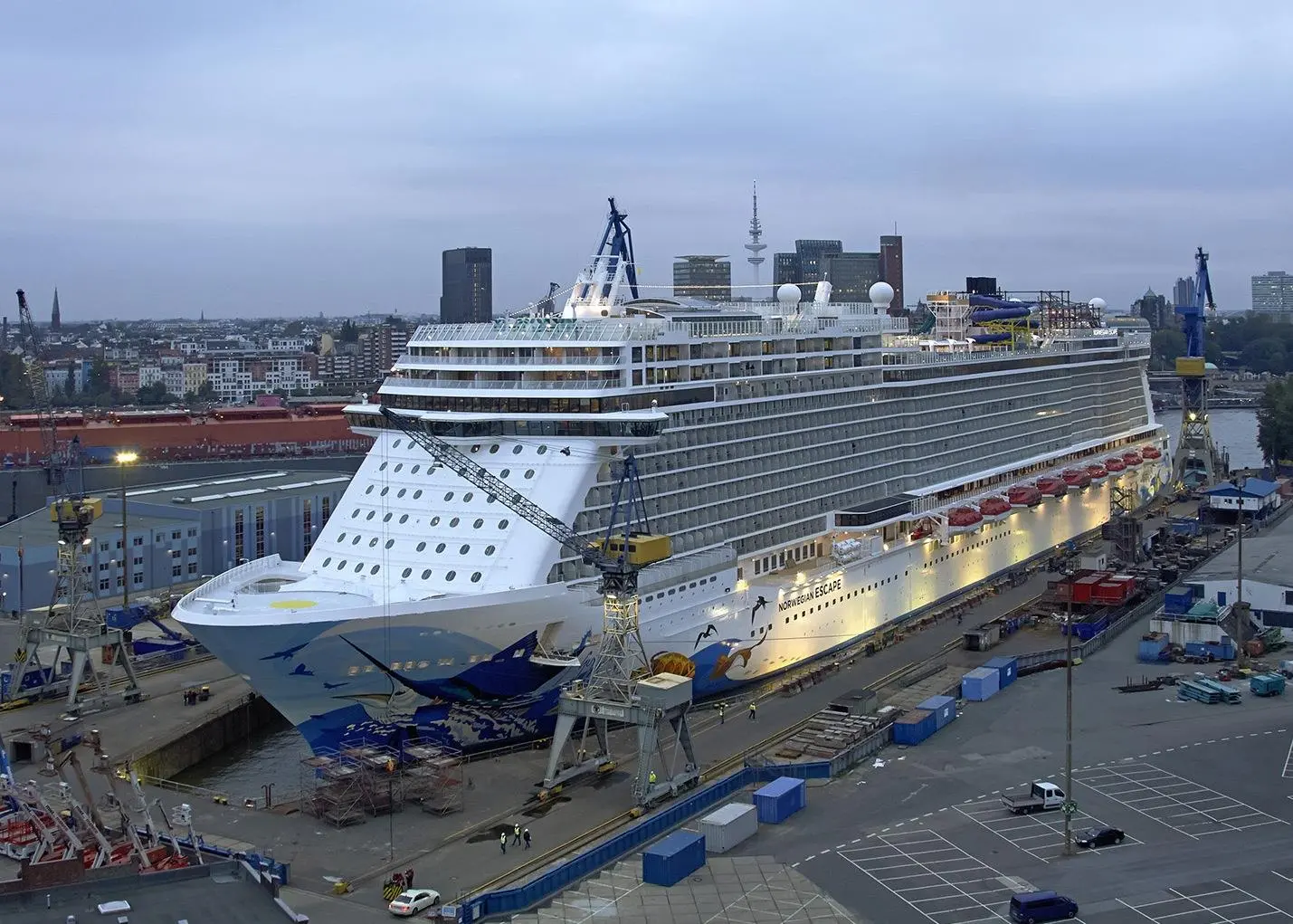
In Hamburg, Blohm + Voss carried out the final two-day docking checks on Meyer Werft’s 163,000gt cruise newbuilding Norwegian Escape in its giant Elbe Dock 17 – one of only a few German docks now able to handle such ships. The work included underwater checks, scrubber adjustments and final inspections.
The much smaller cruise ship 28,890gt Europa came in for two weeks of maintenance, but there was little sign end October of the usual flurry of winter cruise regulars. B+V told The Motorship the upcoming period was an open book – save for Queen Mary 2, due next May.
However there was a variety of merchant customers for the versatile B+V, particularly container ships and tankers. The 70,000 dwt Russian tanker Kirill Lavrov made its first call for class work, ice painting and Azipod overhaul. Sister Mikhail Ulyanov called in March for maintenance. The 4,026dwt LPG tanker Castell Dell’Ovo came in for a main engine crankshaft swap. The 81,283dwt bulker Panther Max, which arrived in July for rudder repairs, was still there late October. The latest of a long string of container ships were the 41,748dwt Leto for drydocking and class work and the 63,352dwt MSC Cordoba for work including engine and rudder repairs and propeller work.
Still in Hamburg, scrubber installations were keeping the Pella Sietas Shipyard busy late year. Chief Technical Officer Björn Pape told The Motorship the work on four 33,000dwt self loading bulkers was lasting into 2016 with each ship calling for two weeks.
Pape revealed that yard teams had joined the first ship, Fitnes, at sea for preliminary installations and carried out shell penetrations during drydocking earlier in the year. The new exhaust funnel section meanwhile built at the yard and installed in one piece when the ship arrived.
After all the speculation it was Lindenau Shipyard in Kiel that bagged the sought-after remodelling and renaming of one of Germany’s best known cruise ships – the classic 22,400gt TV “Love Boat” Deutschland. The ship has now entered service as the floating university World Odyssey for U.S. interests.
Yards in Hamburg and Bremerhaven showed interest in the work. Lindenau Repair Director Bernd Wittorf acknowledged competition but said previous experience with the ship as well as location had paid off.
Along the Baltic in Stralsund, the unique 73m German Navy SWATH research SWATH ship Planet is at Nordic Yards until year’s end for six months of extensive class, repair and overhaul work.
Nordic Wismar docked the 16,994gt container and cargo ship Monchegorsk for five weeks of extensive widening and maintenance including installation of a water ballast treatment plant and pipework.
Nordic’s Susanne Meyer told The Motorship additional work included more container cell supports and Azipod drive overhaul. The underwater hull was cleaned and recoated and additional reefer plugs also installed.
Monchegorsk
was built at the Wismar yard in 2008 for Norilsk Nickel.
Related Articles
 PROPULSION
 GENERAL NEWS
 HYDROGEN