



World’s largest con-ro set for debut
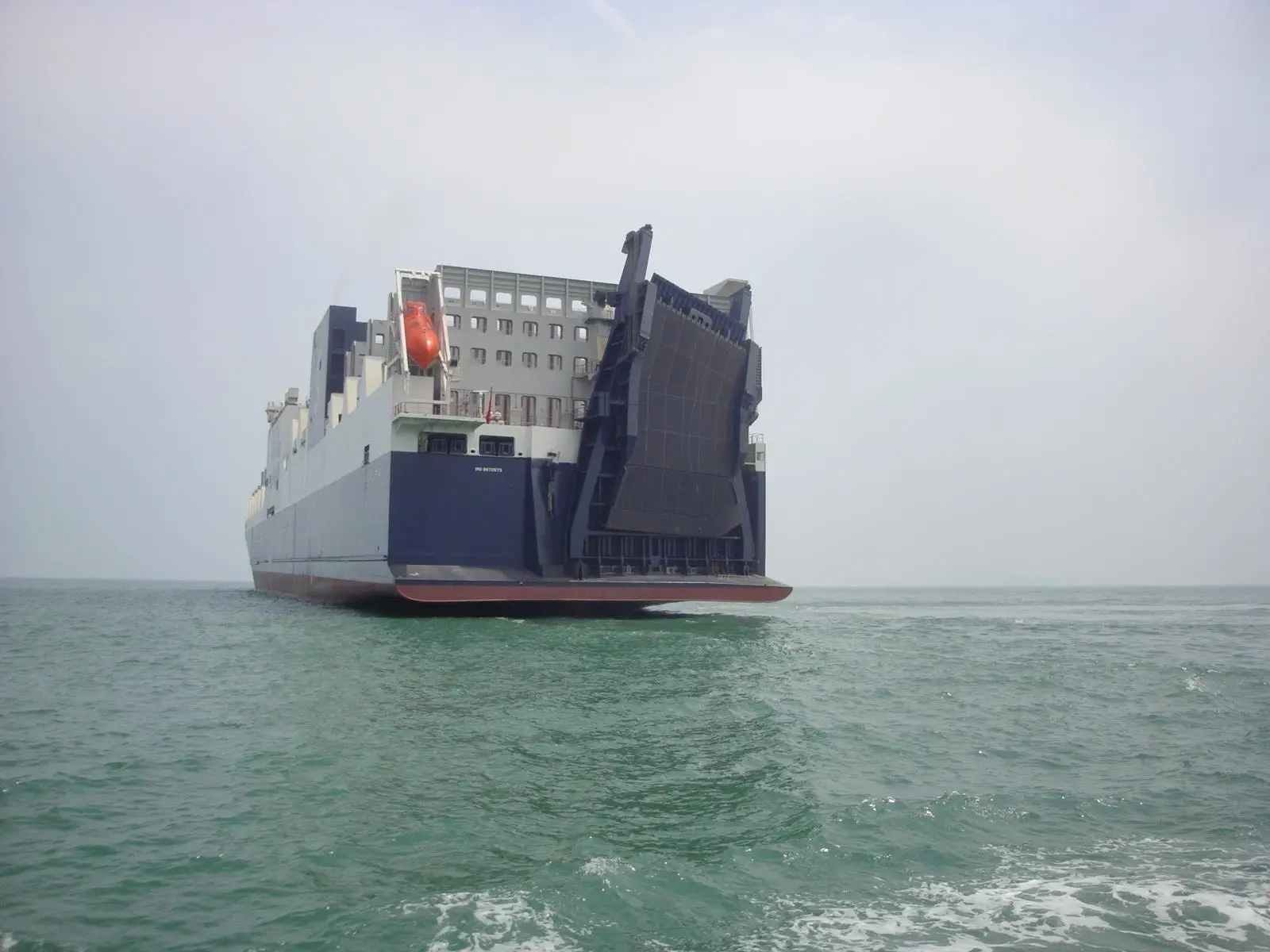
Set for service entry this month on the North Atlantic, the Chinese-built Atlantic Star ranks as the world’s largest combination container/ro-ro (con-ro) vessel. She has the added distinction of embodying a fundamentally different cargo carrying configuration to that hitherto employed in con-ro ships.
Atlantic Star gives first form to the powerful, fourth generation of thoroughbreds ordered by Atlantic Container Line (ACL) for its weekly service linking North America’s eastern seaboard with northern Europe.
The design thinking encapsulated by the project underscores a commitment to innovation that has permeated the 50-year history of ACL, wholly-owned by Italian ro-ro specialist Grimaldi since 2007.
The transatlantic operation caters for containers, project and oversized cargo, heavy equipment, all types of vehicles, block-stowed general cargo and hazardous goods.
Following final-round bidding against two other Chinese yards and two South Korean contenders, New Jersey-based ACL awarded the contract for five G4 (Generation 4) newbuilds to Hudong-Zhonghua Shipbuilding in 2012. Construction was entrusted to the state-owned company’s new yard on Changxing Island, near Shanghai. The entire series is expected to be in commission by mid-2016, replacing the operator’s G3 con-ros dating from 1984/85.
Virtually all con-ro vessels today predominantly stow containers above deck and the lighter ro-ro cargo underdeck. Due to the significant air space in ro-ro areas compared to the denser stowage of containers, the cargo weight typically rides high in a con-ro, necessitating a substantial ballast volume to ensure stability in all conditions.
However, the G4 configuration departs from design practice hitherto, by concentrating ro-ro freight amidships, while the containers are stowed in raised cells fore and aft of the ro-ro section in a partly open-top arrangement. This results in better utilisation of the hull envelope and optimisation of deadweight for cargo, since the need for ballast water is minimised. Even with full cargo payloads, the G3s have to take on ballast, but the ballast requirement on full sailings with the G4s will be zero. Cargo effectively replaces conventional ballast. The innovative design approach was the brainchild of International Maritime Advisors (IMA), domiciled in Dragoer, Denmark.
Hudong-Zhonghua has a reputation as one of the highest quality shipyards in China, with complex special-purpose vessels and naval ships figuring in its prolific output. The enterprise engaged the Danish naval architectural firm Knud E. Hansen (KEH) to adapt IMA’s con-ro concept to ACL’s requirements.
KEH’s scope of work called for delivery to the yard of the basic design package, including class drawings, hull and outfitting general design, machinery plant arrangement, HVAC (heating, ventilation and air conditioning) and electrical and automation design, CFD (computational fluid dynamics) and model test assistance, intact and damage stability and noise and vibration analyses.
Grimaldi referred to the Danish company’s “sterling work in fine-tuning the design, adjusting the angles of deck ramps and eliminating interior columns, for instance, to increase storage capacity, and relocating wiring and valves to a conduit along the keel to ease access and free-up space elsewhere.”
Although only slightly longer than the G3 vessels, and with a beam of 37.6m compared to the G3’s 32.2m erstwhile Panamax gauge, the G4 breed offers twice the dedicated container capacity and significantly increased ro-ro intake, with enhanced capability for ‘high and heavy’ freight.
The 45,000dwt capacity of the Atlantic Star class is based on a design draught of 10.25m, although this rises to 56,700dwt at 11.50m maximum operating draught. The ro-ro section comprises seven fixed and four hoistable car decks, constituting a total standing area of 28,900m2, allowing for about 760 ro-ro units and 1,307 cars. By comparison, the preceding generation offers 18,500m2 for ro-ro. Moreover, the new class has a maximum deck height of 7.4m, relative to 6.2m in the existing G3s, plus increased headroom on the car decks.
A slot capacity of 3,817 teu is offered within the lattice of cell guides in the holds and above deck, embracing a partial open-top layout. In the G3 ships, usage of ro-ro areas for transportation of containers hoists the overall box intake potential to 3,100 teu, but the dedicated container slot capacity is 1,850 teu, half that of the new vessels.
The bridge and accommodation of the Atlantic Star are centrally-located, surmounting the midships ro-ro block, rather than being positioned aft, as in the G3s. The vessel has a transom stern, high-efficiency rudder and single, fixed-pitch propeller direct-driven by a low-speed diesel engine, with the engine room arranged aft.
Weatherdeck cell guides had constituted an important innovation aboard the G3 class more than three decades ago. This has had a signal bearing on ACL’s outstanding safety and cargo delivery record. At the time of the signing of the newbuild contract in 2012, the company said that not a single box has been lost overside in the preceding 30 years. Continuous or raised cell guides also benefit ship turnaround efficiency, simplifying container spotting and dispensing with the need for stacking cones.
A MacGregor-Navire starboard quarter jumbo ramp of 420 tonne capacity borne by vessels of the G3 class had constituted a departure from the axial stern ramp access incorporated in the previous generations. The incoming, wider G4 series employs an angled ramp of the same capacity as that of the G3s, although the stern door is narrower but with more headroom. Under the MacGregor brand, Cargotec has supplied the complete ro-ro cargo access equipment, hatch covers, and cell guides for the latest ships.
Overall stack heights, from the tank top to the uppermost tier on deck, are greater than on the G3s, and the new vessels also offer extra flexibility by way of plugs for 200 reefer boxes in bays 22-24 and 28-32 on deck.
The innovative way in which the hull envelope has been optimised for revenue-earning, in conjunction with the increased efficiency offered by the latest marine engineering technologies, means that the G4 type is equivalent to a 6,500 teu containership in terms of earning power and economies of scale, but with far lower operating costs.
Whereas the G3s are powered in each case by a B&W (now MAN) 6L90GBE six-cylinder unit developing some 17,750kW, Wärtsilä machinery has been nominated for the latest generation. The eight-cylinder RT-flex68D engine, rated in this application at around 22,000kW, employs electronically-controlled common-rail technology for fuel injection, exhaust valve actuation and starting. The installation ensures a service speed of 18 knots, with a power margin to enable schedule recovery if beset by the worst of the North Atlantic weather.
Following the selection of the exhaust gas cleaning system as retrofit installations in four of Grimaldi’s Finnlines ro-ro ferries, the group nominated Alfa Laval PureSOx single-inlet, hybrid ‘scrubbers’ for the G4 newbuilds.
The Atlantic Star class has a powerful outfit of manoeuvring thrusters so as to better ensure self-reliant handling efficiency, safety and turnaround times, and comprising two tunnel thrusters in the bow and one aft, all of 1,750kW output.
As currently maintained by the G3s, ACL’s weekly service connects Halifax, New York, Baltimore and Norfolk with Hamburg, Gothenburg, Antwerp and Liverpool. Atlantic Star is scheduled to be phased into duty on a westbound voyage, departing Hamburg on December 19, Gothenburg on December 21, Antwerp on December 23, and Liverpool on December 26.
In response to ACL’s retention of Liverpool as the UK port of call for the G4 fleet, the Peel Ports Group announced a £10m (US$15.5m) investment entailing the creation of a dedicated storage area with the capacity to handle 70,000 vehicles per annum, and the widening of the passage providing access to Seaforth Dock.
The G4s will not be using the new river berths at the £300m (US$464m) nascent Liverpool2 container terminal development, gauged for the latest post-Panamax box ships. According to Peel Ports, the con-ros have been designed to go through the Gladstone lock, as the ro-ro operations are most efficiently managed on the flat water of the enclosed Seaforth Dock.
At a time when endeavours are being made to boost the UK ship register, and reverse the decline in tonnage of the past few years, the Grimaldi Group is backing the flag by placing two of the G4 vessels under the Red Ensign, with Liverpool as the port of registry. Atlantic Star is the first to be so assigned.
The subsequent deliveries in the G4 programme will be, respectively, the Atlantic Sail, Atlantic Sea, Atlantic Sky and Atlantic Sun.
A deep sea ro-ro pioneer
As one of the enduring names in the liner cargo trades, ACL was formed in 1965 by a consortium comprising Wallenius Lines, Swedish America Line, Transatlantic Steamship Co, and Holland America Line, subsequently joined in 1967 by Cunard Steam Ship and Compagnie Generale Maritime (CGM).
After various changes in its ownership structure, ACL became a wholly-owned subsidiary of the Grimaldi Group in 2007, while retaining operational headquarters in the USA. Access to the Grimaldi service network through transhipment has broadened ACL’s customer base and cargo catchment scope. The Italian owner has put its identity on the G4 class by way of a ‘G’ on the funnel.
ACL pioneered regular deep sea ro-ro service through the introduction of the ro-ro containership concept to the North Atlantic trade in 1967 using four vessels of the G1 class, each offering space for 622 teu and 1,150 cars. These ships were followed during 1969 and 1970 by the G2 series, with capacity for 845 teu and 990 vehicles.
The G3 generation, introduced in 1984/1985, represented a step change in con-ro development, offering an enhanced capability for mixed cargoes, with the possibility to load 2,160 teu containers. Two years later, vessel lengthening raised potential box intake to 3,100 teu.
Atlantic Companion is the first of the G3s to be sold for demolition, a fate awaiting all four remaining vessels as the G4 programme unfolds.
Following the withdrawal of Atlantic Companion at the conclusion of a westbound voyage in late July, the 3,534 teu pure container carrier Northern Expedition was chartered to maintain the line’s weekly schedule until the entry of the Atlantic Star. Over the interim, this has meant that all ro-ro and break-bulk cargo has had to be concentrated on the four other ACL vessels.
As with sisters Atlantic Concert and Atlantic Compass, Atlantic Companion was a product of Kockums, a name synonymous with Malmoe and the erstwhile, dynamic era of Swedish merchant shipbuilding. The Atlantic Conveyor from Swan Hunter on Tyneside and the Atlantic Cartier from Chantiers du Nord et de la Mediterranee at Dunkirk are also testaments to past bastions of deep sea mercantile vessel construction.
PRINCIPAL PARTICULARS–ATLANTIC STAR
|
Length overall |
296.00m |
|
Length b.p. |
287.00m |
|
Breadth, moulded |
37.60m |
|
Depth, moulded to Deck 3 |
14.00m |
|
Depth, moulded to Deck 4 |
22.95m |
|
Draught, design |
10.25m |
|
Corresp. deadweight |
c.44,700t |
|
Draught, maximum |
11.50m |
|
Corresp. deadweight |
c.56,700t |
|
Container capacity, max |
3,817 TEU |
|
Ro-ro cargo area |
28,900m2 |
|
Cars |
1,307 |
|
Ro-ro units |
764 |
|
Main engine power |
22,000kW |
|
Service speed, 90%MCR @ design draught |
18 knots |
|
Class |
RINA |
|
Class notations |
C+ Container Ship, Ro-Ro Cargo Ship, AUT-UMS, Ice Class 1C, Star-Hull, Green Plus, Mon-Shaft, PMS |
Related Articles
 PROPULSION
 GENERAL NEWS
 HYDROGEN