



Lean ro-ro concept
The benefits of increased ship intelligence are clear and numerous. The amount of data is steadily increasing (a 1,000-fold increase in data storage is forecast in the next decade) and tools are already available to measure, analyse, provide support for decision making and permit the control of different functions and services on board. Embracing all these tools will allow us to make ships more efficient and leaner, and remote support and operation, combined with an increased level of automation, will allow ships to function with less crew.
Rolls-Royce is developing the capability to harness the data and create the right tools for marine applications. For unmanned ships to become a reality, the technology will have to steadily evolve. There will be many steps on the journey, but these steps must be in line with reality and the willingness of operators to embrace emerging technologies while managing the level of risk.
As routes are well-known and fairly short, with journeys repetitive, the roro market could see remote operations have a real impact. Many ships currently on these routes are old and in need of replacement, but building new ships is difficult to justify and finance. To maintain and hopefully increase traffic on these smaller routes, a new approach and design philosophy is needed.
This could stimulate new-build opportunities and enable the industry to provide more efficient and environmentally sound vessels. The Blue Ocean team within Rolls-Royce tackled this challenge with its ‘Lean roro’ concept, where operators can lower their costs in several ways. Crew could consist of just having one person on the bridge at all times, with three personnel in rotating shifts. Automatic lookout will enable the single-person approach, with decision support, including object detection, analytic intelligence and sensor fusion, including the use of radar, camera, infrared camera, light detection and ranging (LIDAR) and automatic identification systems (AIS).
Machinery would be monitored remotely, combined with expert support from the control centre on shore. Mooring would be automated and, with fewer crew, pre-prepared meals will be packed on land. Facilities would be cleaned and washing done in port. Fuel costs would also fall, with a modern, lightweight ship operating at modest speeds and high efficiency on LNG.
The Lean roro concept would allow the machinery arrangement to be simplified in line with the ship design and requires 7MW of power for a service speed of 17 knots. The system selected was referenced against two vessels: a second-hand vessel dating from the mid-1990s, with more installed power than needed; and a conventional new build with around 8MW of power. By contrast, the Lean roro system, with 7MW of power, would be powered by two eight cylinder 3,500kW Bergen B35:40 pure gas engines with a hybrid shaft generator driving efficient Promas propellers, and a single MTU 8V4000 M24S auxiliary diesel of 895kW.
Pure LNG engines need fewer on-board systems, and hybrid shaft generation means fewer engines required to maintain propulsion and hotel electric power. Other improvements, while keeping the same cargo load, would come from the designs of ship and propellers.
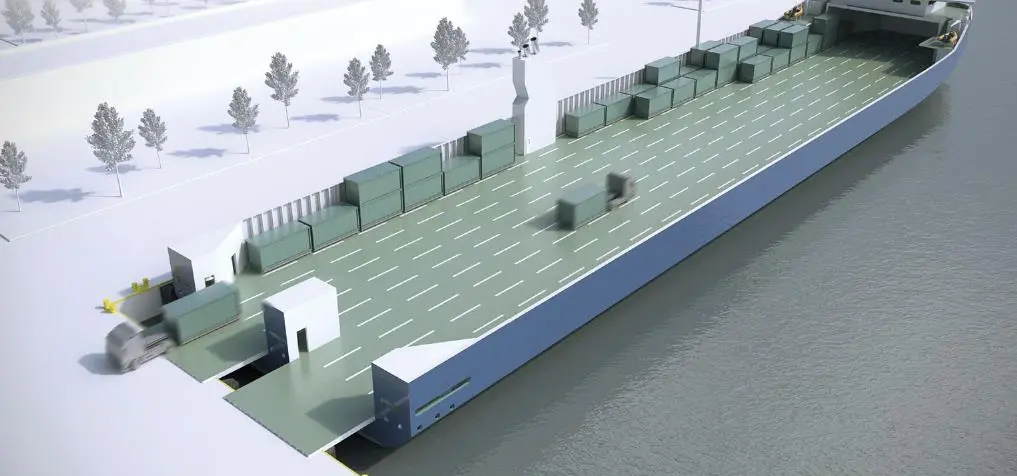
The Lean approach could also slash build costs. A single cargo deck would require no internal and expensive roro ramps and, not being enclosed, would be easier to build.
With all cargo on the main deck, no internal ramps and a wide stern allowing access to nine lanes, loading and unloading would be faster.
The main dimensions would be larger than conventional vessels. Beam would be the main difference, growing as a result of more lanes on the cargo deck. The weight of steel and the volume (GT) would still be less than for a conventional roro, for lower build costs and tonnage related fees.
Certain ship systems could be minimised or removed. A Lean roro vessel would not require a steam system or a diesel system as it would be fuelled by LNG. The deck house would be smaller, with heating, air conditioning (HVAC) and ventilation running from direct electricity.
The Lean roro concept could save operators more than 50 per cent in crew costs, assuming one person on the bridge at all times, with a three-person rotating shift, supported by one multi-role mechanic deckhand.
Capital costs would be lower as less steel would be used. There would be only the equipment required for a single deck, smaller accommodation areas and fewer, more efficient systems. The installation of the LNG storage system would mean additional spend, although fuel costs compared with marine gas oil (MGO) would be nearly half that of an equivalent second-hand roro vessel.
Total annual operating costs for a lean roro vessel are likely to be in the region of €3.75 million – compared with €5.4m for a conventional new build roro and around €6.4m for a second-hand vessel. Capex costs would be in the region of €3m lower than a conventional new build, with the market dictating the price of the second-hand vessel. The Lean approach has a lower total cost than both alternatives and enables operators to review the economics of competing options, and identify the best fit for their operations.
Rulemakers, for their part, must be prepared to look at and identify the areas of vessel operation where the possibilities of intelligent applications could play a role in reducing crew numbers, and look again at the rules, with a view to adapting them.
Operators would then need to embrace the technology to turn the vision into a reality. As the industry looks to become ever more cost competitive at a time of reduced margins, adapting new technologies and managing the risks could be rewarding, but would need real commitment from regulator and operator alike. Tailoring the Lean roro concept for shorter sea routes could be the starting point for a fresh approach.
Related Articles
 PROPULSION
 GENERAL NEWS
 HYDROGEN