



Evolving engine condition challenges
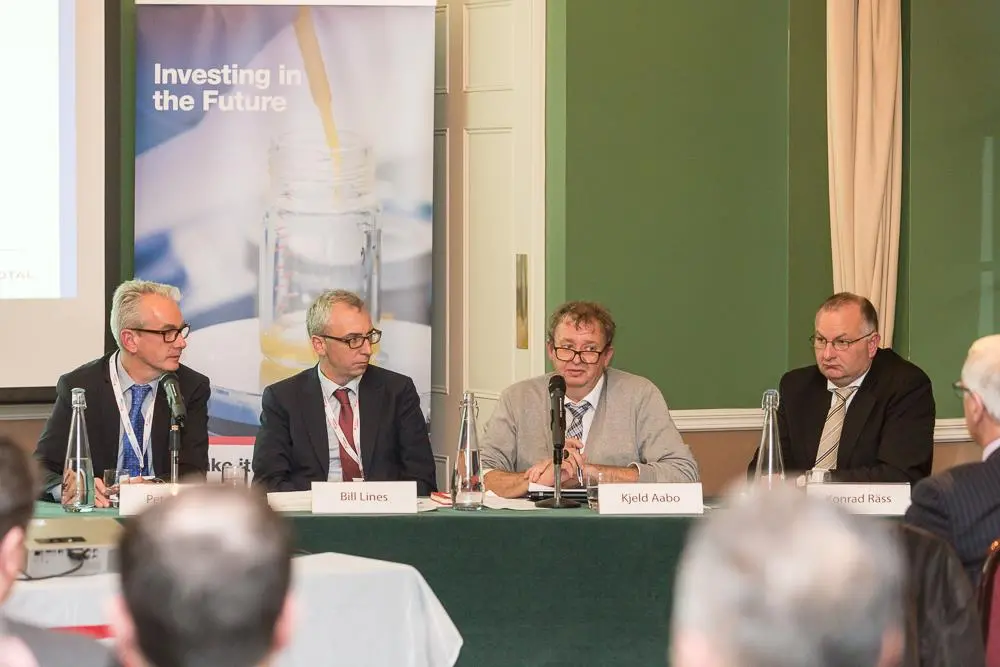
Kjeld Aabo, director customer support, MAN Diesel & Turbo and Konrad Räss, senior manager, materials & tribology R&D at Winterthur Gas & Diesel (WinGD), addressed an audience of ship operators, media and other industry stakeholders at the event, organised jointly with Riviera Maritime Media. The event also proved an ideal platform for Total to announce the first results – and the extension of testing – for its latest cylinder oil formulation.
Compliance with Sulphur Emission Control Areas was to have a major bearing on the discussion, and a useful insight into this and related bunkering issues was provided by Peter Hall, chief executive of the International Bunker Industry Association. “After decades of consistency, we are now challenged by fragmentation,” noted Hall in his opening statement.
Hall reflected the paradox of current sulphur regulations, with ships responsible for compliance but having little control over the fuel they receive from suppliers. The conflict between commercial and statutory sulphur verification procedures – with the industry generally opting to follow ISO testing, which has a different definition to the IMO’s test laid out in MARPOL Annex VI – was also raised.
The recent fuel quality debate at the IMO – with several joint submissions to both the MEPC and the Maritime Safety Committee over the past year – has been driven by alarm at the risk associated with off-spec fuel. Hall acknowledged that off-spec deliveries, particularly in regard to cat fine particles, had either become more frequent or more high-profile. This could be related to the introduction of low-sulphur fuel oils for ECA use. A correspondence group drafting guidelines for fuel suppliers is to report back at the MEPC meeting this year.
Hall also updated stakeholders on the IMO’s fuel availability study, which will examine the availability of compliant fuel in regard to the impending global 0.5% fuel sulphur limit. CE Delft is conducting the survey and will report back later this year, with a view to making a decision on the timing of the cap – 2020 or 2025 – next year. A key question, Hall observed, is whether refiners will be able to step up their production in time.
Completing the regulatory scenario for fuels is the debate over the lowering of the low-flashpoint threshold, from 60°C or less to 52°C. The US proposed the measure in order to harmonise the flashpoints of marine and automotive diesel, but there have been several objections on safety grounds. Nonetheless the IMO is debating the issue, now with the IGF Code on low-flashpoint fuels – adopted in June – as part of its armoury. While the code is focused on LNG, other fuels can be dealt with as ‘alternative designs’, and moves are already underway to extend the code for methanol fuel.
If the fuel situation is growing increasingly complex, so too is the field of engine design – driven in part by similar regulatory issues. “We have never seen as much development in our engines as we have in the past three years, or as we will see in the next three,” said MAN’s Aabo. In response to the Energy Efficient Design Index, for example, MAN has developed a host of measures to enable reduced carbon emissions: the super-long stroke G-type engines, Kappel propeller blades optimised for slow steaming, electronically controlled gas injection and waste heat recovery and management systems.
The link between engine efficiency and cold corrosion lies in the tuning of more modern engines. This enables higher pressure at part loads, which gives better fuel efficiency and lower NOx emissions, but also contributes to cold corrosion, where sulphuric acid caused by low temperatures and high pressure create excessive wear on cylinder liner.
Aabo examined methods of reducing the amount of cooling water that flows around the cylinders. These included insulated piping to reduce flow in cooling pipes, a basic jacket water bypass system that reroutes 80% of the cooling water away from the cylinder, and a cylinder liner cooing system which directs water separately to the liner and cover, enabling water to the liner to be heated when the engine is at part load.
A more advanced option is rating dependent liner cooling, which uses different numbers of bores in liners and different liner angles depending on the pressure in the cylinder. But Aabo noted that this system cannot be combined with jacket water bypass.
Load-dependent cooling systems are now standard on newer, large bore Mk9-10 engines, Aabo said, while the jacket water bypass is available for some engines either as standard or as a retrofit. Temperature-optimised, rating dependent liner designs have also already been introduced for some new engines.
The role of cylinder oil – and in particular using the right base number (BN) and feed rate – remains a crucial factor in preventing cold corrosion. The alkalinity provided by a high BN oil is effective in tackling the acidic build up that causes the problem. He also reiterated the importance of conducting feed rate sweeps – sampling drain oil at various feed rates to establish the correlation between feed rate, residual BN and wear particles – and noted the ‘safe area’ for residual BN and iron particles.
MAN’s recommendations today are for a BN70 oil on older engines (Mk7 or lower), unless they are optimised for improved fuel consumption, part load operation or are derated – in which case a high BN, up to 100, is needed. For Mk8 and newer engines, BN100 is advised. But when operating on low-sulphur fuels, the guidance is to use oil with a BN of 15-40.
Water content is another important factor in cold corrosion, and as much moisture as possible needs to be removed from air going into the engine. Aabo recollected that yards in Japan and South Korea used to have cooling systems at a temperature of 35 degrees. But a cooler intake is more fuel efficient, and also contributes to avoiding cold corrosion, as the air does not reach such high temperatures – and therefore risk condensation – while passing through the cylinders.
Aabo briefly discussed gas-fuelled vessels. MAN has just installed its first ME-GI engine on a newbuild for Tote, the containership Isla Bella, and has sold 160 gas-fuelled two-stroke engines in three years. Aabo reported that oil analysts are anticipating that 10% of the global fleet will be running on LNG by 2030. “We had hoped for more, but let’s see what happens,” he said.
Turning to ECA compliant fuels, Aabo summed up the lubrication challenge. While fuels with less acidic sulphur require less calcium carbonate (and therefore lower BN), the compound also aids detergency. So reducing BN too much would affect the ability of the lube to clean the cylinders. A more sophisticated solution is required, and Total Lubmarine is one company that is addressing that challenge.
Räss from WinGD – the joint venture producing two-stroke engines under the Wärtsilä brand – confirmed the challenges facing piston running as more environmentally restrained tunings are adopted. “For Tier III [sulphur] compliance we tend to focus on high-pressure then low-pressure selective catalytic reduction, then exhaust gas recirculation from a low-sulphur fuel.
“This is a challenge, if you can imagine having to heat up a catalytic converter – you have to change the engine tuning for a while and then cold corrosion might occur because you have insufficient scavenge air to clean the cylinders.”
Räss told delegates that he hopes to see test ships using BN100 lubricant even when running on low-sulphur fuels in ECA zones. “In those zones engines are usually on low load, it is a limited time, and we know that switching lubricants is complicated,” he explained. The downside of switching to low BN oil could be that, when ships switch back to high-sulphur fuels, they have insufficient BN to neutralise the more acidic build ups in the cylinders.
WinGD recommends that operators choose their BN and then adjust the feed rate, from a starting point of 0.9g/kWh. The company’s recommendations for feed rates are derived from a wide database of drain oil samples. One interesting observation concerned what Räss called the ‘infection theory of neighbour cylinders’ – when a cylinder that was being run in showed high residual BN and iron, the neighbour units did too. “We suggest that if you want to make low BN or feed rate tests, you should do it not just on one cylinder, because the neighbours might feed the test unit and the test is for nothing.”
WinGD pistons are laid out with three ceramic coated rings, which give a higher resistance against corrosive attack. The lubrication system has an important role with high BN oils due to the risk of distribution patterns that can cause excess friction on the piston. One feature the WinGD distribution system is the pulse jet, spraying oil in s tangential direction either into, above or below the piston ring pack (depending on age and wear). A fixed volume pump ensures that lubricant distribution remains constant whatever the feed rate. Patented umbrella shaped lube oil grooves help to push the oil upwards and drain excess lubricant from the ring pack to avoid the risk of wear on the top ring.
Räss noted the importance of keeping liner wall temperatures above the dew point of water – a more consistent measure than sulphuric acid – and highlighted some insulation and bypass features. He concluded by asking whether BN rates could be increased even beyond 100 and whether feed rates could be further reduced. “We work proactively with all involved experts, operators and industrial partners towards updated or new solutions,” he said.
Jean-Philippe Roman, technical manager, Total Marine, reviewed the technical environment for cylinder lubricants. He noted that a rapid multiplication of engine designs to tackle technical issues – including cold corrosion, energy efficiency and dual-fuel capability – resulted in many different conditions under which lubricants must operated. This means that recommendations from engine manufacturers have also been developing quickly.
Total Lubmarine has developed a new chemistry for lubricants that addresses two important issues touched upon by Räss and Aabo concerning ECA operation. Roman explained that excess BN from calcium carbonate, when operating on a low-sulphur fuel, can risk leaving ash deposits in the engine. The company’s patented ashfree neutralizing molecules (ANM) can be balanced with calcium carbonate while retaining high BN. The compound is particularly effective at controlling deposits – a factor that will be important as new engine designs continue to bring higher thermal loads and greater risks of leaving deposits from unburned hydrocarbons.
The first product using ANM is Total Lubmarine’s Talusia Optima, a BN100 cylinder oil for deep-sea vessel operating temporarily on low-sulphur fuels. The new chemistry means there is no need to switch lubricants, explained Roman. A test of the first, BN74 formulation on a Wärtsilä engine, for more than 4,000 hours, showed the efficiency of the lubricant in keeping the cylinders clean, with a good wear rate. It also compared favourably against Talusia BN25 lubricant with low-sulphur fuel. Another bench test, for 200 hours on a MAN 6S35ME-B9 engine running on marine distillate oil, showed very low iron levels and very low deposits.
Total Lubmarine has now defined the final BN100 formulation and begun in-service testing on engines from MAN and Wärtsilä. The lubricant has already been in use for more than 2,000 hours – 200 of them within ECAs – on a ship powered by a Wärtsilä 14 RT-flex 96C-B running on HFO and MDO. And in late November testing started on a vessel driven by a MAN S90 ME-10.2 engine switching fuels and sailing in and out of European ECAs. Intermediate inspections of the Wärtsilä test are promising, Roman noted, and even longer bench tests are planned. The company is now in the process of developing an ANM-based formulation for dual-fuel engines, addressing another important element in the increasingly diverse, and challenging, marine engine market.
Related Articles
 ALTERNATIVE FUELS & LUBRICANTS
 FUELS & LUBRICANTS