



Making technology pay
Further, if it is to be used to lighten bigger carriers its own dimensions need to be sized according to the area’s limited depth and infrastructure while still retaining a fairly capacious hold and crane reach. More, it also needs to meet the region’s environmental restrictions – but of course ‘green’ solutions inevitably come with their own footprint.
And here’s the ‘killer’; given the industry’s present low margins, cheaper solutions won’t provide any leverage – but how do you make a new, high-tech bulk carrier pay its way?
The solution to all these questions started life based on an earlier incarnation of Deltamarin’s well-tested B.Delta25 design. Mikki Koskinen, ESL’s managing director, saw this as a good base for a 160m loa, 26m beam vessel that would fit inside the restrictions of the Baltic and North Sea port infrastructure, “but we soon understood absolutely everything else had to change – the demands were so different from what we had done before,” says Deltamarin designer Santtu Frondelius: “It really meant starting from a clean sheet.”
It certainly needs to be ‘clean’ given the environmental pressures. “One of the biggest challenges was to fit everything in, especially the LNG fuel system,” adds Mr Frondelius. All the associated piping needed to be double-walled, and further the 400 m³ LNG tank – enough for a two week duty cycle in moderate conditions – couldn’t be fitted below decks as it would take up valuable cargo space. “While on other vessels you might have the luxury of fitting a tank on the main deck, on a bulk carrier you have to keep the hatch areas clear”, he points out. Therefore a freestanding C-type tank has found a small niche on the aft cargo deck, resting on a footing that will, in the case of any leaks, stop the supercooled LNG degrading the ship’s structure on contact.
The dual fuel main engine (still under discussion at time of writing), will be a slow speed unit linked up to a single shaft and variable pitch propellers.
However this leaves the issue of scaling the power so that the vessel will be able to take on ice conditions while still keeping a reasonable efficiency during normal, 12kn transits. According to Mr Koskinen part of this tangle started to unravel when it was realised that the hotel loads and the three, high-capacity electrohydraulic bulk cranes would demand another 1.5MW from the three auxiliary engines “and so we thought, why not use the extra power to give the ship the extra boost in ice conditions?” This would result in a 6MW main engine with flexibility to take on other loads, with the extra advantage of being able to ramp up the overall power available to the propulsion to 7.25MW if need be.
Easier said than done. Mr Frondelius explains that this has demanded some very clever work with power takeoff and power take-in (PTO-PTI) from Deltamarin. “You can’t just keep everything running in the background because it will ruin the efficiency profile,” he says, so the design team have had to work out where the shaft generator and auxiliaries cut in and out – complicated by the fact they can ‘point’ in different directions. “It’s not just the number of combinations that creates the complexity of this matrix, it’s the marginal cases that really cause the issues – for example if there’s a patch of heavier conditions, what parameters should trigger turning the main engine away from supplying the deckhouse as well as propulsion, and start the auxiliaries instead…”
It’s worth noting that it’s not just the big engine that has been given the ‘green’ treatment: all the engines have exhaust gas heat capture systems and, apart from the emergency set, each of them can also be powered by LNG – as can the boilers: “After all if we are sitting in the port pumping up black smoke into the middle of the city, it simply wouldn’t send the right message,” says Mr Koskinen. He adds: “This doesn’t just lower sulphur and nitrous oxide emissions; by our calculations using LNG in combination with other efficiencies we’ve dropped the CO2 emissions per cargo tonne by half in comparison to the present generation of vessels.”
On the same note, most people in the Baltic region have registered the impact of climate issues – and it’s even affected this particular build. Although ESL originally pursued Ice Class IA Super notation for its vessels, Mr Koskinen says the company is now looking at Ice Class IA “because the winter weather has changed, so although the ice is less thick now, the winds have strengthened”. It doesn’t make for easier transits: “The combination of relatively mild weather but more wind creates a bad, bad situation because it results in moving ice – the worst thing possible. But our calculation is that the extra power and Ice Class IA will be enough to meet the conditions as we see them.”
There are other elements that add to the vessel’s flexibility. The 10m maximum draft allows it to deal with shallow berths – unlike the other, bigger ships explains Mr Frondelius: while the large bulk carriers can stride over long distances, the Baltic’s restricted depth means they struggle to berth without lightering assistance. Since a large part of this vessel’s remit will be to either unload or load – partially or entirely – outside a variety of ports this latest design, like its sisters, will have both bow and stern thrusters to give it the necessary manoeuvrability to get ‘up close and personal’ with its bigger relations, while a larger than usual ballasting system allows the vessel the ability to adapt to differing quay heights.
More novel is the new hydraulic hatch system covering the three holds: unlike traditional designs which leave part of the covers sticking up – and in the way – these fold completely to the fore and aft, allowing the whole area to remain accessible to the three, fast moving, 37.5 tonne specialist (and very expensive) MacGregor four-rope bulk cranes. “It also gives you complete visibility across all three holds from the bridge,” he explains, “substantially increasing safety”.
Having convincingly dealt with the technical angles, there’s still the difficult market conditions to negotiate. Mr Koskinen admits the choice to go with a high tech vessel has got a lot riding on it: “Just think about the freight market we have today, the client is calculating every penny so you can’t charge a premium for a higher-quality ship now, you have to show them that you can do more in the same time, that’s the idea. We just have to prove to them the total cost is less when we do the job.”
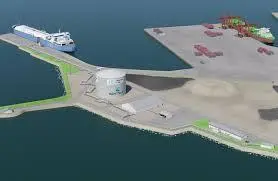
However ESL is also looking at the dropping cost and rising availability of LNG: he points out that the European price is far more than the US’, a situation he expects to begin to correct itself. Further, there’s a handy medium scale LNG import terminal being built in the north of Finland at Tornio and another on the west coast, which will mean that this handysize carrier, due out of the Qingshan Shipyard in 2018, won’t have to go too far in order to refuel.
It has to be said the company’s present operations make for a convincing argument: “The larger bulk carriers may only do 10 voyages a year but we do something between 80 and 100: it’s a lot of work and it’s very intense, but that’s why we believe that investing in the efficiency of the ship and the quick turnaround of cargo will pay off.”
“Put it this way, if you multiply a gain in efficiency across, say, 80 journeys, it makes for a very decisive advantage overall.”
By Stevie Knight
Related Articles
 PROPULSION
 GENERAL NEWS
 HYDROGEN