



Sitting down on the job
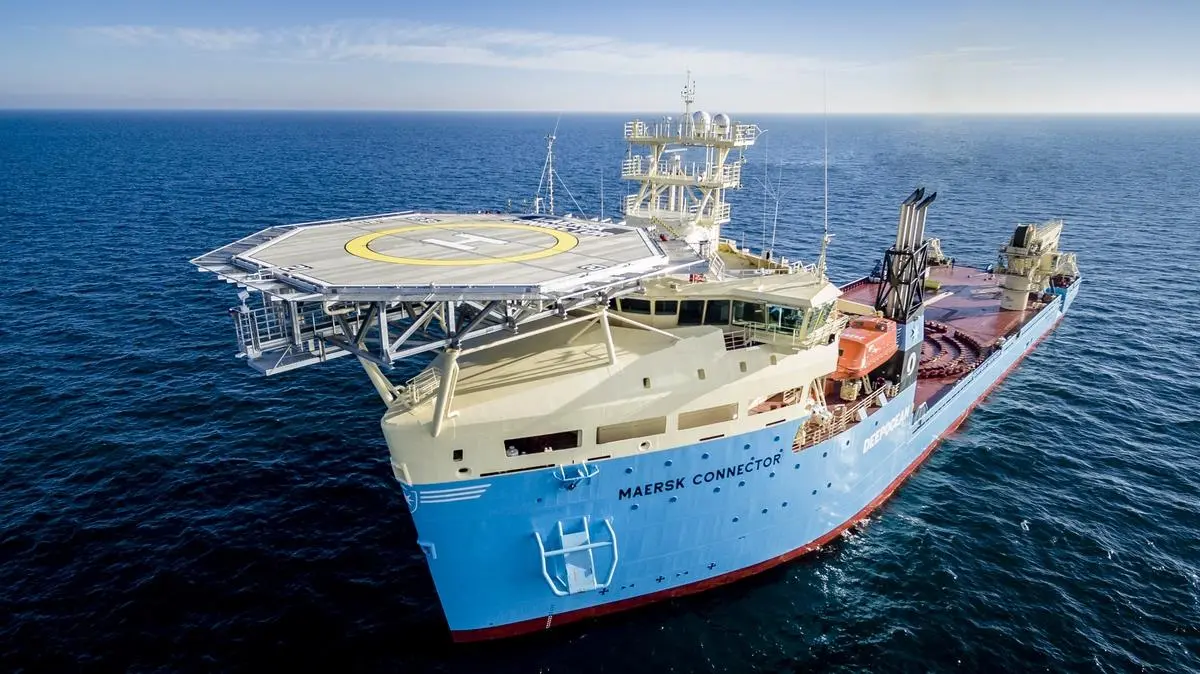
Probably one of the first things to point out is that this 9,300 dwt vessel has a very high cable capacity: it can carry 7,000 tonnes of line, that’s 2,000 tonnes more than its older sister, Nexus, explains Remko Bouma of builder and designer Damen.
The overall configuration has been carved out around the twin requirements of its big carousel – at 27m diameter it takes up almost the entire beam – and the need to keep the vessel operational in all kinds of waters, including the dynamic shallows around windfarms.
This does have an impact on the total design; Connector still has to be nifty enough to manoeuvre inside the wind fields. “The length is about 140m; although it’s a few metres longer than it’s sister, Nexus, we’ve actually tried to keep it as small as possible while still maximising the payload,” says Mr Bouma.
On one hand there is the need for holding station during deeper water operations: “Although the base vessel has been designed for long-distance transportation, it’s actually got an OSV notation and DP2 capability,” he explains.
On the other hand “we wanted a vessel that wouldn’t have to run away when the tide goes out” adds Joao Rodrigues of Maersk Supply, pointing out Connector is going to be deployed just off European and UK coastlines where the waters are subject to huge tidal ranges. Therefore, while a very capable six-point mooring system will help keep the ship working in reduced depths, the bottom of the ship has been flattened and strengthened to take the strain of a controlled grounding in its stride.
And this again impacted design choices. “The main reason for putting the carousel up on deck is that we had a huge amount of space there, almost a whole soccer field, while we needed very big ballast water tanks underneath.”
There are many reasons for the scale of the 2,800m3 ballast system. Firstly, there is the load of the carousel on deck during normal operations, although Mr Bouma is keen to point out “we worked hard to find as much efficiency as we could in the shape and balance of the vessel itself and reduced the weight as far as we could above the centreline”. However, sitting down can create stability issues as the natural centre of gravity is simply that much higher when the hull isn’t supported by water.
Capability has also been considered: four large boosted ballast pumps that can each shift 1,000m3 per hour have been necessary to give the vessel a timely response: “The captain has to have control over the right moment to ballast down and let the ship rest on the bottom, as well as deballasting in order to get up again,” explains Mr Rodrigues. This brings the time for this manoeuvre down to minutes “although once down, the ship can sit, working away for several hours, certainly long enough for the tide to come back in again”.
Sitting dry also creates other issues: “Since the vessel can’t rely on seawater around the hull, we’ve had to put in a different kind of cooling mechanism,” explains Mr Bouma, and yet again, this utilises the ballast water, in this case to take the heat. Usefully, Damen’s Combicoaster and Combifreighter NAPSA-certified designs have provided crossover experience; besides the cooling, it also includes the positioning of oil tanks well away from the shell and the elimination of any retractable machinery. However, Mr Bouma adds “it’s pretty unusual to transfer these design points into a large multipurpose vessel”.
It’s efficiency has also been the subject of attention: while a little deeper with a 6.25m draft, the flattening of the bottom has not had a big impact on the hydrodynamics says Mr Bouma, and since the vessel’s profile is shaped on Damen’s Axe Bow, “which is used to chop waves not wood” it gains from the base vessel’s original, long distance design. It is a better choice than a bulbous bow, he adds, as these tend to have more flair just above the waterline while this particular axe shape “is very good at both maintaining speed and reducing the deck acceleration that accompanies pitching motion”.
The propulsion is provided by twin 2100 kW azimuthing, 2650mm propellers, which Mr Rodrigues explains have been taken a little higher up the hull than on the sister vessel, Nexus, in order to keep them out of the way. There are also three 1,250kW bow thrusters plus a smaller, 800kW stern thruster, all tunnels with four, fixed-pitch blades. Inside, the power is supplied by a pair of a MAK8 M25s, yielding 2,433 kWe each, plus another two MAK6 M25s (giving 1,824 kWe per unit).Together this allows the vessel a transit speed of around 12 knots.
On deck, most of the equipment that’s been installed on Nexus has disappeared in favour of the carousel and Deep Ocean’s aft deployment kit although the vessel still has a 50 tonne capacity knuckleboom and a small stiff boom cargo crane.
However, despite the large changes, Remko Bouma goes on to explain every choice has been carefully considered with flexibility in mind, so while Deep Ocean has the vessel on a seven year charter, “so it probably won’t be changing the carousel for some time”, underneath the vessel has kept as true as possible to a multipurpose remit and the ability to be deployed in the offshore wind and renewables sector as well as the oil and gas industry.
There may be plenty of work out there for a large carousel carrier. For one, the high-voltage industry has realised it wants more in the way of cable on one ship: firstly the windfarms are going into deeper water “but then of course you can’t rule out the links between the turbines and the offshore hubs either, as these bigger wind parks result in a large number of array connections” says Mr Bouma. Further, some countries like Norway are now running electricity to their rigs in an effort to green the oil and gas industry. Plus, there are other umbilicals including some telecoms links that can usefully run under the sea.
However there is another market: country interconnectors: these can help mop up any excess generated energy and stabilise energy flow as demands tend to peak at different times “but they want to have as few a number of joins in this heavyweight cable as possible”, explains Mr Bouma, so higher capacity vessels will have the advantage.
So it’s a market that, despite the economic climate, still shows signs of growth, in every sense of the word.
Related Articles
 PROPULSION
 GENERAL NEWS
 HYDROGEN