



The ‘all or nothing’ of ice design
This, he points out, means that unlike a bulk carrier design which can still manage its duties even if you don’t quite manage to get the propulsion demand spot on, “get the power wrong on an ice breaking vessel and on one side it may be unfeasibly expensive – or on the other, risk getting trapped”; it’s also a consideration for ‘limp home’ mode as he points out “halve the power and you won’t make it out of the ice”.
This makes hashing out the requirements even more complicated: “Bigger engines result in more weight… and then it might not float at the necessary draft,” a consideration in restricted channels.
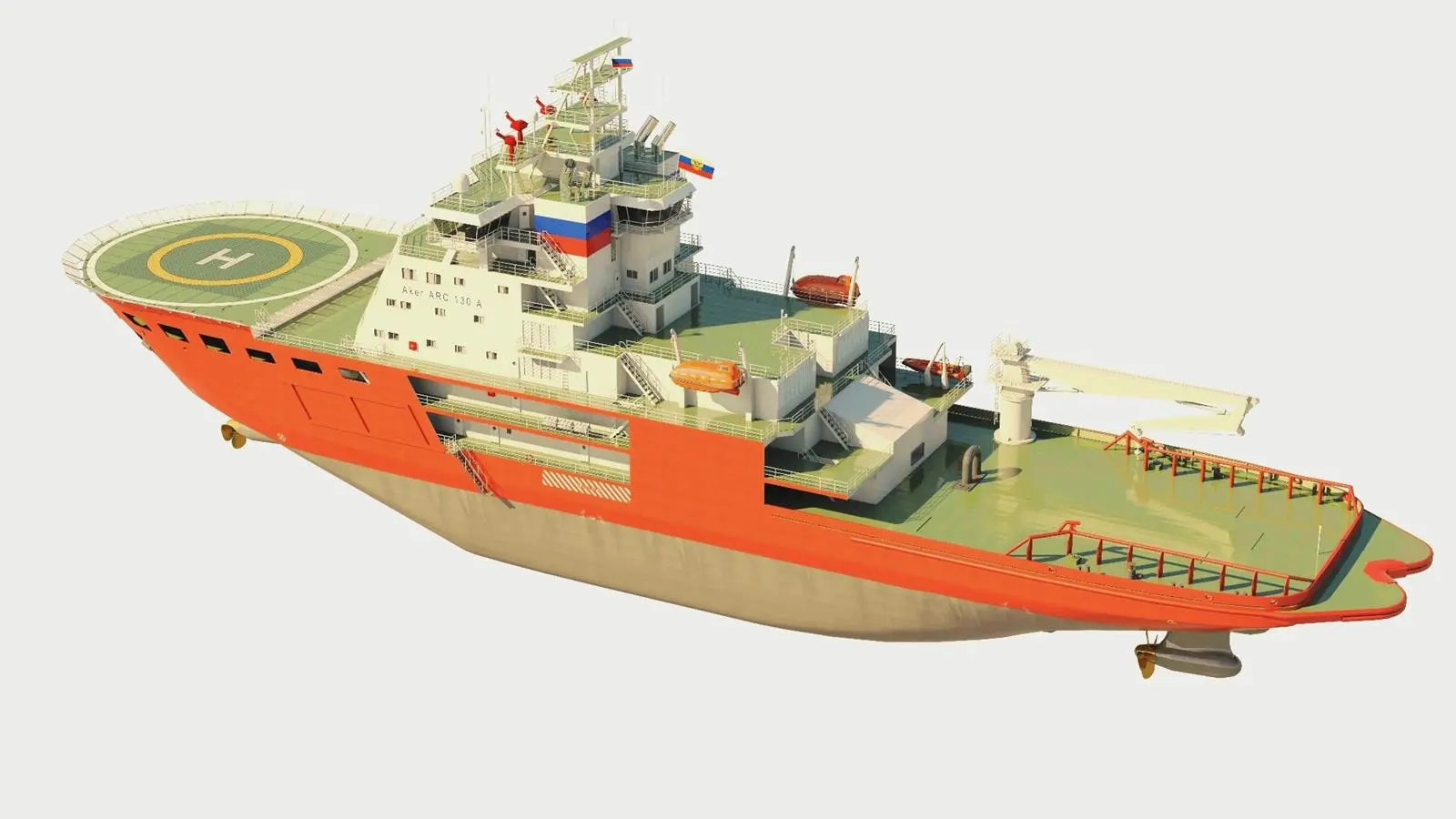
All this poses some truly ‘elemental’ questions for the new Aker ARC 130A icebreaking vessels under build at the Vyborg Shipyard. Due to be delivered in 2017, this pair will help 42,000 dwt shuttle tankers ship out high quality, low sulphur hydrocarbons and crude from the Novy Port terminal under construction in the Gulf of Ob – a shallow water region located off the Kara Sea between the Gydan and Yamal peninsulas in Russia’s far North.
Although based on the Baltic escort icebreaker ARC 130 developed for the Finnish Transport Agency, this design has some important differences: at 121.7m long and 25m wide with a design draught of 8m it’s a little bigger than its forerunner; it also has a higher ice class (Icebreaker8 from the Russian Maritime Register of Shipping) and it’s accommodation for 35 people is up by almost half again from the 130. Most importantly, the output from the capable gensets – a pair of eight cylinder Wärtsilä 32’s and one, six cylinder Wärtsilä 20 – gives the propulsion a total 21,500kW to draw on. One important note: unlike the Finnish counterparts which can run from LNG, there is no possibility for bunkering natural gas near the Novy oil terminal so this means it’s a straight MDO/MGO engine choice.
It has three fully azimuthing thrusters: two units in the stern plus one in the bow. As the DP2 notation requires additional redundancy in the thrusters the ARC130A also has been fitted with a bow-positioned tunnel thruster – the subject of some detailed discussions with Novy operator Gazprom Neft.
This configuration gives more than just added manoeuvrability explains Mr Uuskallio: the seabed and footings around the Novy facility would be vulnerable to propulsion-induced scour, so it’s capable of engaging 6.5MW of power, much kinder on the facility’s structure while also giving the vessel the right platform for DP2 notation.
While the reinforced hull has been optimised both for a 16kn open water transit alongside the ability to break level ice two metres thick with 30cm snow cover “the real issue here is the brash ice, which can grow into really very deep ridges”, says Mr Uuskallio. Despite the ‘nice flat look’ from the bank he explains that once away from the shore, ice can be driven by currents and wind into long piles, most of which is hidden below the surface: “Ridge ice is often one part on top to three or five parts underneath the waterline” he explains, “and these ridges can grow to 20m measured from top to bottom – and be over 50m long”.
However, it would be impossible to size the vessel for every eventuality and detailed modelling of the conditions are required: however, typically these ridges are made up of a mixture of layers with looser stuff on top, followed by dense consolidated ice, voids and so on.
This makes for real difficulties when it comes to simulation: “You have to ask, does a 5m thick ridge with a very hard core provide similar resistance to a larger, softer ridge?”, he explains, and adds that the only answer is to take the design to Aker’s specialist tanks, which freeze and refreeze ice to model these conditions as closely as possible. Further, when the facility gets going tanker movements will doubtless churn up things even more: video analysis of the tank tests allowed “polishing” of the 130A’ design, coaxing out the ability to travel at 4 kn through 7m brash ice with a 50cm consolidated layer.
However, while the gensets are chunky, they have a surprising efficiency: although these vessels will have capability close to the well-known nuclear behemoths Taymyr and Vaygach, they will manage it with 40% less power.
It’s partly because the design takes advantage of one of Aker Arctic’s established innovations, the ability to turn tail and make way stern first: “It’s an idea that’s almost become standard practice” says Mr Uuskallio: less installed power necessary and the ship’s bow can be optimised for open water operation. Near Novy this approach is of particular relevance as the ice ridges can take up most of the 10m channel’s volume, leaving very little clear water underneath. “Using bow-ahead mode you can find a ridge of dense ice gets jammed between the ship’s hull and the bottom,” he explains. “If you go in stern first, the propellers act to flush the ice around the hull – shovelling it away.”
But it doesn’t stop there: “Ice and freezing temperatures amplify every single issue” he says, pointing out this design is expected to take on air temperatures of -50°C and seawater as cold as -2°C. The answers are, again, not straightforward: Mr Uuskallio explains that while earlier winterised notations demanded heating everything “until a thermal camera would show the whole ship glowing like a lightbulb”, it became self evident that a more intelligent approach was necessary. Therefore the 130A design’s layout makes as much use as possible of the gentler ambient temperatures below deck and sheltered areas above: although there’s still a need for warmed handrails and stairwells for the crew plus heaters for some of the tanks and machinery, the design has reduced the potential burden on the gensets to a minimum.
Risk and mitigation at these temperatures is a complex business. The 130A’s deck cranes are much bigger than their Finnish counterparts as it’s operations include offshore supply, so it will be able to lift 25 tonne at 27m (rather than 2.5 ton at 10m), and these are constructed from brittle-fracture proof, high grade F-rated steels. But he adds, some deck machinery is more vulnerable than the rest: “You have to ask, where is it to be placed, and how big is it? Smaller equipment without much mass will freeze more quickly than bigger elements.”
Likewise, the crew has to know the vessel, the equipment and the implications of operations that fall just outside the parameters. “Of course if you design equipment for down to -40°C that doesn’t mean that at one degree lower everything can just stop.” He adds: “With heavy ice conditions, it’s necessary that the captain and engineers really understand the safety case.”
Given this, he says the whole operation has the potential to evolve: “What we’ve seen is that just like a rally team, the crew start finding out different ways to get the most out of the ship.”
Keeping an eye on it
Still, it remains that ice loads exceeding the design parameters are a major risk: in short the crew could do with an extra set of eyes on the hull especially as the stresses can cause permanent damage to the ship.
So, it’s useful that Aker Arctic is getting together with Light Structures AS to do just this.
The two companies are developing an intelligent ice load monitoring system that combines data from optical sensors installed on the steel architecture with information on the ship’s structure.
The fibre Bragg grating (FBG) sensors “outperform electronic devices on all levels” says Inge Paulsen, CEO of Light Structures AS. According to him, optical systems avoid interference noise, are more stable and have lower overall maintenance costs “which makes them cheaper in the long run”. Constructed out of a short segment of optical fibre the ‘grating’ is a pattern in the core that changes the wavelengths that are transmitted or reflected back. This induces a telltale shift in output if any part of the structure is under stress.
The result is a real-time presentation of just how much of the vessel’s structural capacity is being impacted by the ice outside, showing the effective risk level.
It’s useful to have a check. “The fact is that when you are getting into ice it’s scary: there’s a lot of noise, a lot of shaking, but this gives both experienced and less-experienced operators realistic guidance on how much they are actually stressing the hull,” he says. As a decision support tool it should be helpful for the old hands while give those newer to the ice navigation role “assistance in building up understanding”, in other words, letting them know if and when they should really start to worry.
‘In depth’
Aker Arctic’s engineers carry out, quite literally, an ‘in-depth’ assessment on both the ship and the ice it will be navigating during full scale ice trials.
Onboard, the ship’s response to ice conditions is thoroughly measured, taking in everything from propeller speed, thruster or rudder angles, shaft torque and so on as well as overall power alongside the more usual parameters of wind and water depth, plus course, speed and trim.
However, the tests are almost as sophisticated when it comes to the ice: coring and drilling measurements cover not just the more obvious properties like thickness of both level ice and ridges, but also specific weight, temperature profile, salinity, flexural and compressive strength. Plus, it’s well to be aware of the motion of the ice itself.
Again, its physics. Waterborne ice is driven by both wind and current: however, when this meets an obstacle such as fast ice or a shoreline, the resulting compression force can be tricky to deal with: “Vessel movement in compressive ice is difficult even for icebreakers and so ice navigators try to avoid getting trapped in compressive ice fields,” explains Arto Uuskallio. Usefully, an alternative pathway with much lower ice concentration will often simultaneously open up somewhere else and there is a piece of worthwhile information that can help find it.
“In the Northern hemisphere low pressure zones rotate counter-clockwise – if you can predict the path it will take, you can predict the wind direction and use this information to select a route with minimum compression and low ice concentration,” he says, adding: “The art of ice navigation… is to avoid ice”.
By Stevie Knight
Related Articles
 PROPULSION
 GENERAL NEWS
 HYDROGEN