



Slim Hybrid in service six years after order
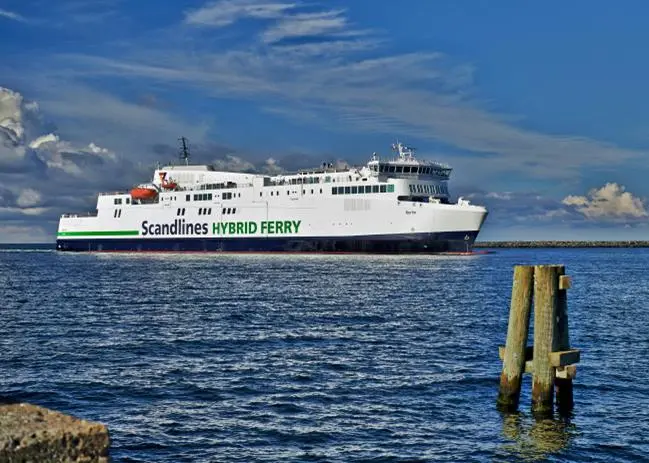
The 169.5m long and 25.4m wide Berlin was named in Rostock for service between the German port and Gedser in Denmark. It will soon be followed by sister Copenhagen. Scandlines originally ordered the ships in 2010 to cement its commitment to traditional Baltic ferry services ahead of the Fehmarn Belt fixed link.
Much has happened since they were booked with the former P+S Yards in Stralsund in Germany.
“It has been a rough road to get to this point” confessed Scandlines CEO Søren Poulsgaard Jensen in Rostock. Ines Rehberg, who named Berlin, said: “The long wait has been worth it and I’m happy Scandlines kept its nerve despite all the difficulties”, she declared.
She was referring to the fact that the ship she named is very different to the ones originally ordered. It has a design draft of 5.5m at 2,900dwt and maximum 6m draught at 4,200dwt – measurements critical for port access. They are what has hampered the completion of the ships until now.
After being ordered at P+S they were later rejected as overweight, not to specification and overdue. After P+S went bankrupt in 2012 they were bought back, first sent to Blohm + Voss in Hamburg and then to Denmark’s Fayard for rectification and conversion which Scandlines says has transformed them.
The ships are now each 700 tons lighter and look a lot slimmer with new lightweight vehicle decks. Scandlines/Siemens Drive Technologies battery-driven hybrid propulsion systems with ESS energy optimisation and AEC Marine closed-loop scrubbers have also replaced original CAT/MaK 9M32CCR diesels.
Other equipment includes Rolls-Royce 144A/5D-B-F fully-feathered propellers with Azipull azimuthing propellersType AZP 120 and Promas Rolls Royce rudder plant. Bow thrusters are Wärtsilä Lips FT 200H units.
Related Articles
 PROPULSION
 GENERAL NEWS
 HYDROGEN