



Innovative LNG carriers to open up Arctic trade
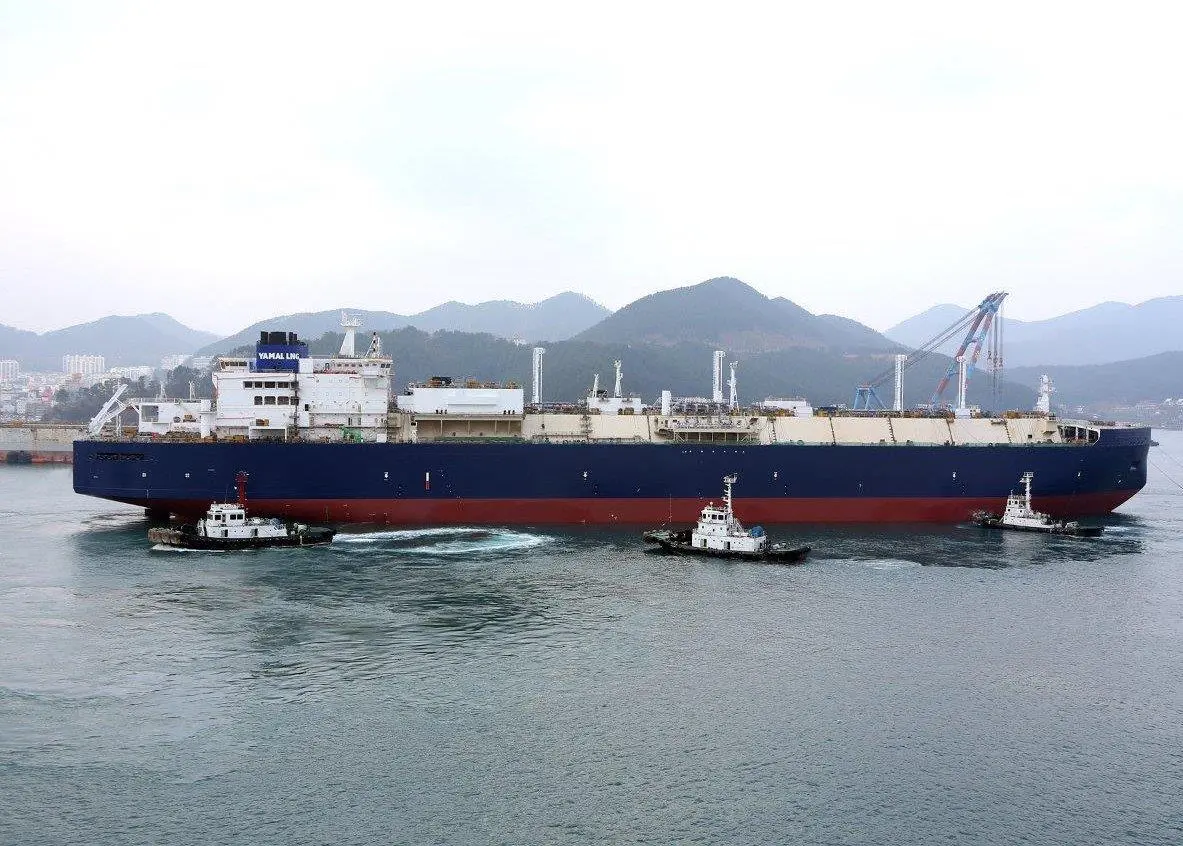
Russia’s US$27 billion Yamal LNG project, one of the largest industrial undertakings ever initiated within the Arctic Circle, will be served by a fleet of LNG carriers of a groundbreaking type, designed to ensure year-round export shipments from northwest Siberia to European and Asian markets.
Built to an icebreaking capability corresponding to the Russian Arc7 standard, the LNG tankers are intended for navigation both westbound and eastbound along the Northern Sea Route (NSR), the ice-infested Arctic seaway linking the Atlantic and Pacific.
Representing the leading edge of a considerable newbuild programme entailing a series of 15 vessels, the 172,600m3-capacity SCF Yamal is being readied at the Okpo yard of Daewoo Shipbuilding & Marine Engineering (DSME) for handover in June.
Russian energy group Novatek and its international partners in the Yamal LNG enterprise awarded long-term employment contracts to various shipowners, paving the way to commitments to a total 15 newbuilds from DSME. While SCF Yamal encapsulates the Russian interest, having been ordered by Sovcomflot, three of the ships are to the account of a joint venture between Mitsui OSK Lines and China Shipping (Group), six are for a joint venture of Teekay LNG and China LNG Shipping (Holdings), and five ships have been booked by Dynagas Holding.
SCF Yamal has been built to the dual class requirements of the Russian Maritime Register of Shipping (RS) and Bureau Veritas (BV). The Arc7 standard to which the new generation has been specified is equivalent to an intermediate level between the Polar Class 3 and 4 criteria of BV, for year-round operation in second-year ice with old ice inclusions, up to an ice thickness of 2.5m.
DSME claims that SCF Yamal is the largest icebreaking vessel worldwide. She has a very powerful propulsion installation based on a dual-fuel diesel-electric power plant and three azimuthing propulsors. Instead of the usual westbound routing out of the Arctic via the Barents Sea, shipments to Asia during the summer months will be made by voyaging eastbound along the NSR and out into the Pacific via the Bering Sea, resulting in substantially reduced delivery times, as well as savings in fuel consumption and lower emissions per cargo tonne.
The adoption of the requisite winterisation measures and cold protection technology is confirmed by the BV notation COLD (-45,-52), indicating that the hull has been prepared for operation in an ambient temperature of minus 45degC and that ship’s equipment should be able to function normally at minus 52degC.
Philippe Donche-Gay, BV’s executive vice president and head of the marine and offshore division, said “We have made extensive investment in research into ice loads and navigation in ice, working with major Russian institutions and Asian yards. This effort, coupled with our world-leading expertise in large LNGCs, gives us a strong technical basis to class these highly sophisticated vessels.”
Aker Arctic, the Finnish specialist in ice-going vessel design and technology, has been closely involved with the Yamal LNG scheme from the start of detailed engineering work in 2010. By the time that Novatek and its project partners had formally decided towards the end of 2013 to proceed with the LNG production and export terminal at Sabetta, Aker Arctic had undertaken extensive design development for the envisaged fleet of 15 icebreaking LNGCs.
Double action icebreaking
Pivotal to the Yamal LNGCs is the double-acting principle originating from Aker Arctic. This enables ice-classed vessels to operate efficiently in the conventional bow forward direction in open seas and light ice, while running astern in thicker ice and full icebreaking mode. Accordingly, as embodied in SCF Yamal, the design features a moderate ice bow and a heavily reinforced structure and icebreaking profile aft, allowing the vessel to sail sternwards in the most difficult conditions prevailing on the Arctic seaway.
The propulsive force for the astern icebreaking mode is conferred by a podded electric propulsion system comprising three, 360-degree steerable Azipod units delivering a combined, maximum 45MW power. By employing the double-acting principle, the vessel will, for example, be capable of crushing ice of 1.5m thickness while making five knots when sailing sternwards, compared to two knots when proceeding bow-first.
The six main diesel generator aggregates, constituting the central power plant serving the vessel’s entire energy needs, are distributed between separate engine rooms, bounded by a double hull, giving protection from the ice plus a high level of redundancy.
The hull has been constructed with ice belts forward and aft. Comprehensive fatigue life analysis was carried out to ensure that the structure would be able to withstand the expected extreme stresses throughout the vessel’s life. BV’s IceSTAR analytical tool was used to assess ice loadings.
Developed in collaboration with the State Marine Technical University of St Petersburg, the latest version of the IceSTAR software not only provides for estimations of ice loads, but also ships’ kinematics due to impact with multi-year ice and icebergs, and assessment of safe navigation speed in ice-infested waters. LNG containment systems can be damaged by sloshing effects resulting from the vessel striking icebergs or hard, multi-year ice, such that kinematics plays an important role in investigating sloshing risks.
An intensive impact test was conducted at the yard so as to validate the ship’s durability. Using full-scale blocks having the same structure and size as those employed in the vessel’s construction, steel balls of 1t and 7t were dropped from heights of 5m-7m and 1m-2m respectively to simulate the impact of ice of 2m-plus thickness striking the ship’s hull. DSME reported that no cracks resulted in the welded surfaces, confirming the high durability factor. The test was attended by representatives from the shipowners and charterers, and by inspectors from RS, BV and five other leading classification societies.
Switzerland-based ABB was contracted to supply the generators, switchboards, transformers, electric drives, propulsion control, and the three 15MW Azipods for each of the new LNG carriers. Wartsila’s dual-fuel technology has been specified throughout, entailing six 50DF engines per vessel. The plant has to cope with the dramatic variations in engine load entailed in ice-forcing and manoeuvring in high-Arctic conditions.
The main generators are of ABB’s 60Hz AMG synchronous design, comprising four units of the 12,500kVA, 6kV 1600LK14 LSE type, driven by 12-cylinder Wartsila 50DF engines at 514rpm, plus two 9,389kVA 6kV units, model 1250QP14 LSE, driven by nine-cylinder models of the 50DF medium-speed engine.
The design of dual-fuel prime mover has a nominal maximum continuous rating of 975kW per cylinder. As the Wartsila installation in each ship amounts to 66 engine cylinders, the mechanical power concentration is a massive 64,350kW.
The machinery was produced in South Korea by the joint venture company Wartsila Hyundai Engine Co (WHEC) and is expected to be mainly run on LNG, while also affording the capability to ingest heavy fuel oil (HFO) or low-viscosity marine diesel oil (MDO). When operating in gas mode, carbon dioxide (CO2)emissions are some 25% less than those of a conventional marine engine running on diesel fuel, SOx and particle emissions are negligible, and NOx is drastically cut by some 85%.
The electrical outfit includes two 6.6kV main switchboards and two 6.6kV cargo switchboards, two soft starters for cargo pumps and heavy-duty compressors, a four-piece 110V direct-current (DC) uninterruptible power supply (UPS) system, and four 11,500kVA and two 13,000kVA propulsion transformers. The three 15,000kW Azipods feature 180% cyclic overtorque capabilities for operation in heavy ice.
LNG containment
Cargo containment is in four membrane-type tanks of the NO96-GW design developed by Gaz Transport & Technigaz (GTT), and offering a reduced daily gas boil-off rate (BOR).
Cryogenic globe and check valves employed in the cargo handling system have been supplied by the UK designer and manufacturer Bestobell Valves. The outfit includes the main discharge line throttling valves that control the initial flow of LNG from the cargo tanks when pumping first starts.
Given the conditions in the Russian Arctic, the on-deck valve installation has to be capable of trouble-free operation in ambient temperatures as low as minus 54degC. Although this is not an issue in the sense that the valves are designed to operate down to minus 196degC, the build-up of ice on the valve and actuator equipment creates extra weight, necessitating special supports to prevent excess loads damaging the valves.
Supervision of the newbuild programme at Okpo is in the hands of the associated company Unicom Management Services (Cyprus), which oversees the technical, commercial and crewing management of the SCF Group fleet.
The Yamal LNG project
Yamal LNG is an integrated project for natural gas production, liquefaction, marketing and shipment. It is located deep in the Russian Arctic, a region that is ice-bound for seven to nine months during the year, and where the sun remains below the horizon for three months at a time. Subject to such extreme conditions and remote from all cities and oil and gas infrastructure, it presents considerable logistical challenges.
Novatek, Russia’s leading independent producer of natural gas, has a 50.1% controlling stake in Yamal LNG, and is partnered in the venture by state-owned China National Petroleum Corporation (CNPC) and Paris-based Total Group, each with a 20% holding, and by the Chinese state-owned infrastructure investment vehicle Silk Road Fund, with a 9.1% interest. The partners are ploughing US$27 billion into the project, and most of the future LNG production has already been sold through 15-20 year contracts, primarily with European and Asian customers.
Tapping reserves in the vast Yuzhno-Tambeyskoye gas field, Yamal LNG entails the construction of three LNG trains, each of 5.5m tonnes annual capacity, making for an eventual, overall production capacity of 16.5m tonnes of LNG per annum. Using 15 LNG carriers of unique design, shipments will be made around-the-year from two ice-protected loading berths at the new port at Sabetta. The first LNG train is to be operational by 2017, and full capacity is due to be achieved by 2021.
Developing the Northern Sea Route
The Northern Sea Route (NSR) is a 2,150 nautical mile shipping corridor along Russia’s northern coastline, through the waters of the Arctic Ocean, comprising the Barents, Kara, Laptev, East Siberian, Chukotsk and Bering Seas. It is the shortest maritime route between the ports of Europe and the Far East, and links the mouths of Siberian rivers into a single transport system .
St Petersburg-based Sovcomflot, the management company of the SCF Group, has been a leader in developing the NSR. One third of its fleet of about 140 vessels has a high ice class. Sovcomflot’s 117,150dwt tanker SCF Baltica became the first large vessel to transit the Arctic seaway from the Atlantic Ocean to the Pacific in 2010. The following year, its 162,400dwt Suezmax tanker Vladimir Tikhonov made an experimental passage of the NSR with gas condensate from Europe to Asia. The route opened-up for commercial shipping by the Vladimir Tikhonov passes north of the Novosibirsk Islands.
For its part, Dynagas made history in 2012 when the Greek company’s 149,700m3 Ob River became the world’s first LNG carrier to transit and transport a cargo through the NSR. The voyage distance from Hammerfest , in Norway, to Tobata, Japan, was about 6,800 miles, compared to the 12,200 miles otherwise entailed in sailing via Suez. Captain Oleg Durasov, master of Sovcomflot’s 118,000dwt ice-reinforced tanker Viktor Bakaev, was aboard the Ob River to lend his specialist knowledge of the Arctic seaway.
To date, SCF Group vessels have transported over 600,000t of cargo between the Atlantic and Pacific along high Arctic routes.
PRINCIPAL PARTICULARS—SCF Yamal
|
Length overall |
299.0m |
|
Breadth |
50.0m |
|
Depth |
26.5m |
|
Draught, loaded |
11.7m |
|
Draught, fresh water |
12.0m |
|
LNG cargo capacity |
172,600m3 |
|
Deadweight |
98,000t |
|
Power/propulsion system |
Dual-fuel diesel-electric |
|
Primary system voltage |
6.6kV |
|
Main generators |
4 x 12,500kVA + 2 x 9,389kVA |
|
Main generator engines |
4 x 11,700kW + 2 x 8,775kW |
|
Total main engine power |
64,350kW |
|
Speed |
19.5knots |
|
Class |
RS/BV |
Related Articles
 PROPULSION
 GENERAL NEWS
 HYDROGEN