



Expanding multihull applications
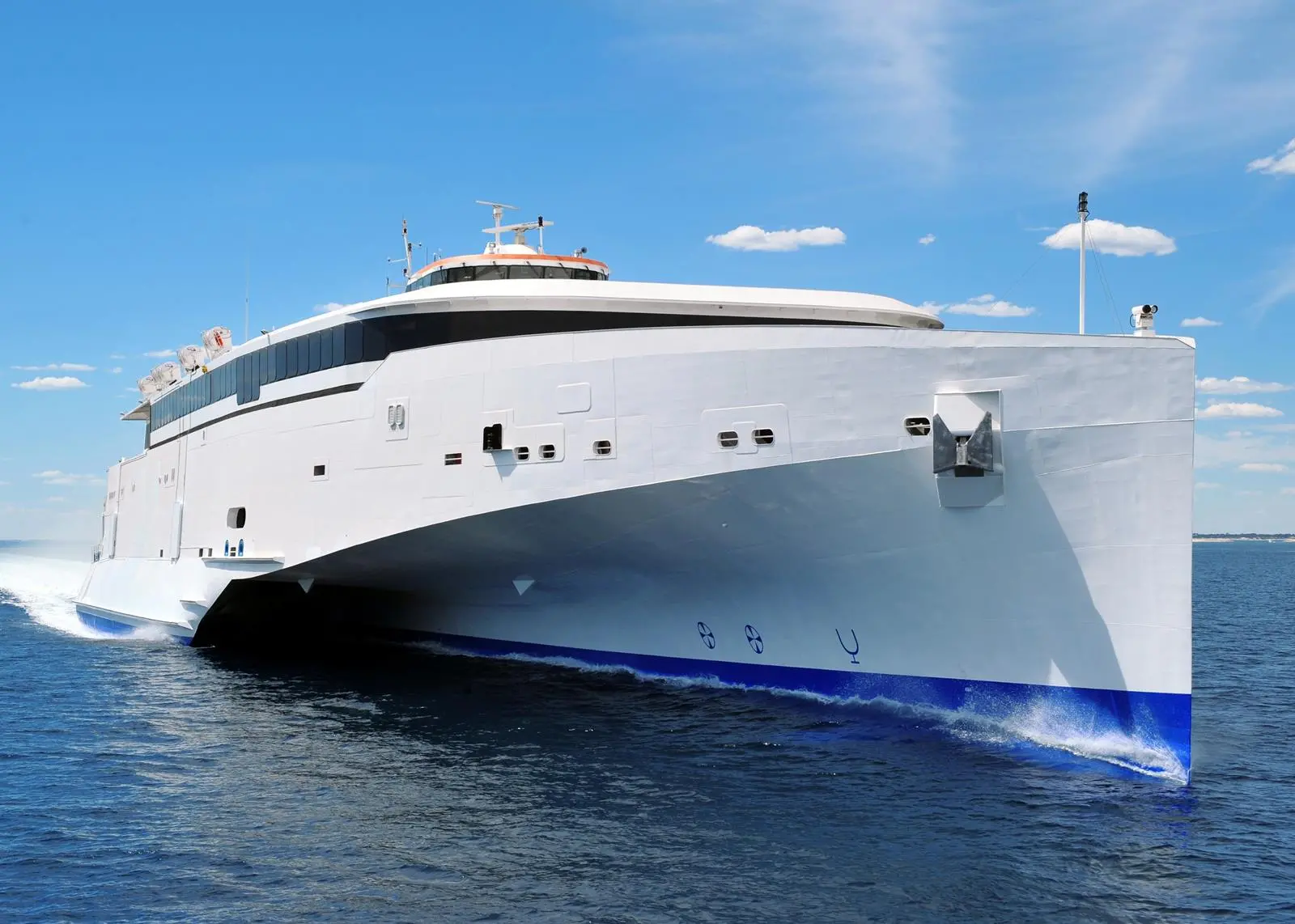
In 1988 the Radisson Diamond was hailed as a revolution in cruise ship design, the first to be based on a catamaran hull. Unfortunately as far as can be traced she was also the last, but this 18,000 tonne ship pioneered the possibilities of large catamaran hulls for shipping. She was later converted into a casino ship, so it must be assumed that she never was a great success as a cruise ship.
On paper, catamarans would appear to offer a great deal over a conventional monohull ship. The deck area is larger, they should be more stable and they would normally be more efficient because of the long, narrow hulls. However in the shipping world the catamaran concept has found its niche only in specialist applications , including crane and construction ships as well as in some offshore oil applications where semi-submersible drilling rigs and floating platforms might be considered to be multihulls.
One reason for the lack of enthusiasm for large multihulls in the shipping world is the small internal volume – a vital aspect of ship design when cargo capacity is important. The catamaran cannot compete partly because of the divided space in the hulls and partly because they tend to be more sensitive to displacement. In rough seas the clearance between the waterline and the bottom of the cross deck can be critical because of wave impact and this can be a limiting operating factor. The movement of a catamaran hull tends to be different to that of a monohull, with a more jerking motion in rough seas that can be uncomfortable for passengers. Finding a dry dock that can handle the wider hull of a catamaran can also be a challenge.
Fit for ferries
The ferry market for smaller vessels used on rivers, estuaries and coastal routes is today dominated by catamarans, where the twin hulls can support a larger above deck passenger cabin. This application was pioneered by Westermoen Hydrofoils in the 1970s and this type of ferry is now built by many yards and in operation around the world. In their latest manifestation, catamarans are being used as the basis for a new generation of ferries with electric propulsion and it is here that the efficiency of the catamaran hull scores highly. LNG fuel is also being pioneered as a fuel for catamarans both large and small, and in the search for reduced emissions the efficiency of the catamaran hull has proved to be a bonus.
The demand for multihulls altered dramatically when the wave-piercing catamaran was developed in Australia by Incat. Initially this was built in smaller sizes up to 25 metres but when its capabilities were proven as offering a seaworthy and efficient alternative to monohulls with more sea kindly vessel motions, larger sizes were developed and became a viable solution for fast ferry services on route previously operated by larger displacement ferries.
The wave piercing catamaran relied on long, narrow side hulls for its main running surfaces. But instead of a cross deck like a conventional catamaran, the space between the hulls was filled with a ship-shaped hull form that tended to remove the problem of wave impacts on the cross deck. With speeds up to 40 knots these early wave piercers became a viable fast ferry solution for many open sea routes with minimal weather downtime.
Wave piercers grow
The success of the wave piercer prompted designers to take a fresh look at a variety of multihull hull forms and spawned a new generation of large fast ferries. The most notable were the giant 40-knot Stena Line ferries based on catamaran hulls but with semi-SWATH (small waterplane area twin hull) underwater sections. These were pioneered by the building of the Stena Voyager and they operated successfully but with gas turbine engines the increase in fuel prices curbed further develop of these very large fast ferries.
Wave-piercer catamarans have grown in size to versions over 100 metres long and capable of carrying vehicles as well as passengers. They are the only new generation of passenger vessel to win the famous Hales Trophy for the fastest crossing on the Atlantic, previously held by the celebrated Atlantic liners. They are in operation in many parts of the world and the US military has built some as fast logistic vessels.
In the offshore wind farm sector, the support fleet is virtually all based on catamaran hulls. While these craft can only make transfers in calm and moderate conditions, the big attraction is the squared-off bow, which fits snugly against the offshore structures for personnel transfer. In a further development of the catamaran hull there is the air-supported hull where seals between the hulls forward and aft allow an air cushion to be maintained to reduce the wetted hull surface and thus the resistance which allows greater efficiency and higher speeds.
In smaller sizes, multihulls have found application in a wide variety of roles. They work well as harbour maintenance vessels and some fishing companies are attracted by the increased working deck area. Several larger catamarans have been built for operation as survey vessels where the attraction is the stability of the hull in moderate conditions. Even catamaran pilot vessels have been built, but here the catamaran comes in the form of a SWATH where the main buoyancy is underwater and only a narrow strut links the buoyancy with the main hull to reduce vessel motions. These SWATHs have a higher resistance because of the larger wetted surface area, and in the pilot vessel role they are used primarily as launching platforms for smaller pilot transfer boats.
Novel designs
A variety of hybrid designs have been proposed where the naval architect is trying to optimise the multihull design for the role it is expected to perform, with foils being one of the many possibilities that can be added to the design. Amongst the many proposals being put forward for more efficient ships there is also the trimaran – a design area in which there appears to be an even wider range of possibilities than there is with the catamaran.
Trimarans tend to be based around long, thin displacement hulls which can be wave-piercing. The main variations are in the location and shape of the twin side hulls that help to stabilise the centre hull. One early concept was the Ilan Voyager design developed by Nigel Irens. Here the side hulls are well spaced out from the centre hull to reduce the wave interference between the hulls and four 40 metre versions of the Ilan design have recently been completed by the French yard CNM as offshore patrol vessels.
60-metre trimarans to a design developed by LOMOcean in New Zealand have been built by North Sea Boats for the Indonesian Navy. Here the side hulls are relatively close to the main hull. LOMOcean has developed a wide variety of multihull concepts including wave piercers and one design was for a 300 metre ocean going trimaran designed for open ocean passenger routes.
In Australia, Incat has been the major proponent of the wave piercing catamaran and rivals Austal has developed and built both catamarans and trimaran designs for passenger carrying. Austal built the 127 metre long trimaran Benchijigua Express for passenger operations in the Canary Islands which had a speed of 40 knots. The same concept although on a slightly smaller scale has been used as the basis for 40 knots ships for the US Navy who has been pioneers in adapting fast multihull technology for military uses. The navy is also building both catamarans and wave piercing catamarans for their Littoral Combat Ship role with major orders for these craft going to US yards.
One of the more extreme multi-hull applications has been the Pentamaran design developed by BMT Nigel Gee. This concept has been designed for the role of a fast cargo carrier with speeds up to 40 knots. The centre hull is stabilised by twin slim stabilising hulls on each side but the concept has yet to attract investors to build a prototype. There have also been proposals for large eco-cruise ships based on trimaran hulls.
In the Caribbean, Gold Coast Yachts has built a number of passenger catamarans based on twin long thin hulls to cope with the Caribbean trade wind sea conditions. Now they are nearing completion of a Tandem Cat, as catamaran hull passenger boat that actually has four hulls, two forward and two aft with the idea of producing a more stable and efficient design.
This Tandem Cat is one of a wide variety of designs being developed as the shipping world seeks more efficient and sea kindly hull designs. Most of the proposals never leave the drawing board and the few that do appear to have only a limited application in specialised roles. The military is at the forefront of much of the large multihull development where there is less concern about comfort and cargo carrying ability. In the hard commercial world where it is the bottom line that counts, the jury is still out on multihulls except for some specialised applications.
Related Articles
 PROPULSION
 GENERAL NEWS
 HYDROGEN