



Teekay opens new chapter in LNG powering
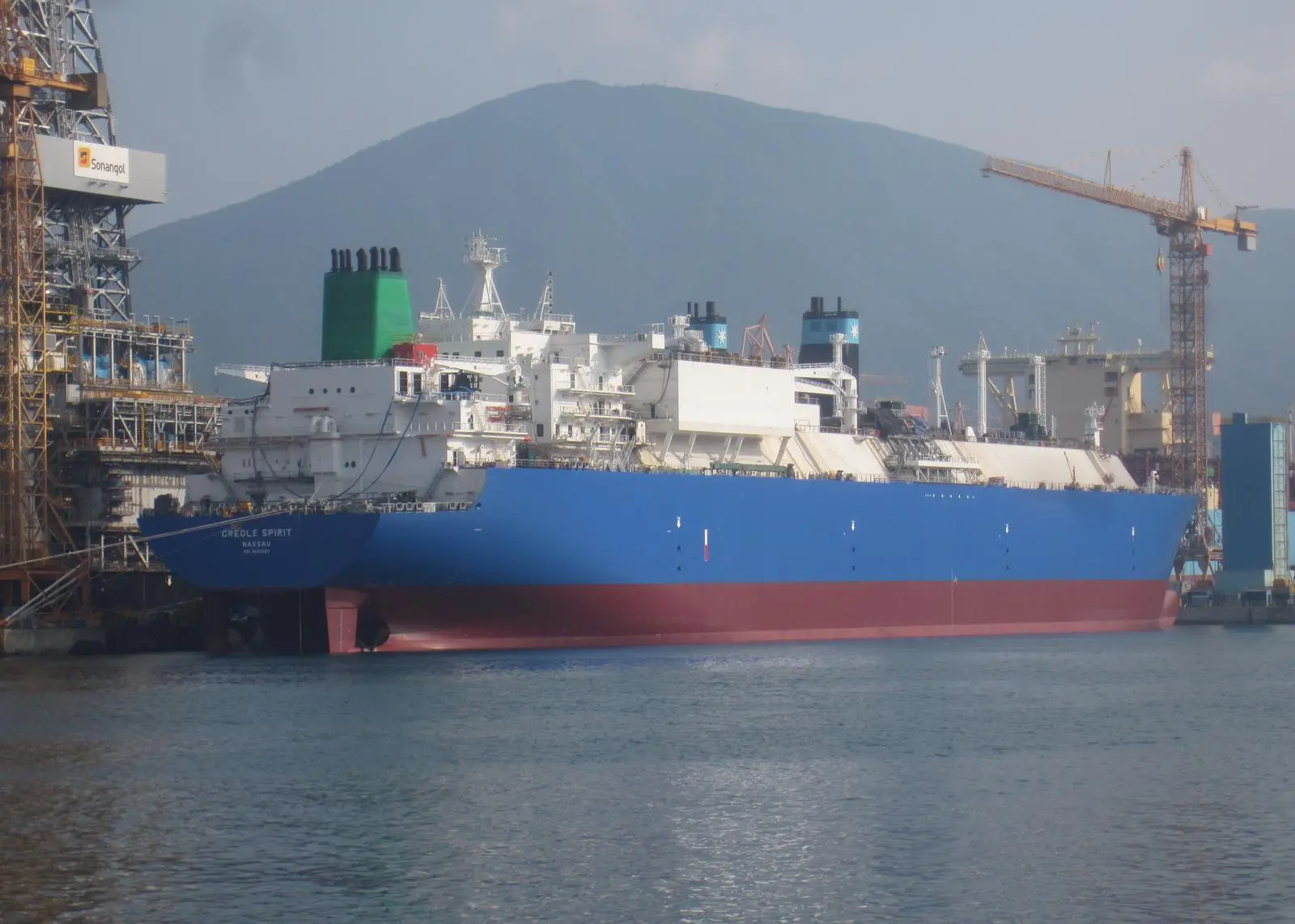
Ranking among the world’s highest capacity LNG carriers able to transit the expanded Panama Canal, Creole Spirit has been phased into the USA’s emergent export trade in LNG, using the new Sabine Pass terminal in Louisiana. Towards the end of April, the vessel brought a landmark US shipment to the European market, discharging a cargo for Portuguese company Gas Energia at the port of Sines.
Creole Spirit is technologically distinguished as the first newbuild LNG tanker to have been specified with gas-injected, dual-fuel ME-GI two-stroke engines, developed by MAN Diesel & Turbo. She has also provided the opening reference for Wärtsilä’s combined inert gas generator and gas combustion unit (GCU).
The membrane-type carrier is the lead ship in a series of nine vessels of 173,400m3 capacity contracted from Daewoo Shipbuilding & Marine Engineering (DSME) by Teekay LNG Partners, as part of a considerably larger fleet development programme spread over several yards. She and second-of-class Oak Spirit are the subject of five-year timecharter commitments by Cheniere Energy, an associate of Cheniere Partners, owner of the Sabine Pass LNG terminal.
Eschewing the dual-fuel, medium-speed diesel-electric ‘power plant’ solution favoured today for most newbuild LNG carriers, Teekay has opted for a direct-drive propulsion system based on dual-fuel, gas-injected two-stroke engines, with auxiliary power derived from dual-fuel, four-stroke gensets.
The propulsion installation comprises two five-cylinder models of the G70ME-C9.2-GI type, produced in South Korea under licence from MAN Diesel & Turbo. The design has a nominal maximum continuous rating of 18,200kW at 83rpm, and offers the flexibility for operation on heavy fuel oil (HFO) and marine gas oil (MGO) as well as natural gas. Drive is to a four-bladed, fixed pitch propeller manufactured by HHI.
The ME-GI technology is reckoned to be 20% more efficient than the popular dual-fuel diesel-electric (DFDE) option, and up to 30% more fuel-conservant relative to traditional steam turbine propulsion, overwhelmingly used for LNG carriers before the industry’s take-up of DFDE powering.
The four generator aggregates are based on Wärtsilä L34DF dual-fuel engines, two in nine-cylinder configuration, and two in six-cylinder format.
Teekay’s initial order with DSME for two ships, ultimately extended to nine, followed two years of newbuild project discussions with the Korean yard, and confirmation of design and economic studies and the readiness of prospective charterers to accept the new engine arrangements. Key objectives for the owner in developing the next-generation LNG carrier class were to reduce drive train complexity and fuel consumption, achieve lower, through-life operating costs and deliver increased customer value.
According to Teekay and MAN, the ME-GI concept offers competitive advantage through an engine type that burns 26-30 tonnes less fuel per day on an HFO-equivalent basis than the most modern DFDE installations. Moreover, the base two-stroke diesel engine from which the ME-GI is derived is a cornerstone of the Teekay fleet, with a proven reliability record, such that the selection of the gas-injected DF version was evidently well-received by the company’s seagoing engineers.
From a maintenance standpoint, an advantage of the ME-GI solution is that the two-stroke plant achieves the requisite power with substantially fewer engine cylinders compared to a four-stroke DFDE installation. Besides the reduction in drive and electrical complexity, having fewer high voltage components in the engine room infers reduced safety risks.
In addition to the aim of achieving compliance with existing and future emissions legislation, Teekay also addressed the issue of methane slip and the growing debate around the subject. It concluded that the high pressure gas injected ME-GI engine performs better in this respect than alternative propulsion plants. In fact, MAN claims that the methane slip on the ME-GI is virtually undetectable due to its operation in the Diesel cycle, as opposed to Otto cycle low pressure engines. Methane is far more destructive as a greenhouse gas than carbon dioxide.
The vessel design as a whole exceeds the Energy Efficiency Design Index (EEDI) specified for ships to be built in 2025. Customers or charterers will benefit not only from the fuel savings, but also from increased cargo delivery volumes attributable to the engineering and insulation technologies employed.
While encapsulating a bid for technical simplicity, Teekay’s next-generation LNG carrier design also sets itself apart with higher cargo tank pressures, to confer greater operational flexibility. The system has three bar settings, at 0.7, 0.35 and 0.25, whereby the high pressure set point is mainly apposite to potential ship-to-ship cargo transfers. The higher cargo tank pressure also provides additional redundancy in the unlikely event of compressor malfunction.
As with the entire series from DSME, Creole Spirit has been specified with the NO96 GW membrane cargo containment system developed by Gaz Transport & Technigaz (GTT). The standard Perlite insulation material used in the earlier NO96 design is replaced in the primary and secondary thermal insulation boxes with glass wool, reducing the daily cargo boil-off rate (BOR) from 0.15% to a guaranteed level of some 0.125-0.13%. The NO96 GW solution retains the original system’s bearing plywood structure.
The Burckhardt compressor system delivers fuel gas, derived from the boil-off naturally produced through cargo evaporation during the ship’s voyage, to the dual-fuel engines. Compression takes place at a pressure of 300 bar for direct injection into the two ME-GI engines.
Furthermore, the Creole Spirit generation incorporates an innovative means of recovering surplus boil-off gas (BOG). By means of the Partial Reliquefaction System (PRS) devised by DSME in conjunction with Teekay, any of the gas not used by the engines, as when the laden vessel reduces speed, is converted back into a liquid state and returned to the cargo tanks. This is achieved by lowering the excess gas pressure from 300 bar to 3 bar, consequently reducing the temperature, in a pair of Joule Thomson valves. The ship can thereby recapture an estimated 70-80% of the excess gas, resulting in a greater delivered cargo volume than would otherwise be the case.
Although the ability to control pressure lessens the need for a gas combustion unit (GCU), Creole Spirit is installed with a combined inert gas generator and GCU, the first of its kind. The concept of melding the two systems into an integrated, total solution was developed by Wärtsilä in cooperation with DSME. The plant burns excess BOG using a system based on the proven Wärtsilä Moss inert gas generator. This arrangement completely eliminates the requirement for a conventional GCU, thereby providing capital expenditure savings for the customer.
Under contract to DSME, the UK firm Bestobell Marine has been retained to provide its high pressure, cryogenic globe valves to each of the Teekay newbuilds. Fitted in the pipework downstream of the high pressure pumps, the valves play a vital part in managing the fuel gas supply to the engines. Each shipset also includes Bestobell’s unique FLIV valve, used to isolate the cargo tanks from the secondary float measurement system.
Teekay LNG Partners, a publicly-traded limited partnership formed by Teekay Corporation, ranks among the world’s largest independent owners and operators of LNG and LPG carriers. The company has 19 further LNG tanker newbuilds in hand and on order in the Far East, following the commissioning of Creole Spirit and Oak Spirit.
Besides the seven remaining units of the ME-GI powered class to come from DSME over the next two years, six Arc7 ice-class vessels of 172,000m3 ordered in conjunction with China LNG Shipping for the Russian Yamal LNG project are due out of DSME between 2018 and 2020. In addition, Teekay has a stake in four 174,000m3 newbuilds booked by an international consortium from Hudong-Zhonghua in China against scheduled deliveries in 2017-2019. Two additional LNGCs of 174,000m3 capacity embodying the ME-GI engine concept have been awarded to Hyundai Samho Heavy Industries of South Korea on the strength of charters to BP Shipping, for handover in 2019.
In 2014, Teekay LNG opened a state-of-the-art navigation and cargo operations simulator training centre at its global gas operations headquarters in Glasgow.
(sidebar piece)
Creole Spirit and second-of-class Oak Spirit have each been assigned to five-year timecharter contracts with Cheniere Energy. The group’s Sabine Pass terminal is the first in the contiguous USA to receive approval for LNG exports. Located along the Sabine Pass River in Cameron Parish, Louisiana, on the border with Texas and less than four nautical miles from the coast, the terminal comprises two berths able to receive LNG carriers of up to 266,000m3 capacity and accessed by a channel maintained at a minimum depth of 40ft (12.2m).
The huge natural gas liquefaction complex that Cheniere Partners is developing through subsidiary Sabine Pass Liquefaction will ultimately comprise six liquefaction trains with an aggregate, nominal production capacity of approximately 27m tonnes per annum. Train 1 began commercial operations this year, and the first shipment was made during February, using the 160,000m3 Asia Vision. Chartered by Cheniere Marketing, the vessel conveyed her cargo to Brazil.
The Sabine Pass facilities are well situated in relation to the country’s shale gas resources. The Gulf coast and mid-Continent regions contain five of the six major US shale plays and three of the largest tight-sand formations. The natural gas productive capacity of these regions represents a major portion of current and prospective US output. The Sabine Pass LNG terminal receives from and delivers to 11 interstate and intrastate pipeline systems on the Gulf coast.
PRINCIPAL PARTICULARS—Creole Spirit
|
Length overall |
294.9m |
|
Length b.p. |
282.9m |
|
Breadth |
46.4m |
|
Depth |
26.5m |
|
Draught |
12.5m |
|
Deadweight |
83,400dwt |
|
Gross tonnage |
113,263gt |
|
Cargo tank system |
GTT membrane |
|
Cargo capacity |
173,400m3 |
|
Propulsion machinery |
2 x dual-fuel two-stroke engines |
|
Propulsion power(nominal MCR) |
2 x 18,200kW |
|
Auxiliaries |
4 x dual-fuel four-stroke engines |
|
Class |
DNV GL |
|
Class notations |
+1A1 Tanker for liquefied gas, BIS, BWM(T), Clean, COAT-PSPC(B), E0, Gas-fuelled, NAUT(OC), Nauticus(Newbuilding), TMON |
|
Flag |
Bahamas |
Related Articles
 PROPULSION
 GENERAL NEWS
 HYDROGEN