



Royal refit as Blohm+Voss unites
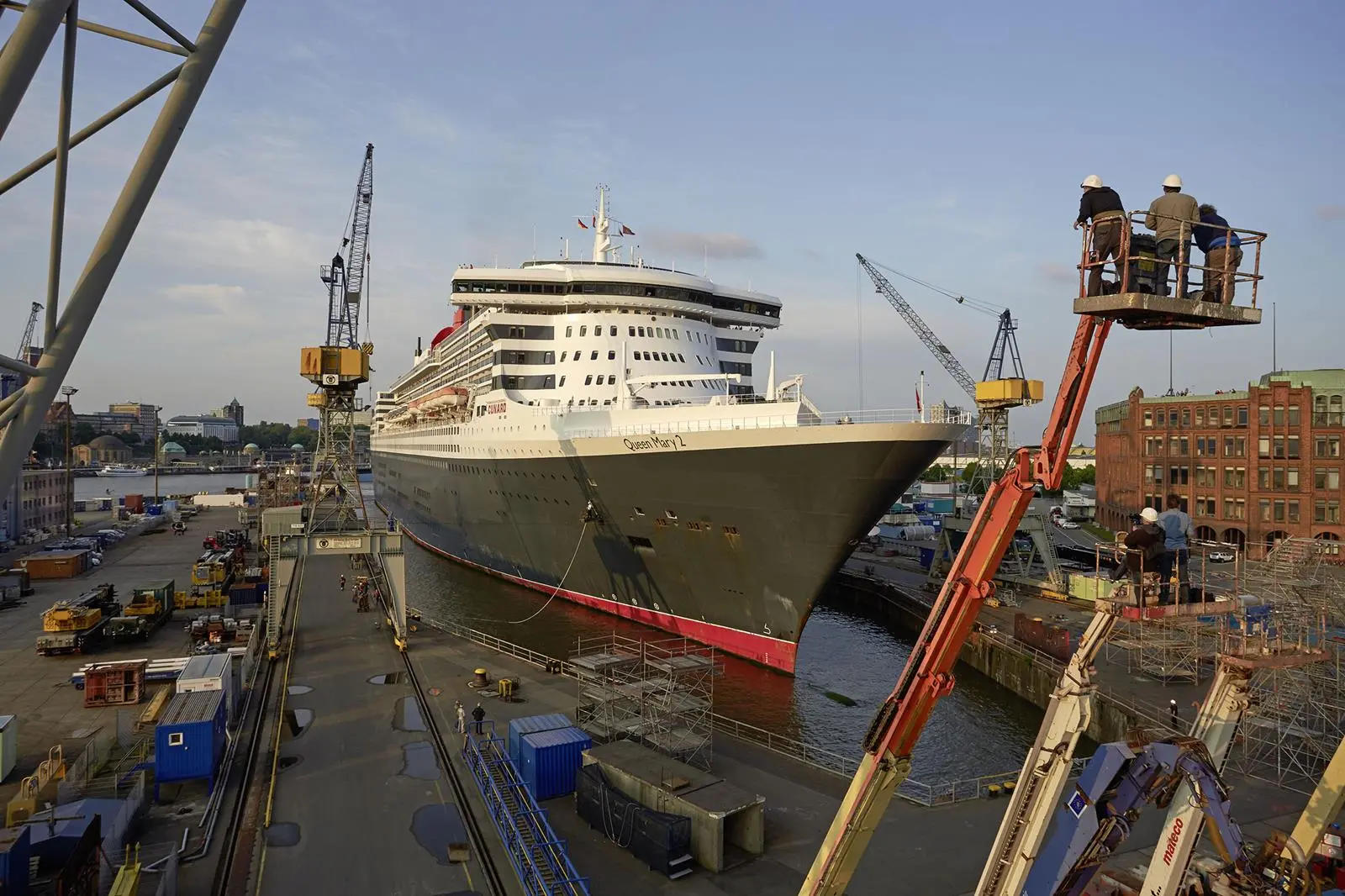
Blohm+Voss is abuzz with energy and purpose. Everywhere minibuses are unloading groups of hard-hatted workers, some of the 3,500 who will work on Queen Mary 2 while it is in the famous Dock “Elbe 17”, and lorries are shifting some of the more than 600 containers of materials needed for the major renovation programme. The atmosphere around the yard is tinged with excitement at once again hosting one of the world’s great cruise ships.
During 21 days between 27 May and 17 June, Queen Mary 2 underwent the biggest refit since it entered service in 2004. Squeezed into the 351.2m long, 59.2m wide Dock “Elbe 17”, the 345.03m vessel was given an extensive cosmetic overhaul – including the addition of around 50 new cabins, 35 of which on its top deck – and major engineering and class renewal works.
Among the engineering works, sulphur scrubbers and particle filters were installed on all four main engines (sixteen-cylinder Wärtsilä 16V46CRs); new ballast water management, waste treatment and freshwater production plant was installed; and the ship’s four podded propulsion units, three box thrusters and four stabiliser units were reconditioned. A new coat of environmentally friendly hull coating completed the work.
Most of this will go unnoticed by passengers. More important for them will be the new cabins and the modernisation of the existing suites as well as entertainment areas and restaurants. While much of the interior, cosmetic work was carried out by subcontractors or Cunard’s internal teams, Blohm+Voss also played a major role. Not only did the yard take overall responsibility for the complex work programme, it also prefabricated several steel deck sections (with a total weight of around 200 tonnes) that were installed on deck 13, where the new cabins were built.
Michael Brasse, head of corporate communications at Blohm+Voss, notes: “The greatest challenge is the engineering, the planning, the logistics, to manage the operational procedure and the integration of systems and components delivered by partner companies.. In Hamburg we have the infrastructure and partners to deliver this, built up over many years. This expertise, know-how and ability for complex management is a great advantage when handling these projects.”
It is this ability to undertake complex works on time that has driven Blohm+Voss’ business in cruise repair and conversions over recent years. The Queen Mary 2 is a particularly frequent visitor, having been in dock at Hamburg six times, but there is plenty of work from other ships too – notably last year when the company completed a record 10 cruise conversions. The first of them was Cunard’s Queen Victoria, a more spacious fit for Dock “Elbe 17” at 294m loa, booked into the shipyard for a second time to have scrubbers, exhaust filters and a ballast water treatment installed amid a significant renovation of her hotel and public areas.
The Queen Victoria was the also among the first of Cunard’s vessels to call after parent company Carnival Corp signed a ‘favoured customer agreement’ with Blohm+Voss in September 2014, making the yard a preferred repair and maintenance provider for Carnival’s fleet in Europe. The multi-year deal covers planned maintenance and yard-based repair, but also access to the Blohm+Voss ‘flying squad’ – a globally operating repair team that the yard says it can send anywhere within 24 hours.
Blohm+Voss is the only yard in North Europe to have such an agreement with the world’s biggest cruise ship operator, and the relationship offers a strong base underpinning its repair business. But although the impressive cruise visitors are among the most high profile for the Hamburg yard – and the most visible from across the Elbe, where residents can watch the works proceeding – they are not the only element.
In April, Blohm+Voss officially merged its two distinct ship repair and shipyard businesses. Other than changing the name of the company on contracts, that change was barely significant in itself – certainly the public in Hamburg is only aware of the wider Blohm+Voss, not its previous separate companies. Of more importance was the following restructure into four main business units.
Project management of repairs and conversions of passenger, merchant and offshore vessels – such as the Queen Mary 2 and, when The Motorship visited, the Hapag-Lloyd container ship Montreal Express – is handled under the ship services unit.
A dedicated mega yacht unit handles newbuilding and refitting of big yachts, from 80m in length to, well, anything; in 2010 the company built the 162m Eclipse for Russian tycoon Roman Abramovich. The construction of megayachts is a major focus for Blohm+Voss. As part of the restructure the group moved nearly 100 employees from Kiel – where the yacht engineering team had been based historically under former Blohm+Voss owner ThyssenKrupp Marine Systems – to the Hamburg head office, where the team now shares a floor with the rest of the mega yachts business unit.
The mega yachts unit was further strengthened in June when Blohm+Voss won a tender to set up a new maintenance and refit facility for megayachts in La Ciotat in the south of France. Partner La Ciotat Shipyards is in charge of the site development, providing a large dry-dock and neighbouring workshop premises embedded within the existing shipyard, due to open in November. As the company’s first repair outpost for megayachts, it will be an important expansion of the business.
The third element to Blohm+Voss’ business is the production unit, which functions as both an internal division – providing steelwork for the mega yacht and ship services units – and as a partner to external companies. This unit is particularly active in the newbuilding of naval vessels, as a production partner for ThyssenKrupp Marine Systems on Germany’s Type 125 frigates. The company has also partnered with Damen Shipyards in a bid to build Germany’s new MKS 180 frigates – a groundbreaking tender that represents the first time a European military has opened up its building programme to companies across the EU.
The fourth major business unit, power plant and marine services, provides engine services for ships and power stations. On the marine side, this incorporates repair and overhaul of all main engine types and other machinery, as well as well as workshop services.
The reorganisation makes clear where Blohm+Voss’ priorities lie. The focus is on one side on the repair and conversion of passenger ships and merchant vessels (and in a better market, offshore units), and on the other a burgeoning mega-yacht construction and repair business.
On 17 June this year though, there was just one focus, as workers at Blohm+Voss and onlookers on the river Elbe watched Queen Mary 2 float out after a landmark refit project more than 18 months in the planning.
Related Articles
 PROPULSION
 GENERAL NEWS
 HYDROGEN