



Game-changer for Baltic tanker trade
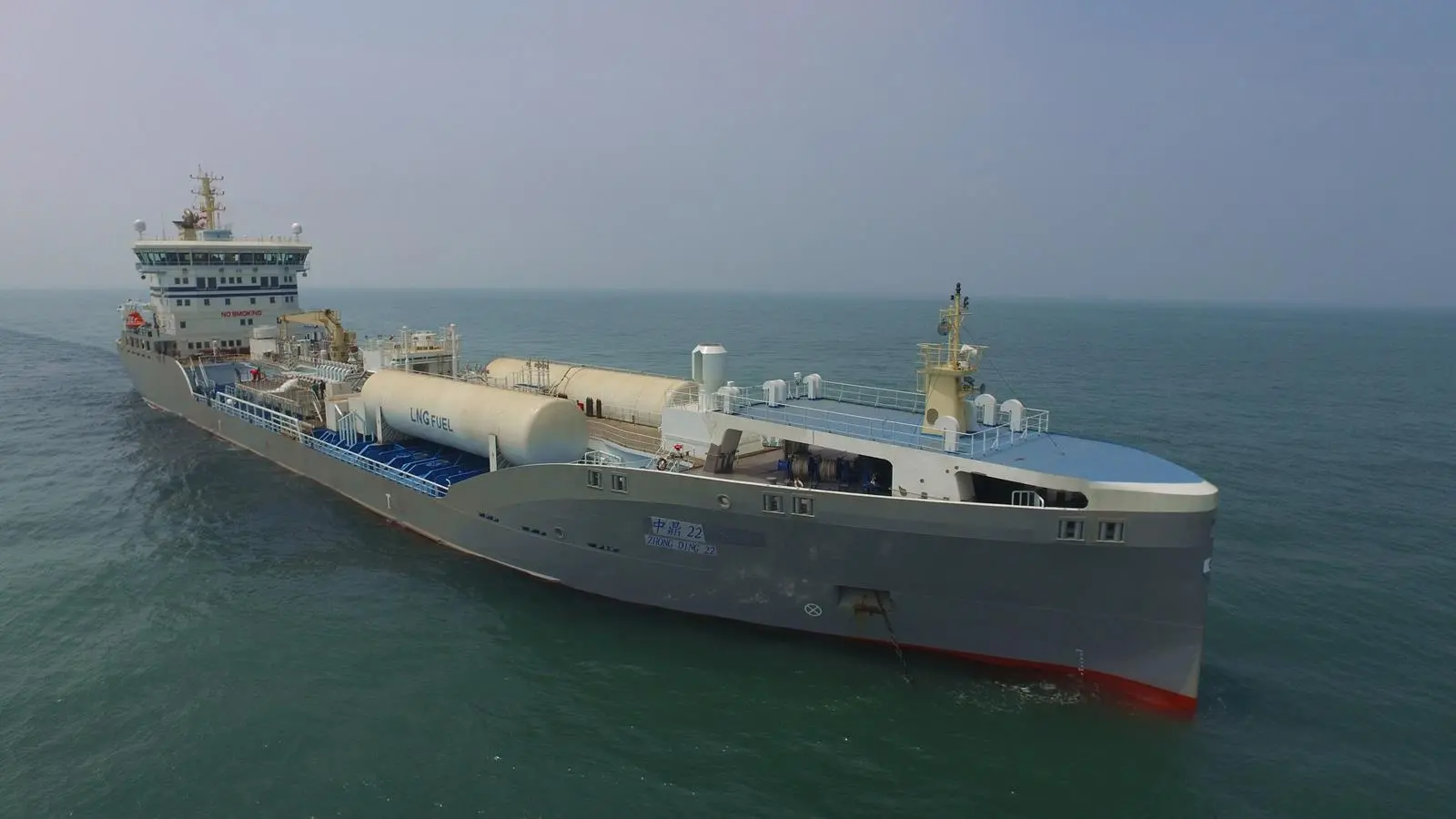
Putting down a new marker for dual-fuel, two-stroke engine technology, the 15,000dwt oil/chemical products carrier Ternsund entered the North European distributive traffic during August. The Danish-registered vessel leads a series of four LNG-fuelled tankers ordered in China by Terntank Rederi. EU funding support was forthcoming for the project’s ‘green’ objectives and credentials.
Terntank is a family-owned business based in northern Denmark, specialising in the coastal and shortsea oil and chemical tanker trades. The construction programme was implemented and shaped to ensure viability and environmental compliance in the highly competitive and heavily regulated areas in which the company operates.
The new ship’s Wärtsilä 5RT-flex50DF installation is the first dual-fuel, low-speed engine employing the low-pressure X-DF gas admission technology developed by Winterthur Gas & Diesel (WinGD) of Switzerland. With the June 2016 transfer of Wärtsilä’s final 30% stake in WinGD, the latter has become a wholly-owned subsidiary of China State Shipbuilding Corporation (CSSC).
When the machinery is running in gas mode, the vessel is expected to yield negligible SOx and particle (PM) emissions, 85% less NOx than under IMO Tier II regulations, and 25% less CO2 than those of a conventional diesel engine. By comparison with a similar-sized ship built around 2005, with a speed of 14 knots, the environmental performance is even more impressive, at 97% less NOx and 40% less CO2, and 99% less SOx and PM.
SECA COMPLIANCE
The negligible sulphur content of natural gas means that Ternsund can accordingly meet the 0.1% sulphur ‘cap’ applicable in IMO-designated Sulphur Emission Control Areas (SECAs), within which she will predominantly trade. In gas-fuelled operation, the X-DF main engine also facilitates compliance with the Tier III restrictions on NOx, without necessitating additional exhaust aftertreatment measures. However, giving still greater dimension to the environmental strategy behind the design, Ternsund also houses a combined exhaust gas heat recovery and selective catalytic reduction (SCR) plant.
Furthermore, as LNG has a 10-15% better energy value than marine gas oil (MGO), and in conjunction with an optimised underwater hull design, Ternsund offers a daily fuel consumption of some 15t or less per day, compared to 22t for existing ships of similar size. The adoption of a large-diameter propeller in conjunction with a two-stroke main engine means that only 65% of the maximum power output will be needed to reach a service speed of 14.5 knots.
Terntank ordered Ternsund and a sister vessel through AVIC International Ship Development of Shanghai in November 2013, and subsequently extended the deal by booking third and fourth newbuilds in April 2014.
The diverse Chinese group, whose interests include technical consultancy Deltamarin, assigned construction to AVIC Dingheng Shipbuilding, which has a high profile in specialised tanker production. Following her June 27 handover from the Dingheng yard on the Yangtse River, in Jiangsu province, Ternsund sailed to Singapore to load a cargo for discharge, and for its first LNG bunkering, in Rotterdam in early August. The vessel then commenced duties with Finnish charterer North European Oil Trade (NEOT).
EUROPEAN FUNDING
The fleet development programme was implemented under the auspices of the BalticSO2lution project and has qualified for partial EU funding in accordance with the Trans-European Transport (TEN-T) initiative.
BalticSO2lution is one of several endeavours encompassed by the EU co-sponsored collaboration platform known as Zero Vision Tool (ZVT), an expression of the European bid to stimulate the transition from conventional marine fuels to cleaner-burning LNG. ZVT supports the development of more environmentally sustainable and energy efficient shipping in the Baltic, and the building of an LNG infrastructure.
Ternsund is based on Rolls-Royce Marine’s NVC 615CT design, an IMO Type 2 tanker for chemical and petroleum products, featuring a slender hull form, vertical stem, and reduced bow flare and shoulders, in keeping with the overall objective of lessening resistance and progress-impeding motions in all sea conditions.
Although the NVC 615CT type can be built with stainless steel tanks throughout, the ice-classed Ternsund was specified with the MarineLine 784 cargo tank coating system from Advanced Polymer Coatings. MarineLine’s properties of high resistance, versatility, non-permeability and ease of cleaning confer the flexibility to handle and transport multifarious and diverse oil and petrochemical products and other liquids.
TANK STIFFENING
The revenue-earning section is subdivided by transverse bulkheads and a centreline, longitudinal bulkhead into 14 tank compartments, served by seven deepwell pumps, and providing an overall load capacity of 16,800m3. The LNG fuel tanks are mounted side-by-side on the forward section of the weather deck, which is heavily ‘ribbed’ as a consequence of using external tank stiffening.
The Wärtsilä RT-flex50DF design of main engine offers a maximum continuous output at the R1 rating point of 1,440kW per cylinder, at 124rpm crankshaft speed. In the Ternsund application, the engine has been delivered at a rating of 1,170kW per cylinder, running at 102rpm. The installation thereby provides a maximum power concentration of 5,850kW.
The powering arrangements, in conjunction with the hydrodynamic attributes of the hull form and the efficiency of the propulsion train, enable the ship to make 14.5 knots at just 3,800kW output, allowing for a shaft generator load of 500kW. An LNG consumption rate of 15.5t per 24 hours is anticipated when operating in gas mode at 14.5 knots, falling to under 9t at 12 knots.
The LNG fuel storage tanks on deck have a combined capacity of some 630m3, making for an endurance of 6,600 nautical miles, and supplemented by 550m3 of gas oil tankage underdeck.
Whereas high-pressure gas injection engines operate on the Diesel cycle, the low-pressure X-DF type works on the lean-burn Otto cycle when in gas mode. The requirement of the X-DF generation of machinery for only low pressure gas compression makes for greater simplicity and lower costs relative to alternative gas engine solutions, according to engine designer WinGD. High-pressure, electrically-driven compressors are not required. Moreover, the technology allows stable operation on gas across the entire load range, obviating any need to switch to diesel at low loads.
TEST BED TRIALS
On the testbed, the 5RT-flex50DF was run continuously for several days in gas mode, and a series of automated fuel changeovers between diesel and gas were executed. When the ship was on sea trials, the engine was operated at a range of load points in both gas and diesel mode up to a high load level exploiting the sea margin of the Ternsund, with her hull in new condition, free of fouling.
The value of the prestigious shipbuilding project to China’s maritime industrial sector, which now owns one of the world’s three leading marques of two-stroke marine engine, has been all the greater for the production of the main engines for the Ternsund class at the Zhuhai factory of licensee Yuchai Marine Power Co.
The auxiliary outfit comprises three Mitsubishi MAS 850-S gensets, each rated at 790kWe and driven at 1,800rpm by V12 engines of the proprietary S12A2-MPTK type. In addition, Ternsund incorporates a variable frequency drive shaft PTO/PTI (power take-out/power take-in) generator that doubles as an efficient supplier of electrical energy at sea or alternatively as a source of emergency propulsion power.
System supplier WeTech Solutions selected a variable frequency drive, permanent magnet shaft generator from Finnish compatriot company The Switch for each of the four newbuilds. In PTO mode, the power available for the ship’s electrical network is up to 780kW, while the shaft generator’s maximum rated output in PTI operation is 1,000kW.
Terntank has a track record in environmentally-inspired technical strategy. Its 2003-built products carrier Ternvag was retrofitted with a selective catalytic reduction (SCR) plant at the request of Swedish oil company charterer Preem. The tanker was subsequently ranked “the most sustainable vessel arrival in Rotterdam in 2014”, by virtue of her Environmental Ship Index (ESI) rating. ESI is an indication of environmental performance based on emissions of NOx, SOx and CO2.
Vessels awarded a high-score ESI are eligible for discounts of up to 10% on port charges in Rotterdam, and the discount is doubled if NOx is below a certain threshold.
ANTI-NOX HEAT RECOVERY
The wherewithal for NOx exhaust gas treatment aboard the Ternvag is a plant designed and manufactured by the Gothenburg company GESAB, which has also supplied its post-combustion technology to the Ternsund. A combined unit for waste heat recovery and NOx reduction known as a Catamiser meets Tier III requirements.
In the Catamiser, the SCR unit is surrounded by spirally wound heating coils, achieving efficient waste heat recovery. The integrated plant is claimed to be a more cost effective, compact solution compared to the use of a separate SCR and economiser. The weight and space savings achieved are of added significance in a tanker of Ternsund’s modest size.
Delivery of second-of-class Ternfjord was expected by the end of August. It is understood that Ternfjord is the subject of a timecharter agreement with ExxonMobil in Norway, primarily for petroleum products distribution from the Slagentangen refinery near Tonsberg to points along the Norwegian coast. The second pair of Terntank newbuilds at AVIC Dingheng is due in service by early 2017.
BOX OUT: Seeking the BalticSO2Solution
The overarching aim of the pilot project BalticSO2lution is to environmentally optimise the energy product supply chain in the Baltic Sea. A fundamental element in achieving the goal of an effective transport model is the evaluation and introduction of a low-emission, dual-fuel engine technology package suitable for both newbuild vessels and retrofit applications.
Ternsund is acting as the ‘testbed’ for the package, and will operate mainly between Sweden and Finland and calling at up to 21 ports and terminals. The project is expected to increase demand for LNG in the region and promote the development of LNG bunkering infrastructure. It is also intended to assist the shipping sector to meet the sulphur Emission Control Area (SECA) requirements which came into force in January 2015 and to contribute to achieving the ‘modal shift’ objective of the EU’s Motorways of the Sea scheme in a Baltic context.
Co-sponsored by the EU to the tune of EUR 3.6m (US$4m), the BalticSO2lution initiative has entailed cooperation between Terntank, Winterthur Gas & Diesel, energy and environmental consult Wega Enviro, and energy supplier NEOT. The latter has chartered Ternsund for coastwise and shortsea distributive shipments from the Gothenburg oil refinery of Finnish company St1.
The BalticSO2lution pilot project is an element of an EU collaboration platform known as the Zero Vision Tool (ZVT). Terntank and other participants in ZVT are pressing for more widespread European reductions in port and fairway dues to help offset the higher building costs entailed with the most environmentally sound, efficient ships. Another initiative under ZVT , relating to measures to establish an LNG bunkering network in the Skagerrak/Kattegat area and the Baltic Sea, has led to the development and ordering of an LNG bunkering vessel for southern Scandinavian waters.
Skangass, which is to supply LNG fuel to the NEOT-chartered tankers, is to long-term charter the 5,800m3 newbuild bunker vessel under construction at the Royal Bodewes yard in the Netherlands.
PRINCIPAL PARTICULARS—Ternsund
|
Length overall |
147.00m |
|
Length b.p. |
143.50m |
|
Breadth |
22.00m |
|
Depth |
11.70m |
|
Draught, design |
8.70m |
|
Draught, scantling |
9.00m |
|
Deadweight |
15,000t |
|
Gross tonnage |
11,374t |
|
Cargo tank capacity |
16,800m3 |
|
Slop tank capacity |
200m3 |
|
Cargo segregations |
7 |
|
Cargo loading rate, maximum |
5,600m3/hour |
|
Cargo discharge time, design |
8 hours |
|
Main engine power |
5,850kW |
|
Service speed, @ 65% (3,800kW), on design draught, 10% sea margin, shaft gen @500kW load |
14.5 knots |
|
LNG fuel consumption @14.5 knots |
15.5t/day |
|
LNG fuel consumption @12.0 knots |
8.9t/day |
|
Class |
BV |
|
Class notations |
Hull, Mach, Oil Tanker/Chemical Tanker, Dual fuel, ESP, Unrestricted Navigation, Ice Class 1A, AUT-UMS, SYS-NEQ, MON-SHAFT, VCS, InWaterSurvey, CleanShip, CPS (WBT) |
|
Flag |
Danish |
Related Articles
 PROPULSION
 GENERAL NEWS
 HYDROGEN