



Early progress for fuel cell demonstrators
Fuel cells – which generate electricity from hydrogen produced (via a reformer) from methanol, natural gas or diesel – have been in commercial use since the 1960s. But their potential to reduce emissions to virtually zero, high efficiency across load profiles and dramatic reduction of noise and vibrations has only relatively recently brought them to the attention of the marine industry.
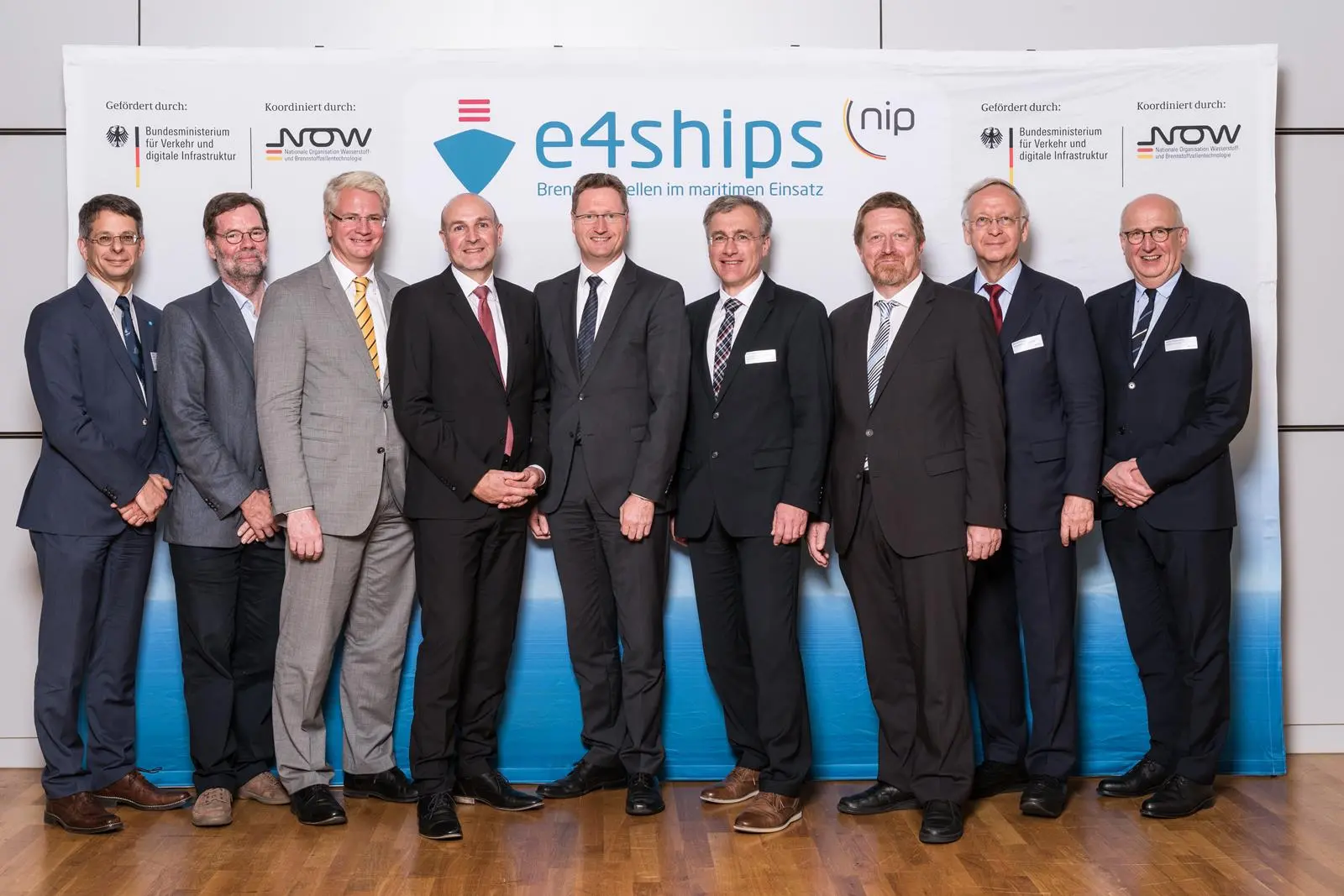
According to Gerd Würsig and Ralf Sören Marquardt of DNV GL, the e4ships project, funded by the German government’s National Innovation Program Hydrogen and Fuel Cell Technology, represents ‘the most serious, most advanced and largest fuel cell development project in the world’.
The project partners have developed fuel cell systems for seagoing vessels for the market and implemented them on a Scandinavian ferry and a German multipurpose vessel. The aim is to prove the viability and safety of fuel cells for marine operations, develop feasible technical solutions and feed into the development of regulations facilitating their use – notably the International Maritime Organization’s IGF Code for low flashpoint fuels. At SMM Hambug last month, the project team discussed progress during its first phase.
Under the Pa-X-ell sub-project, Meyer Werft has established demonstrators both at its yard – for first technical examinations of reliability and suitability – and onboard the Viking Line ferry Mariella.
Onboard the ferry, the company has installed a 90kW system comprising methanol-fuelled high temperature polymer electrolyte membrane (PEM) fuel cells. The liquid cooled fuels cells were developed by Fischer Eco Solutions and SerEnergy. They are 5kW modules arranged in racks of six (so three racks are onboard Mariella), and feature internal methanol reformers for hydrogen production.
DECENTRALISED ENERGY NETWORKS
The fuel cell system supplements the conventional energy supply, providing both electricity and thermal energy, as well as cooling power via an absorption chiller unit. A methanol supply and storage system was also installed.
The modular nature of the fuel cell network offers some intriguing possibilities. The aim, notes Bernard Meyer, managing director of Meyer Werft, is for “the new resulting modules to be the basis of a decentralised network onboard in the future”.
A decentralized energy arrangement would provide several advantages. It would mean small energy flows within the individual systems, high redundancy and strong safety benefits. However, at present there are no set standards for distributed power networks at IMO level – something Meyer Werft and the e4ships partners hope the project will help to rectify in its later stages.
Reinhard Lüken, general managing director of German shipbuilding and ocean industries association VSM, explained: “On the international level, shipbuilding and shipping are highly regulated. Therefore the e4ships results have been successfully introduced into the relevant instruments of the IMO, creating the international legal basis to use fuel cells commercially. The German shipbuilding industry thrives on environmental innovation and its commercialization. However, in order to fully exploit the potential of the fuel cell technology other alternative fuel sources must be approved.”
FURTHER DEMONSTRATORS
Looking to the future of the Meyer Werft demonstrator projects, the company hopes to increase the output of the individual fuel cells to up to 20kW while expanding their lifetime to beyond 20,000 hours. The company also hopes to introduce a natural gas reformer to the vessel. While the project team is aiming for long-term testing on its existing demonstrator vessel, it will also look to develop the decentralised energy network on two further vessels: a hybrid system on a megayacht with fuel cell modules both onboard and on a pier, and onboard a cruise ship for the electricity supply for a single fire zone.
The aim of the second demonstrator sub-project, SchIBZ, is the development of a diesel-operated hybrid fuel cell system with a scalable capacity of 100-500 kW for seagoing ships, intended to be the main power source for vessels of all kinds.
The installation onboard Bremer Reederei’s 4,100gt multipurpose vessel Forester is a containerised 50kW system, with an electrical efficiency of about 50%, using a lithium-ion battery to buffer the dynamics of the fuel cell and the ship’s grid. Low-sulphur diesel is employed as fuel, with the aim of introducing natural gas as an energy source at a later stage.
The project has been fruitful since its launch in 2009. As it enters its second phase, the project parties are aware that – while ground has been made on technical and regulatory aspects – there is a long way to go before fuel cells represent a commercially viable solution. Klaus Bonhoff, managing director of e4ships coordinator the National Organization for Hydrogen and Fuel Cell Technology (NOW), concludes: “Hydrogen and fuel cell technology is developing real alternatives for the specific needs of the shipping industry and is a technologically innovative response to climate protection issues. Especially in ports and coastal areas fuel cell systems on board of ships can contribute significantly to the improvement of the air quality. In the future, it makes sense to use the drive for smaller vessels too. In 2017, the National Innovation Program enters a new phase which especially aims to create the framework conditions necessary for the commercial market breakthrough of the technology.”
Related Articles
 ALTERNATIVE FUELS & LUBRICANTS
 FUELS & LUBRICANTS