



Signed, sealed and delivered – on time
However, he admits it’s not that surprising when one considers the difficulties of integrating a high-tech, pressurised system, writes Stevie Knight.
One of IHC’s solutions is a 122m DSV with a small wave breaking bulbous bow and a fine entry which broadens to a flare just above the waterline, resulting in a 24m beam. This yields enough space for a 120 person-plus accommodation block and forward helideck while still retaining a capacious deck area of over 1,100 m².
The six main gensets, four delivering 2,835kW each and a pair of 1800kW, are routed through three switchboards to give the vessel its DP3 notation. This may seem over-the-top but it needs to meet both hotel load and the diving spread draw as well as power the propulsion and Dynamic Positioning (DP) system: this consists of an aft-placed pair of 3,000kw azimuthing thrusters, two forward 2,400kw retractable units and another two tunnel thrusters pushing out 1,200kW each.
But, despite all the space and power, there are still significant challenges to overcome. The dive equipment integration issues are well known says Bloem, so IHC Hytech has paired up with specialist Dräger to enable a turnkey vessel which will arrive on time and complete “right down to the safety certificates” – a perennial issue for newbuild DSVs.
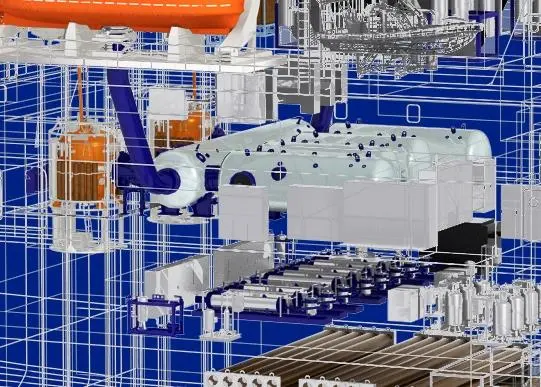
This particular design is open for customisation, but it centres around a fully automated, 18-person, twin-bell saturation diving spread. Ronald van Son, product director at Royal IHC, adds it means getting an awful lot of kit onboard: “It is a real challenge to fit everything in,” he admitted.
Starting at the bottom, big gas storage bottle racks hold around 30,000 m³ helium/oxygen mix, enough for a 30- to 60-day supply (depending on working depths). These are placed well down in the hull simply because at something like 130 tonnes these tanks are weighty enough to affect stability.
On the third deck and central to operations are the long surface compression chambers. Putting human beings through cycles of pressurisation and depressurisation is a time consuming, tightly controlled process; therefore, both safety and efficiency dictate that the dive teams can be resident in these chambers, held at saturation pressure, for anything up to a month.
CRITICAL PIPELINES
It’s not for the faint hearted as virtually everything – including food – must pass through pressurised ‘equipment locks’. So, while these units are sophisticated pieces of kit incorporating showers, sleeping and rest arrangements plus CCTV and a complete comms system, most people would feel a little uneasy unless they were confident of the robustness of the life-support equipment. Therefore, a CO2-scrubbing air treatment plant, balanced helium/oxygen feeds and dehumidifiers are central to the installation. Thus “there’s an awful lot of critical tubing”, explains van Son.
To get to work, divers traverse airtight telescopic trunk passages that lead to the two diving bells which are launched through dedicated moonpools. At the top the side-mating hatches give an airtight, sealed exit into the saturation chambers; at the bottom the deployment frames release the 15-tonne bells into dives that can reach 300m.
Of course, it’s a hefty job so even the launch and recovery kit commands quite a bit of space. Six large deployment winches roughly 2.5m in diameter work together to lift each bell. However, even the LARS winches are dwarfed by the two umbilical reels; these are almost twice their size as they must hold up to 400m of umbilical line supplying the divers with gas, power, hot water and communication.
The unthinkable, nightmare scenarios do have to be thought of – but even in an emergency the divers cannot be brought straight up to the surface. Therefore, the main working deck has a pair of 11m long, self-propelled hyperbaric lifeboats ready for over-side launch by davits; these will get injured divers safely to the nearest, shore-based decompression chamber.
The supporting functions can’t be overlooked either. So, there are a couple of control suites and offices positioned on a tweendeck; on one side these govern the bell’s communications, environment, launch and retrieval (Dive Control) while on the other these are dedicated to the hyperbaric chambers’ demands (Life Support Control). Nearby are workshops kitted out to maintain or prepare ad hoc pieces as required, to be deployed either by the 250-tonne main crane or by ROV.
Although retaining the 1,100m2-plus working deck is no mean achievement, the impact on the vessel from all this kit goes deeper than the space requirements. “For example, the moonpools, two for the diving bells, and another couple for ROV deployment means that you have a lot of holes puncturing the vessel’s hull,” says van Son. As the entire dive system “weighs something between 600 and 700 tonnes” it has meant strengthening the surrounding structure and reinforcing the scantlings while keeping the vessel at the design draft.
Despite the challenges, this intense Dräger-IHC collaboration has resulted in a DSV design that may yet make honest men out of project managers… ones who won’t have to keep their fingers crossed when scheduling the handover date.
Related Articles
 PROPULSION
 GENERAL NEWS
 HYDROGEN