



Dual-fuel Canadian tanker for hot cargoes
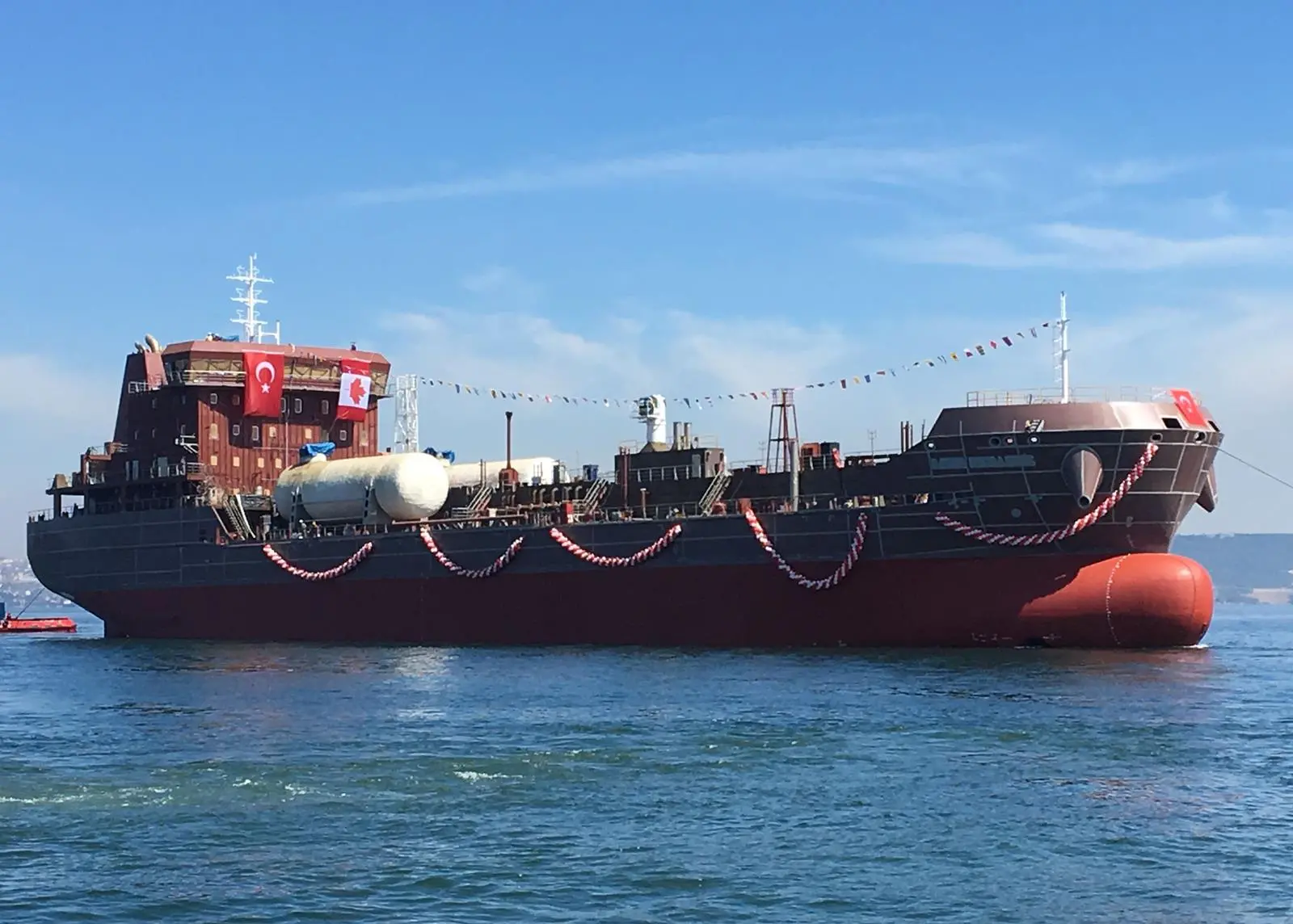
Quebec City-based Transport Desgagnés is embarking on a further, major stage of renewal and expansion of its diverse fleet with the introduction in December of an asphalt/bitumen/product tanker powered by dual-fuel machinery.
Delivered by the Besiktas Shipyard in Turkey, the 15,100dwt Damia Desgagnés has been built to the exacting demands of transporting ‘hot’ cargoes on the Canadian east coast, St Lawrence and Great Lakes, where temperatures can be as low as minus 30degC. The vessel is set be followed by three dual-fuel, IMO Type 2 chemical/product tankers from Besiktas for the Canadian company, due between the first and third quarters of 2017.
Damia Desgagnés is destined to replace the Thalassa Desgagnés, which has provided sterling service over the past 23 years. As with the outgoing ship, which is of Norwegian construction dating from 1976, the new vessel will be mainly engaged in the asphalt/bitumen traffic between Montreal and the east coast and points along the St Lawrence River, albeit while offering a broader trading capability and flexibility.
Damia Desgagnés is claimed to be the first Canadian merchant ship other than a ferry to be specified with dual-fuel propulsion machinery. When operating in gas mode, it is anticipated that CO2 emissions will be reduced by approximately 25% due to the lower carbon content in natural gas compared to liquid fuels. NOx will be cut by over 85% through the lean-burn combustion process, and SOx will be almost eliminated as natural gas contains very little sulphur. The arrangements ensure compliance with Emission Control Area(ECA) limits, as apply in North American waters.
The design offers a total cargo capacity of 15,260m3 and the flexibility to load oil and petrochemicals besides asphalt and bitumen in 12 cargo tanks supplemented by two slop tanks. In the case of asphalt, a 13,350t shipment can be taken at the 7.8m design draught. As befits the ship’s trading region, she is classed to Polar 7 standard, for summer and autumn navigation in thin, first-year ice, potentially containing old ice inclusions.
The seaborne transport of asphalt, or bitumen, has special requirements, principally the need to keep the product at its liquid temperature, calling for continuous heating and heavy hull and cargo tank insulation. High-temperature cargo containment demands comprehensive design evaluations relating to the impact of such temperature levels on the tank and surrounding structures.
Damia Desgagnés incorporates integral rather than independent tanks, for carrying asphalt at a temperature in the order of 170-180degC, with the cargo tank heating system designed accordingly. Mild steel heating coils are fitted throughout the cargo, slop and residue tanks. The heating arrangements take into account the expected environmental conditions within the ship’s intended trading sphere, as reflected in the BV class notation COLD confirming winterisation to an ambient temperature of minus 30degC.
Each of the four cargo pumps, supplied by the German manufacturer Leistritz, is rated at 400m3 per hour, providing the ship with a maximum loading or discharge throughput of 1,600m3/h by way of the four deck manifolds. The closed loading system incorporates a vapour return line. A computerised monitoring system is provided for the cargo and ballast tanks, and the cargo spaces are served by portable washing and permanent gas-freeing systems.
LNG-FUELLED FOCUS
The ship has been engineered throughout to run on LNG, as regards both propulsion and auxiliary machinery. The Canadian tanker is powered by a Wärtsilä 5RT-flex50DF, two-stroke dual-fuel engine, with a power output of 5,540kW, and allowing the use of LNG, marine diesel oil (MDO) or heavy fuel oil (HFO). Drive is direct to a four-bladed, variable-pitch propeller, with a 1,450kW shaft generator supplied by WE Tech.
Service speed is around 13 knots, and the high level of manoeuvrability demanded by the intended operating profile is answered by the adoption of 750kW and 550kW Brunvoll tunnel thrusters at the bow and stern, respectively.
Dual-fuel technology has also been adopted for the main genset installations, in the shape of two Wärtsilä 8L20DF medium-speed prime movers and a single 6L20DF model, and LNG fuel will also be used by two 3,000kW thermal oil heaters, sized to meet the vessel’s considerable heating load. LNG fuel storage is provided in two deck-mounted, 300m3-capacity, Type C tanks, fabricated by Gas & Heat, the Italian gas carrier cargo system specialist.
Damia Desgagnés provides the first-ever application for Alfa Laval thermal fluid heating systems with dual-fuel burners. Thermal fluid was favoured by the shipowner because the requirement to heat the asphalt cargo to transport temperatures approaching 200degC would otherwise need a steam pressure of 20-30 bar. Thermal fluid has 3-6 bar of pump pressure to overcome pressure losses in the line, resulting in less installation cost and risk.
Nonetheless, modifications to the standard system were necessitated to suit the dual-fuel design of the Desgagnés vessel. “LNG has a major impact on the engine room, where double-wall piping, ventilation equipment and other precautions are required,” observed Alfa Laval’s thermal fluid systems’ sales manager Pieter Borg. “Apart from adapting the burners of the thermal fluid system, we’ve had to make other modifications, for example in the automatic controls.”
Due to the vessel’s prospective trade in very low temperature waters, the tanker is equipped with a secondary hot water loop, filled with water and glycol, connected to the thermal fluid heating system so as to heat the engine room air intake and ballast water.
Alfa Laval’s contract has also embraced the steam boiler plant, separators, boosters, filters, tank cleaning machines and ballast water treatment.
Desgagnés advised The Motorship that the new-generation asphalt tanker and the subsequent newbuilds would operate on LNG from the start as far as practicable, to the extent that LNG distribution logistics would allow in relation to the fuel demand from the ships. LNG fuel delivery arrangements are being worked out with suppliers, and the number of LNG bunkering places will evolve over time. The vessels will bunker mainly in Montreal and Quebec City, and ultimately also in at least one port on the Great Lakes.
SEAWATER LUBRICATION
The Canadian owner’s comprehensive attention to environmental aspects was also demonstrated in its request that system integrator Wärtsilä should incorporate Thordon COMPAC seawater-lubricated bearing technology. As an alternative to oil-lubricated systems, with the attendant risks of oil leakage and pollution, the scope of supply includes COMPAC seawater-lubricated propeller shaft bearings and the Thordon water quality package, to ensure a clean and consistent flow of seawater to the bearings.
The array of Bureau Veritas class notations held by Damia Desgagnés includes CleanShip Super, denoting that the vessel has a range of technical solutions to meeting strict environmental standards, including ballast and grey water treatment systems, as well as the means of operating for at least seven consecutive days with no discharge of effluents or residues.
In addition, the certification with the Green Passport notation confirms that certain specific materials used in the construction of the ship are identified and documented in a record updated annually and re-certified every five years. This is to ensure safe handling and disposal of the materials at maintenance and repair stages, and during the vessel’s eventual dismantlement at the end of its service life.
Groupe Desgagnés has pursued a vibrant fleet modernisation and development strategy over the past 10 years, entailing multipurpose cargo vessel and ferry tonnage besides tankers. The four-ship series at Besiktas denotes the second connection with the Turkish shipbuilding industry within this period, as it received the 18,000dwt chemical/product tanker Sarah Desgagnés from Gisan Shipyard at Tuzla in 2008. The vessel was adapted for St Lawrence Seaway navigation and strengthened to 1A ice class standard.
Desgagnés chairman Louis-Marie Beaulieu stated that “The Damia Desgagnés is part of an extensive investment programme for the renewal and expansion of the fleet with vessels fitted with cutting-edge technology, which demonstrates Desgagnés’ commitment and confidence in its future.”
BV shows mettle in specialised sector
Classification of the Damia Desgagnés with Bureau Veritas is testament to the society’s leading position in the asphalt tanker sector. More than 40 such vessels, representing about `19% of the existing world fleet in this specialised category, are currently to BV class, and the latter’s role is set to grow substantially by virtue of its project involvement with two-thirds of such tankers under construction and on order.
Among the largest asphalt/bitumen carriers, the 30,000dwt/28,895m3-capacity Palanca Montevideo and Palanca Muscat were constructed by Hyundai Heavy Industries(HHI) and delivered under BV class to Wisby Tankers in 2013-2014. A new generation encapsulated by the 37,000dwt/35,666m3 Asphalt Splendor, bearing BV notations, made its debut this year with US-based Sargeant Marine. Built by AVIC Dingheng on the Yangtse River to a SDARI design, Asphalt Splendor is set to be followed by two further examples of the 37,000dwt type, for Sargeant Marine and Japanese owner Kumai Senpaku, respectively.
The BV reference list will also be extended by a 50,000dwt bitumen/oil/chemical tanker contracted from HHI by ASP Ship Management of Australia, and by two 37,000dwt asphalt carrier newbuilds ordered at Hyundai Mipo Dockyard by the Swedish company Wisby Tankers. The latter’s modern asphalt tanker tonnage includes a series of four 13,600dwt/14,900m3, BV-classed asphalt/bitumen carriers commissioned from 3 Maj’s Rijeka yard in Croatia over the course of 2013.
Exceptionally high cargo temperatures up to 250degC in asphalt tankers affect steel strength and properties, placing particular demands on structure, construction quality, equipment and overall design. “This makes a comprehensive design review essential for new projects,” asserts BV’s tanker and gas carrier business development manager Carlos Guerrero. The society has developed the tools and special skills for assessing newbuilds, against the backcloth of the growth in vessel size and complexity, while forging closer links with leading operators such as Wisby Tankers, Sargeant Marine and Iver Ships.
“BV has proven design review expertise for all types of tanks and the particular challenges they represent,” said Guerrero. “For independent tanks, interaction between tank and hull is the major focus; for integral tanks, heating of the hull structure results in thermal stresses, and impacts on material strengths and buckling sensitivity. Our iterative process includes temperature mapping, thermal and strength analyses of hull, tanks and supports.”
A by-product of the petroleum refining process, asphalt has many uses, as it is a strong cement, readily adhesive, highly waterproof and durable. It is described by Melbourne-based ASP, whose fleet includes vessels managed on behalf of Sargeant Marine, as “a plastic substance that imparts controllable flexibility to mixtures of mineral aggregates with which it is usually combined, its principal use being for road construction and large sealed areas.”
PRINCIPAL PARTICULARS—Damia Desgagnes
|
Length overall |
135.00m |
|
Length b.p. |
129.24m |
|
Breadth |
23.50m |
|
Depth |
11.30m |
|
Draught, scantling |
7.90m |
|
Draught, design |
7.80m |
|
Gross tonnage |
11,750t |
|
Cargo capacity @100% |
15,260m3 |
|
Cargo capacity @98% |
14,950m3 |
|
Cargo/slop tanks |
12+2 |
|
Main engine |
1 x 5,450kW |
|
Speed, service/maximum |
13/14 knots |
|
Class |
Bureau Veritas |
|
Class notations |
I +Hull, +Mach, Asphalt-Bitumen-Chemical/Oil Tanker, FP>60degC, ESP, Dual Fuel, Unrestricted navigation, Cold(-30degC), +AUT-UMS, SPM, Polar Class 7, CleanShip Super(BWT, GWT, NDO-7 days), +SYS-NEQ-1, IWS, Green Passport, VCS, IWS, Mon-Shaft, Protected FO tank |
|
Flag |
Canada |
Related Articles
 PROPULSION
 GENERAL NEWS
 HYDROGEN