



A bridge over troubled water
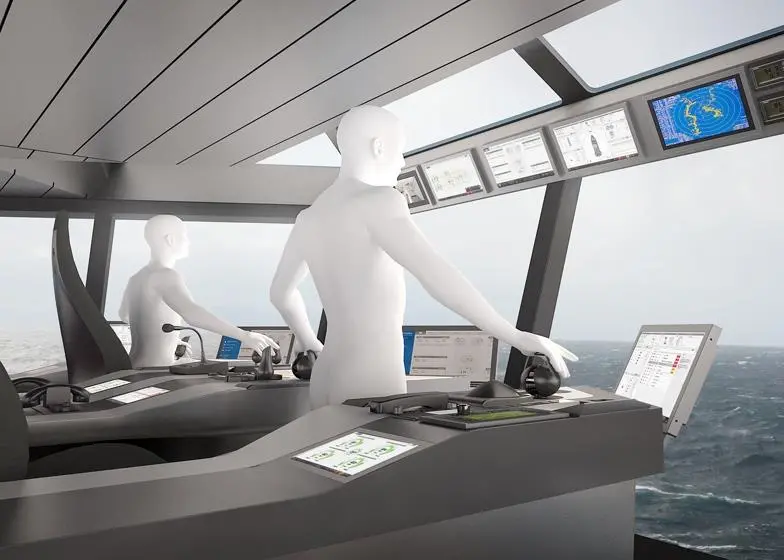
“There has been altogether too much complexity in PSV control layout, and you really have to be focused on what you are doing especially if you are close to a rig,” says Davide Lamparelli, industrial design expert for Wärtsilä Norway.
He adds: “It’s not unheard of for captains on the bridge at night to have to go searching with a flashlamp for the right button in a huge aluminium frame full of them to feel absolutely sure of pressing the right one in the array. What’s more with so many different equipment suppliers sometimes you are looking for a button, sometimes a switch or knob… I’ve even seen really new, just-signed-off bridges where the crew felt the need to put customised tags on certain controls.”
The system Wärtsilä has developed works by ‘smart layering’ information on touch display, popping up propulsor data in sequence depending on what’s engaged – and it also prompts the user a little. “We tried to create a system that gives the necessary information at the right time, with any immediate calls to action or alerts ‘jumping out’ from the rest although the others remain selectable.” The system has also shaved the number of physical buttons down to just two – backup and emergency stop.
In the same vein, both Ulstein and Rolls-royce point to the need for overarching systems that will mop up some of the clutter on the bridge. Rolls-royce’s Ludvig Kaare Oyen points out that everything has become so crowded “with big, long screens for every piece of equipment that sometimes operators can barely see past them to look out of the windows”.
Kjetil Nordby Associate Professor at the Oslo School of Architecture and Design, agrees. He has been running some of the research into Ulstein’s Bridge Vision project and adds the best phrase to describe it all, (coined by his colleague Komandur Sashidharan) is a ‘supermarket’ bridge: “Although there’s lots of shelf space, a lot of negotiation goes on as to what systems get first, second or third ranking and so on – complicated by the fact that some with a large physical interface may not actually be used as much as others,” he explains.
But despite the shared focus, the systems are very different, although like Wärtsilä, they have taken the same ‘layered’ approach.
Rolls-royce’s ‘Unified Bridge’ takes on the complexity by absorbing as much functionality as possible into a number of largely touch screen based systems, while – very importantly – segregating protocols and networks so that one failure can’t impact the rest. Mr Oyen explains that where all the functions couldn’t be digested by the central system, the original interfaces have been tucked away, for example on the underside of a desk panel, ready to be ‘flipped out’ if the need arises. There’s also a remote control rollerball integrated into the central desk.
Mr Oyen adds that there were some hoops to jump through with the class society to get approval for multiplying the functions of both levers and screens: “It’s not unexpected, after all their rules were made yesterday and we are moving into tomorrow’s technology. But we are talking here about the whole bridge, and where navigation is concerned the rules are a lot more strict.”
However, you can’t get away from the fact that it comes down to two very different sets of requirements that pull in opposite directions: a ‘tied together’ human interface which needs to show and allow responses to multiple areas – but one that remains consistently simple and recognisable. Both Rolls-Royce and Wärtsilä have done some clever work with colours, Wärtsilä’s propulsion system having graphics that move from a ‘blue’ (in control) to an ‘active orange’ when the system or the user is performing a special process. Interestingly the same LED colour mapping is on the levers or buttons themselves, giving instant feedback upon engaging a drive.
The reason? Mr Lamparelli points out that these big, powerful systems can be slow to respond so there’s a temptation to doubt whether it’s actually connected. “If you just press something and there’s a lag, you might well be tempted to press it again.”
His point is that you need to make sure the captain gets the right feedback and ‘feeling’ from any action. “Things happen in a fraction of a second, so the captain needs a layout that is clear and comfortable, knowing intuitively without having to look too hard ‘that’s the backup’ or ‘that’s the failure light’.”
So, despite the pull of some very clever technology, Mr Lamparelli points out the obvious issues. “You can’t make too big a jump into high tech solutions otherwise there’s too great a shock; people simply won’t recognise it.” This, he says, is partly why Wärtsilä has retained typical aluminium machine parts that give a familiar feeling to the design.
“You need to give the captain the sense that ‘I have the ship in my hands’,” concludes Mr Lamparelli.
This ‘feeling’ is actually an important argument, says Prof Nordby, against tying everything into touchscreens. “You can be so set on clearing as much clutter out of the physical bridge as you can that you end up by replicating the clutter in the virtual world.”
Touchscreens, if you are not careful, can result in overusing one sense because first of all you have to look at what you are going to touch – and it’s not a strain free way of working for arms and hands either despite its lack of physical presence, he adds. However, Prof Nordby points out, “it is possible to combine a medley of types of interaction” to get the best out of each of them.
He explains that there’s a big place for knobs and levers, as holding something familiar means you usually don’t need to look to know how it’s set. However, despite the advantages their accuracy might be improved and they don’t show you how they are engaged with the larger onboard systems – which a digital display can.”
He adds: “Critical systems benefit from a persistent presence – like a big red button. However, for non-critical systems you might not need physical real estate at all. Some of it comes down to evaluating how much available attention people onboard really have in any given situation and shape the systems accordingly.”
There’s yet another issue which inevitably creates tension. Mr Oyen points out that in this industry each equipment supplier tends to have his own set of interfaces, unlike many other environments where a general set of protocols have been established “which of course makes it all a lot more difficult for the users”. For this reason Rolls-royce has made sure that everything getting tied into its bridges has a common look and feel right from the pumps to the window wipers “so across all the screens we’ve got the same colour-type menus and generic controls”.
However, Prof Nordby adds that there’s a tricky balance to be had. On one hand complex third party components may have been developed around a particular interface for very good reasons; DP systems for example need a certain amount of historical consistency. On the other hand, he says, “a lot of third party equipment really doesn’t need its own interface – there’s usually a number of advantages for manufacturers in tying their component into a central system”. However, it has to be an extremely well informed decision, and this is why Prof Nordby says “there is no substitute for taking the specialists out onto the vessels to see what is really happening with their area of expertise”. Even if they do go a bit ‘green’ for a couple of days.
Retrofitting
A last point is the impact on older craft. Some tech just isn’t going to be suitable for the previous generation of ships, and even those that are seem to be finding themselves on a steep path. “Retrofitting vessels is always going to be the biggest challenge, the amount of equipment now being asked for on PSVs really has become an issue,” says Mr Lamparelli.
He says that it’s best to keep away from large, difficult to fit systems and develop something that is both compact and adaptable. It’s not just the installation that benefits: “A slimmer machine plate that combines everything in one means the relevant controls don’t end up in some crazy spot far away from the actual display,” he adds.
By Stevie Knight
Related Articles
 PROPULSION
 GENERAL NEWS
 HYDROGEN