



A bright future
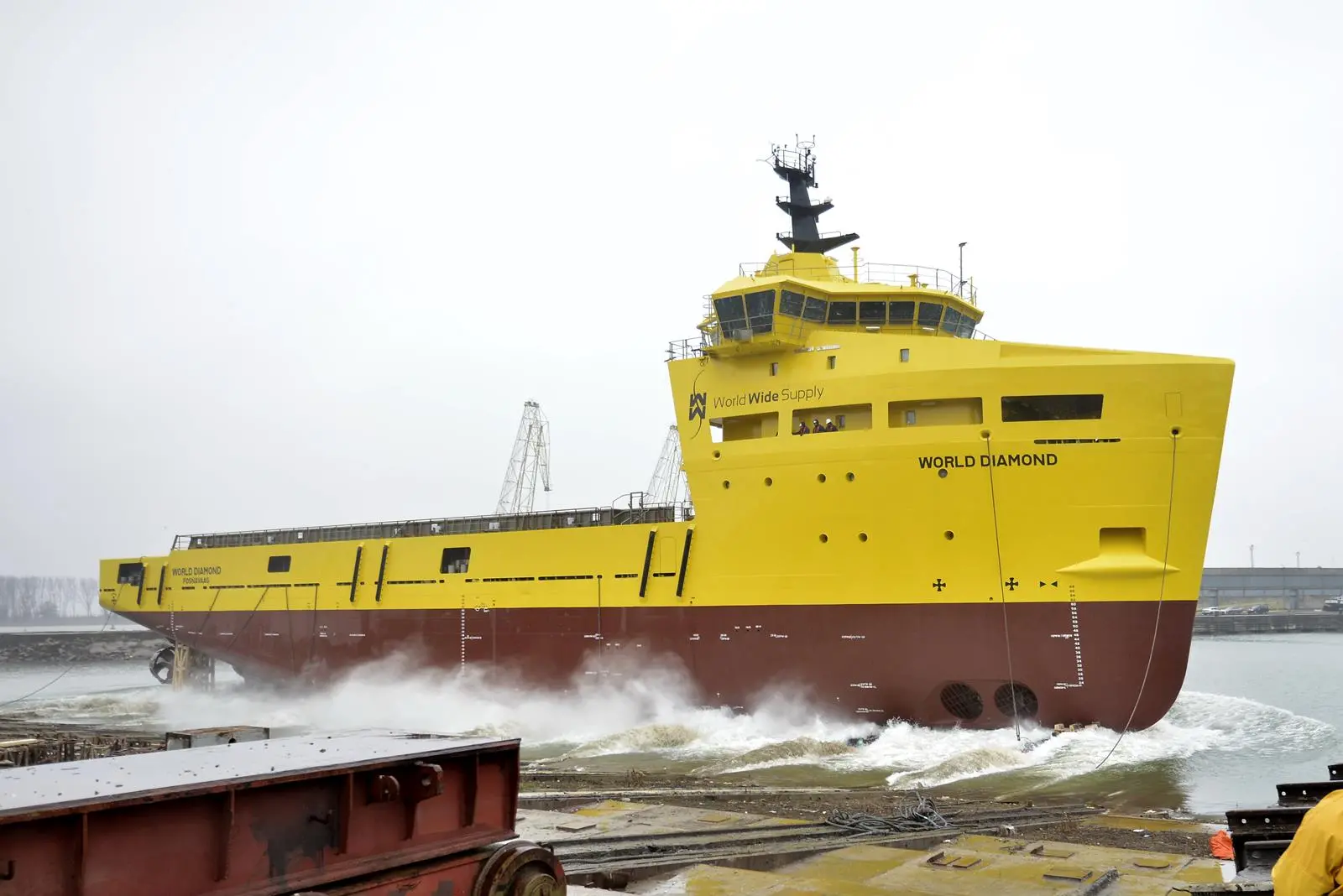
It wasn’t just a marketing ploy. “Why paint vessels with dull colours? After all
,
you want a vessel like this to be recognisable in steep seas
,
if only for safety
,
” he says so the newly founded World Wide Supply (WWS) might have had six very bright ships indeed by the end of 2013 if the paint formulation had been possible. As it is
,
the deep yellow
and
red livery makes the first three in the water
,
the
World Diamond
,
Pearl
and
Peridot
,
rather distinctive.
Almost as unusual is that the 80.10m
,
3
,
300 dwt design has been carved out for a world-wide deployment
,
a challenge in itself.
Coming up with a PSV suited to very diverse markets has meant dealing with “the inevitable tension between regulations
and
preferences in different parts of the world
,
” explains Mr de Lange. He says that because of this
,
most support vessels are planned with a specific trade in mind
,
however
,
Damen
,
following its natural leaning toward adaptable designs
,
“was looking to create something much more flexible”.
His colleague Mark Couwenberg points out: “Its actually quite a difficult task to get a truly global design as you have a pull toward more of a certain kind of cargo depending where you are: in the US the deeper drilling results in the need to transport a lot more liquid mud for example
,
whereas in other areas you might need more specialist crew.”
He adds: “All this meant that the build needed every litre of tank volume it could get
,
” he explains. “Sometimes it was like being involved in a giant
,
three-dimensional puzzle: if you moved one area around
,
it would impact on the specifications for another. We looked very carefully at every aspect from the hull up: details like the pipe routing needed to come under a lot of scrutiny.”
It seems as if the World Diamond
and
its sisters has kept its large capacity along with personnel: for example the 720 square metre deck can carry 1
,
400 tonnes while the tanks together can hold around 5
,
000 cubic metres
and
a pragmatic solution to the usual pull between cargo
and
personnel has resulted in a st
and
ard layout for 24 people with an alternative meeting the needs of 36 personnel: “North Sea operators keep individual cabin arrangements
,
however
,
in other parts of the world two sharing is quite acceptable
,
” says Mr Couwenberg.
Mr de Lange adds that despite the challenges
,
its not all a ‘seesaw’ between competing requirements: “We have built the World Diamond with Damen’s E3 principles in mind: so the common thread is that they are economical
,
feasible
,
efficient.”
The main Caterpillar engines are a pair of 3512s
,
matched with a secondary pair of C32s giving a total of 4
,
500kW of power: these are placed in the foreship giving lots of clear cargo space aft
and
making it easier to distribute the power via the switchboard to items like the two
,
big 1
,
740mm Schottel FPP bow thrusters
and
the pair of Schottel 2
,
300mm azimuthing
,
nozzled propellers which give the ship a speed of 13.2 knots at 5.00m draught.
Mr de Lange goes on to say that a lot of attention is given to environmental impact. These vessels having gained a green passport; the engines have a Selective Catalytic Reduction (SCR) unit onboard
and
are primed to run on low sulphur diesel.
The vessel also operates a waste heat recovery system as the engine cooling water is recirculated around the vessel: Mr Couwenberg explains: “You can save a significant amount of fuel as in most conditions you don’t need to use the boiler anymore
,
it’s just a backup for the extremes.”
Further
,
the hull has a straight design. Mr Couwenberg explains that below the waterline it’s as sharp as possible
,
but just above this there is still not much immediate flare: “Again its another balancing act; while old fashioned bows have lots of cargo room
,
they gain it by bulging out
,
but this makes for a hard hit. We reduced the angle of flare to a minimum
and
this way it slides into the wave. So
,
while the total motion is slightly bigger
,
it’s not so harsh.
Unlike many other Damen vessels
,
it’s not a modular design “as the whole has to be very integrated” although Mr Couwenberg explains that it may well st
and
to be developed as a ‘block’ design in future. Interestingly
,
an important part of the process is to make a complete 3D model of the ship: “If you are just looking at the detail in two dimensions
,
its too easy to overlook a door
,
put a pipe across it
and
then find you can’t open it – so modelling in 3D is a crucial stage in the design
,
” says Mr Couwenberg.
Damen has all its capabilities under one roof
and
although the initial outlay “isn’t necessarily the cheapest” Mr de Lange says that “too many shipowners have gone for the lowest cost vessels
and
been stung by the downtime
and
maintenance”. He adds the object is to give real value for money
,
which means to “connect the customer to the yard for the future
,
not just a single project”.
As to the bright future
,
Mr de Lange adds: “Sooner or later Damen will have its glow-in-the-dark vessel.”
By Stevie Knight
Related Articles
 PROPULSION
 GENERAL NEWS
 HYDROGEN