



A few words as we get closer to our centenary
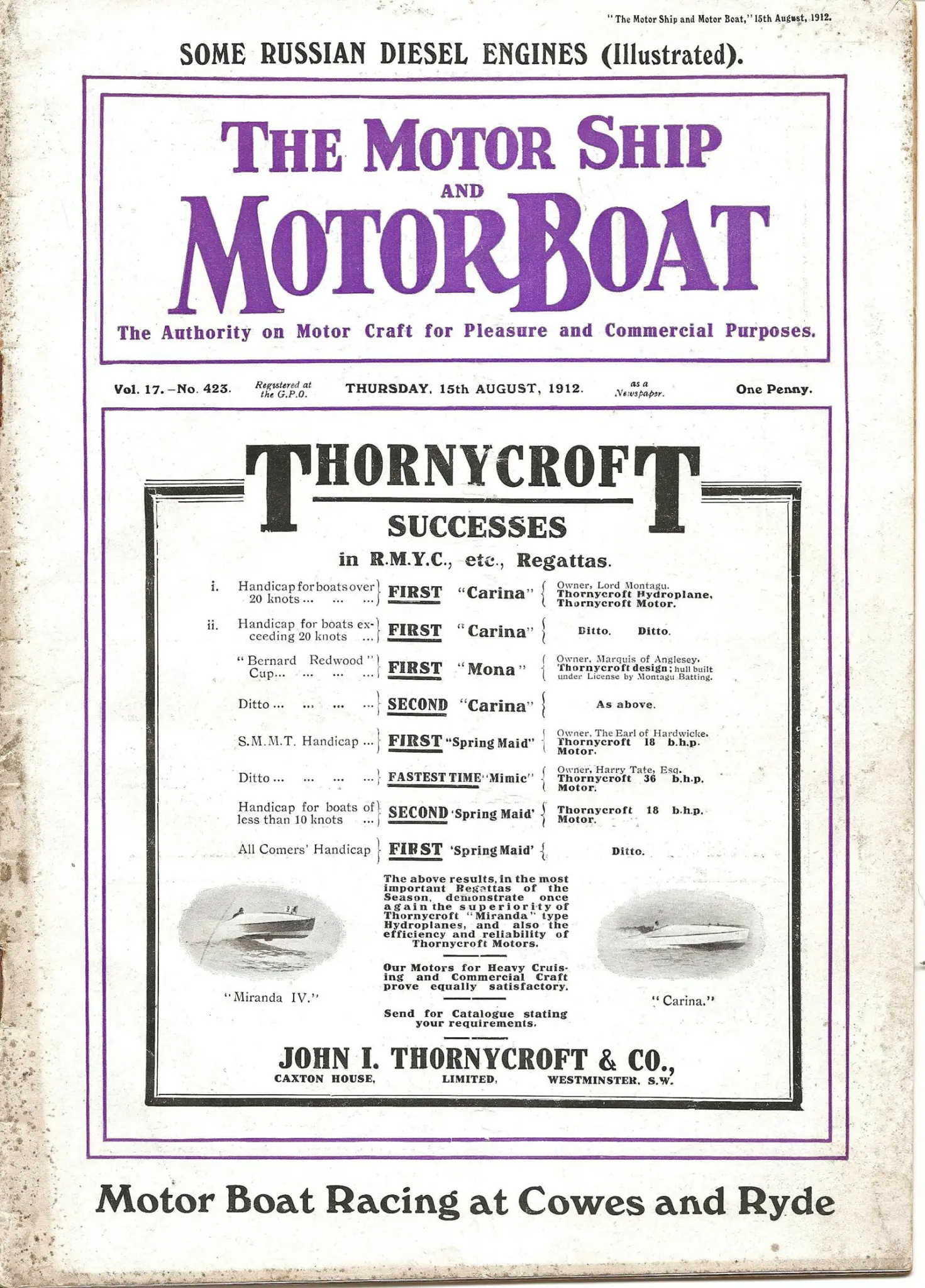
For those who may not read the regular historical snippets in print and on our web site, The Motor Ship (before 2007 the title had two words apart from the definite article) came into being in 1920. It had actually been around in a slightly different form for a few years before then; the current editor has a couple of issues of The Motor Ship and Motor Boat from 1912. He knows that its sister title, The Motor Boat, began in 1906 – he began his work as a maritime journalist on its successor Motor Boat & Yachting.
It was thanks to one man that The Motor Ship became a title in its own right. That was the legendary A.P. Chalkley, editor of The Motor Boat, who became the first editor of The Motor Ship from its inception right through to his death in 1959, at the age of 73. He was followed by a pair of Wilsons, first the almost equally legendary ‘Tug’ (Bill) and then Keith, later to become well known as a consultant. None of Chalkley’s successors are likely to be able to manage 39 years at the helm, though several have enjoyed relatively long periods in charge and a few lasted a comparatively short time. One of the title’s proud boasts when I first joined it at the end of the 1980s was the small number of editors it had in its 60-odd years. We were, I believe, on our sixth or seventh. All, before and since, I believe, have managed to make their mark in some respect.
The Motor Ship became well-known as a training ground for technical maritime journalists and editors. Many came to the title after a career at sea, adding writing and editing skills to their marine engineering knowledge. Some had worked in shipyards or as naval architects. A few were journalists who became attracted to the camaraderie and rewarding nature of the maritime press. A large proportion of marine writers past and present went through The Motor Ship; some (me included) were to return as editors.
The magazine’s initial raison d’ être was two-fold. First, to champion the cause of the Diesel engine – something we continue to this day, though somewhat less evangelistically than of yore, the internal combustion engine having replaced steam power as the prime choice for ships. Its second mission was to promote British shipbuilding and marine engineering, and that is an area where circumstances forced a change of direction and an international outlook after 60-or-so years of publication.
Who better to give their impressions of the premier technical marine journal than some of its former editors? Doug Woodyard was at the helm in from 1977 to 1985, remained as a contributor after he left for a freelance career, and although recently officially retired is still well-known as a contributor and consultant to other respected marine titles.
We asked him about the drastic changes in world shipbuilding during that time.
“My time as editor was significant for the marine industry as well as for magazine production. The period saw the savage decline of UK shipbuilding and marine engineering in the international arena and the remorseless rise of Japanese and Korean groups, which was reflected in our coverage,” Doug recalls.
“Famous British yards and engine builders in the north east of England and in Scotland went to the wall and our UK editorial features shrank in size. Visits to Asia by editorial staff necessarily became more frequent, and I went to China in 1980 and 1982 to prepare reports on its then fledgling newbuilding export industry. The seeds of Chinese success were difficult to see in those days.
“Marine conferences were also in their infancy but we were encouraged to start the annual Marine Propulsion conference in 1979, now in its 33rd successful year: the Future Fuels theme of that first event remains an issue today.
“Colour editorial pages – once too expensive – became more common and enhanced our ship and engine reports, and the PC was first exploited in the office in updating our quarterly ‘Ships on Order’ statistical supplement. Articles were still prepared on typewriters – word processing was introduced later – but fax machines eased production.”
In fact the statistical tables had become quite a feature of The Motor Ship, and it employed a staff statistician. It also had access to its publisher’s art studio, enabling production of the famous cut-away ship views and engine drawings, and general arrangement drawings on fold-out sheets. All of these are now a too-expensive luxury, unfortunately.
A couple of years after Doug, the editor of the magazine was drawn from the statistics department, albeit a statistician who had been to sea. Paul Doughty, now working in PR, recalls:
“A few weeks ago I was reorganising my memorabilia and came across a thank-you letter from MAN B&W – as the engine builder was then known – written when I stepped down as editor of the world’s leading marine technology magazine. To be asked to write a few words some years later to celebrate the title’s 90 years of existence is a testament to The Motorship’s international reputation as it continues to deliver high quality information to its global audience.
“Shipping has always been important to international commerce and its global impact has developed and shifted as different centres – whether for shipbuilding, marine engineering or the commercial hubs – have risen and declined. Yet The Motorship continues to deliver.
“It is a tribute both to my successors and my predecessors that The Motorship is still held in such high regard. Yet it is also an acknowledgement that, despite the constant shift in economic winds, there is still a very real demand for accurate information, well-written and well-presented that meets the needs of this global audience of discerning experts.
“Part of the reason for The Motorship’s longevity is its continued focus on cutting edge developments in marine technology for deep sea shipping. The relative importance of some topics may wax and wane over the decades but the core interest in marine engines and developments in propulsion continue to pique the interest of discerning engineers across the globe.
“I am proud to have been associated – in some small part – with The Motorship’s success over the past 90 years and have little doubt that it will continue to deliver accurate, readable and timely information to marine engineering experts over the next decade to pass 100 years of publication.”
My first period with The Motorship was during that period, and I can testify to the high standards of accuracy and quality of writing that had always been demanded of the staff (we had a four-strong editorial team then, plus outside contributors, sub-editors and layout artists). I had already moved on to another marine publication by the start of the next era.
Paul’s successor, Dan Thisdell, came from outside the marine industry, although he is still involved in the transport press, albeit in aviation. He presided over a difficult time. We were one of several magazines that, although still profitable, didn’t really fit into any of the publisher’s core markets, so after a few attempts to expand, then contract, the scope of coverage, it was eventually put up for sale.
Dan continues: “My first year as editor of The Motor Ship was perhaps the most extraordinary of my time in journalism. The job came with what amounted to a brief to give the title, then coming up to its 80th birthday, a new editorial and commercial direction, as the publisher clearly thought it needed a jolt. I like to think I brought a fresh take on journalism, but the task was daunting – what I knew of ships was that one end was pointy and the other had a whirly thing.
“What I found was a magazine much-loved by the industry – an editor of The Motor Ship never need pay for a drink – but, well, needing a jolt. The obvious answer was to get back to being focussed on marine technology, and quit doing all the extraneous stuff like shipping line financial reports and shipyard order and delivery data that was well-covered by Lloyds List or Tradewinds. Without having a dig at a publishing company that had looked after TMS for decades, including some hard times, Reed Business Information didn’t really grasp that the readers weren’t businessmen – they were engineers. With not a little cajoling of staff and advertisers, and with the help of a major redesign, we got there – but, as I said, what a year!
“That year ended with a whole new set of challenges brought on by the title being sold and then 9/11 and the subsequent downturn. And, also, a realisation that it was time for a new editor; I’d done my bit and so The Motor Ship needed, again, an editor who knew one end of a vessel from the other.”
That person was to be found not too long later. There was a short period when Peter Moth (a name well known as founding editor of our now ‘mother’ title Maritime Journal) acted as caretaker (we were not then in the same ownership as MJ), and another editor, Richard Burton, served for a year before John Barnes returned. John, a naval architect by profession, was one of those who had cut his journalistic teeth on the title and had branched out into marine PR and editing other magazines (including, like me, Safety at Sea International, though John managed to do so twice).
John takes up the story: “It is 40 years ago this month that I joined the staff of The Motor Ship as a young journalist under the editorship of the legendary Bill Wilson. I had left a career in the UK shipbuilding industry, when we had one, to become the journal’s Naval Architect in succession to Robin Burnett, who had left to join RINA and start The Naval Architect. Four years later I too left to set up an offshore journal (Ocean Energy), under the umbrella of The Motor Ship, and over the subsequent years moved on in journalism and PR/marketing but always within the shipping sector.
“It was therefore with great pride that I rejoined the journal as editor in November 2004 at its then offices in Swanley, Kent. By this time the journal and its operation had noticeably changed, as had technical publishing in general, with much reduced staff levels and the adoption of the latest production techniques. Nevertheless the same enthusiasm for the subject matter remained and we were a happy, though small crew. During my time I had the pleasure of chairing the annual conference in both Bilbao and Copenhagen, as well as making various visits in the UK and abroad. Sadly my time as editor was short-lived and I left in March 2007, when the journal was acquired by Mercator Media, to join the Institute of Marine Engineering, Science and Technology (IMarEST) as Editor in Chief.”
And so to the present. What you see before you is where we stand at present. A lower budget, even further reduced editorial staff levels, but a happy and productive team, I believe, and, as part of Andrew Webster’s Mercator Media, we are once again part of a maritime publisher’s portfolio.
Thanks to all of our readers, advertisers, past and present staff and management. With you, we look forward to celebrating our 100 years of existence in a stronger, brighter, 21st century format.
Related Articles
 50 YEARS AGO
 50 YEARS AGO
 50 YEARS AGO