



A new generation of fast ferry
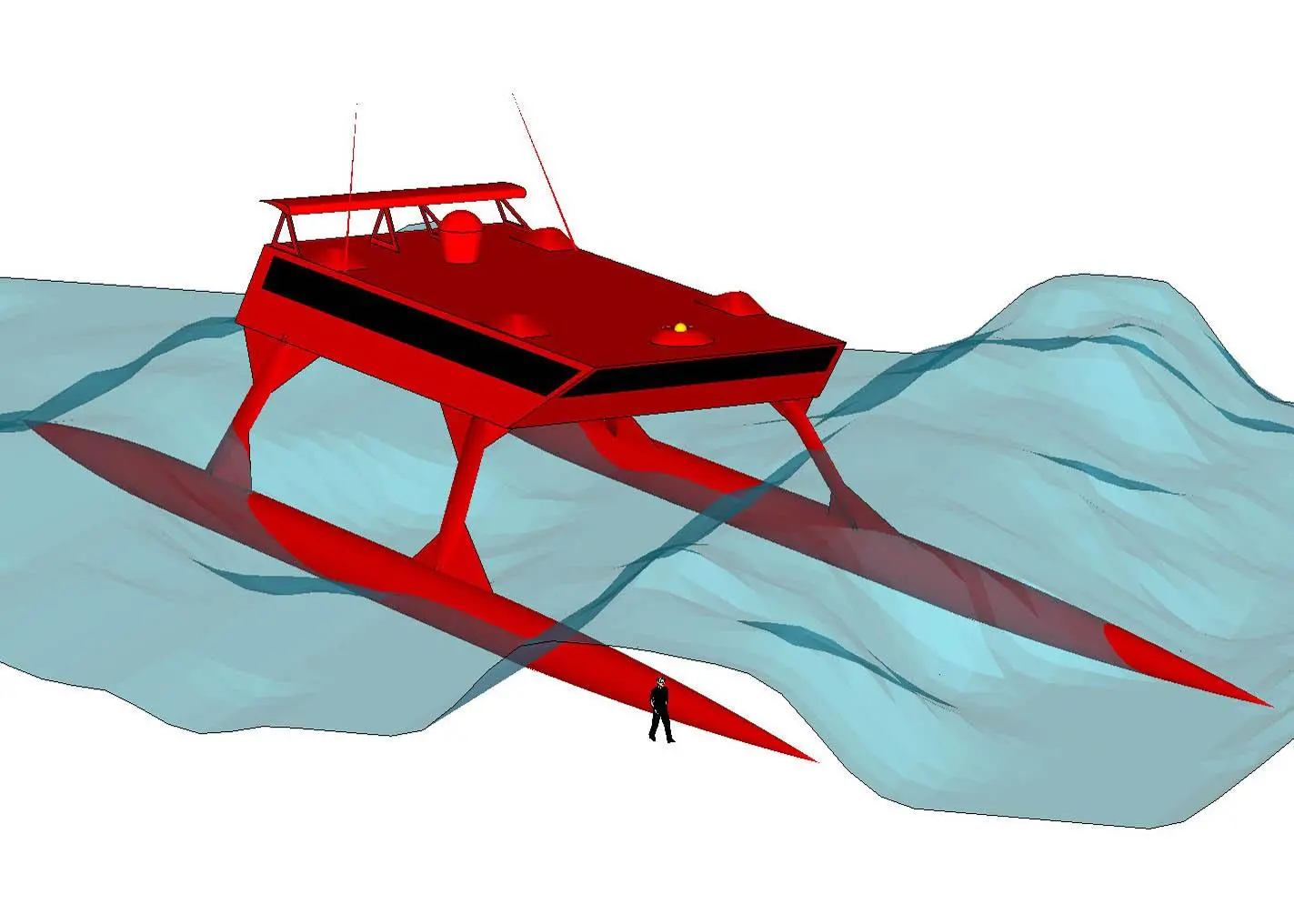
Based on very long thin hull technology, a ferry version would combine high speeds with very low fuel consumption to make the new ferries both fast and ‘green’.
This new high speed vessel concept has been developed over the past eight years. “We are now ready to start work on building an 18m prototype at a UK West Country shipyard,” commented Richard George who is heading up the team at Atlantic Glider. “The current breed of high performance ferries is based mainly on wave piercing or catamaran technology which requires considerable power to attain high speeds. That technology has now reached a plateau, which is why we are now developing this new technology that will take fast high speed ferries to a new level. Not only is our new technology capable of high performance but it is also very economical and capable of a long range at high cruising speeds in adverse sea conditions”.
Mr George is leading an experienced team of designers, captains and businessmen in developing the new Atlantic Glider technology that promises to drastically reduce the fuel consumption of fast ferries and at the same time offer much higher transit speeds and the ability to operate in rough seas. “We have reached the stage where we are ready to start building a prototype so that we can test the theory in real open sea conditions. We are setting out to demonstrate that we can achieve the Holy Grail of fast ferry design, operating at high speeds in rough seas with minimal fuel consumption.”
“We recognise that we have to demonstrate the capabilities of our Atlantic Glider concept and to do this we will be using the traditional proving ground for new types of vessel, the Atlantic Ocean”, said Mr George. “The 18m prototype has been sized to give us the information that we need to build a larger 52m version capable of crossing the Atlantic at high speed”. The Atlantic Glider team is confident that the 52m ship could cross the Atlantic in two days, which could knock half a day off the current record. It could achieve this by using just 10% of the fuel used by the current record holder Destriero. “The Atlantic has traditionally been the proving ground for new fast ship designs and this is where the current breed of wave-piercing fast ferries has demonstrated their capabilities”, commented Mr George. “Our aim is to bring the Blue Riband of the Atlantic back to Britain but with our minimal fuel consumption perhaps we should call this the Green Riband.”
A fast ferry version of the 52m vessel will have the capacity to carry 200 passengers in considerable style. Such a ferry will not be competing with the current vehicle-carrying ferries but is aimed at open sea routes of between 200 and 500 miles where the current ferries have limitations. “We expected to be able to offer a smooth ride at high speed and on some routes we should be able to provide competition for short haul aircraft”, said Mr George.
The long thin hulls of the design will make the vessel largely immune to waves up to 4m or 5m in height and it is anticipated that the concept should prove attractive on inter-island routes in the Caribbean and Far East. The design is also expected to generate interest from the military where its excellent sea-keeping qualities could make it attractive both for patrol and surveillance duties as well as to special forces operations.
The concept for the 52m version will be powered by four standard diesel engines and these will be coupled to a new concept of water jet propulsion where the jet nozzles exit from the hull just aft of the midway point rather than at the stern. This will give the vessel high manoeuvrability as well as effective forward thrust.
This innovative water jet propulsion system is only part of the new technology that is incorporated into the design. “We have had to find a lot of new solutions to enable this concept to operate at high speeds in rough seas,” said Rob McCall, the main design engineer of Atlantic Glider, “but we think we have found viable solutions to take us forward on this project”.
Editorial Note: Several months after this item first appeared we were contacted by Rob McCall (see above) who had subsequently split from the Atlantic Glider company and is now marketing the design to the superyacht market, under the name Glider Yachts. He claims that the concept is his property, and suggests that publication was contrary to his wishes. We contacted Richard George at Atlantic Glider, who declined to comment. As the article by Dag Pike was correct at the time of publication we have not altered the text, but readers should be aware of this development. 28 August, 2013.
Related Articles
 PROPULSION
 GENERAL NEWS
 HYDROGEN