



A new start for UK yards
Among the suggestions was that Britain should provide facilities for building ships in the 150,000 to 250,000 dwt range; the journal pointed out that although increased demand was expected for these ‘giant ships’, this was still only likely to represent little more than a tenth of total tonnage, and as price per ton dropped as size increased, Britain’s traditional market position, turning out multi-deck cargo ships under 150,000 dwt, was likely to prove more profitable in the longer term.
Elsewhere, the magazine reported on the German-built Tor Anglia, which with four 5,000bhp Pielstick engines was reckoned to be Europe’s most powerful ferry. The 138m long, 7,645gt ship was built for ro-ro services on the England-Sweden-Holland route, carrying trucks, cars and passengers at up to 21.5 knot speed. With loading and unloading on a drive-through basis, using stern ramps and watertight bow doors, as is current practice, the ship was designed for fast turn-round in port – though four to five hours was still scheduled in port, with crossing times from Immingham of 26 hours to Gothenburg and 13 hours to Amsterdam.
The April 1966 magazine also brought news of the latest generation of large engines, with the 900mm bore Stork engine being made available at an increased rating of 3,000bhp/cylinder. The magazine reviewed the in-service performance of the Doxford J-type engine, which had experienced some minor teething troubles but in general had performed extremely well in 9-cylinder 20,000bhp rating, running smoothly and quietly even down to 22rpm.
The other hot topic of the time – automation – continued to occupy many column inches. AEI had launched its own pneumatic system for main engine control, known as Marecon, which was claimed to be simpler, cheaper, safer and more reliable than the electrical systems on the market. Cost of a fully automated bridge control system was quoted as £4,000, while for £8,000 the company could provide an electronic marine data logging system, with mimic diagram display and print-out facilities. The Eriksberg shipyard in Sweden outlined its view on automation, noting that owners were starting to demand engine rooms which could be operated at ‘quiet’ times without a manned control station. 19 of the 20 ships on order at the yard were to be delivered with automatic systems. Meanwhile, AEG of Germany had introduced an automated system for loading and discharging of large tankers, including ballasting, which was said to minimise over-stressing of hull material and cut risk of explosion.
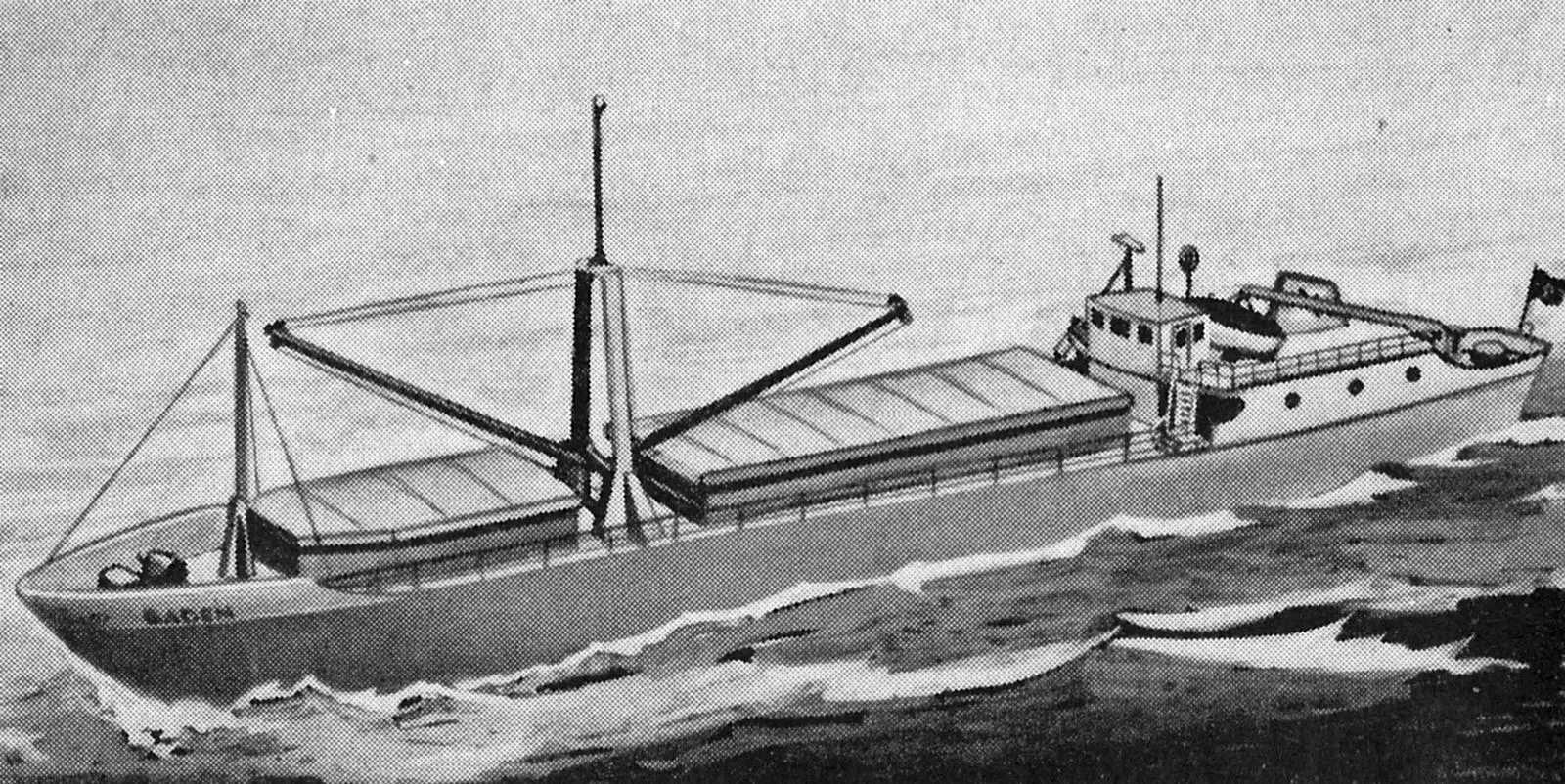
First of an interesting class of small cargo vessel was under construction at the Trondheim yard in Norway for owner Fred. Olsen, for North Sea and Rhine service. The design brief was to achieve the maximum possible hold capacity while keeping below 299gt, the maximum allowable for operation with a crew of seven. The ship would be able to carry 65,000ft3 of grain, around 10% more than other ships of equivalent tonnage. The 825dwt Baden was just 58m long and 10m in the beam, and featured a lifting and lowering mechanism for the bridge, for Rhine operation. The ship was powered by a 12-cylinder 800bhp Caterpillar engine.
Finally, the April 1966 issue included the annual supplement of ships on order, indicating that nearly 2,000 vessels totalling over 42 million tons were the subject of contracts at worldwide shipyards. All but 128 were diesel powered, and 39% of the tonnage was being built in Japan.
Related Articles
 ALTERNATIVE FUELS & LUBRICANTS
 ALTERNATIVE FUELS & LUBRICANTS
 OPINION