



A novel design goes chasing the surveys
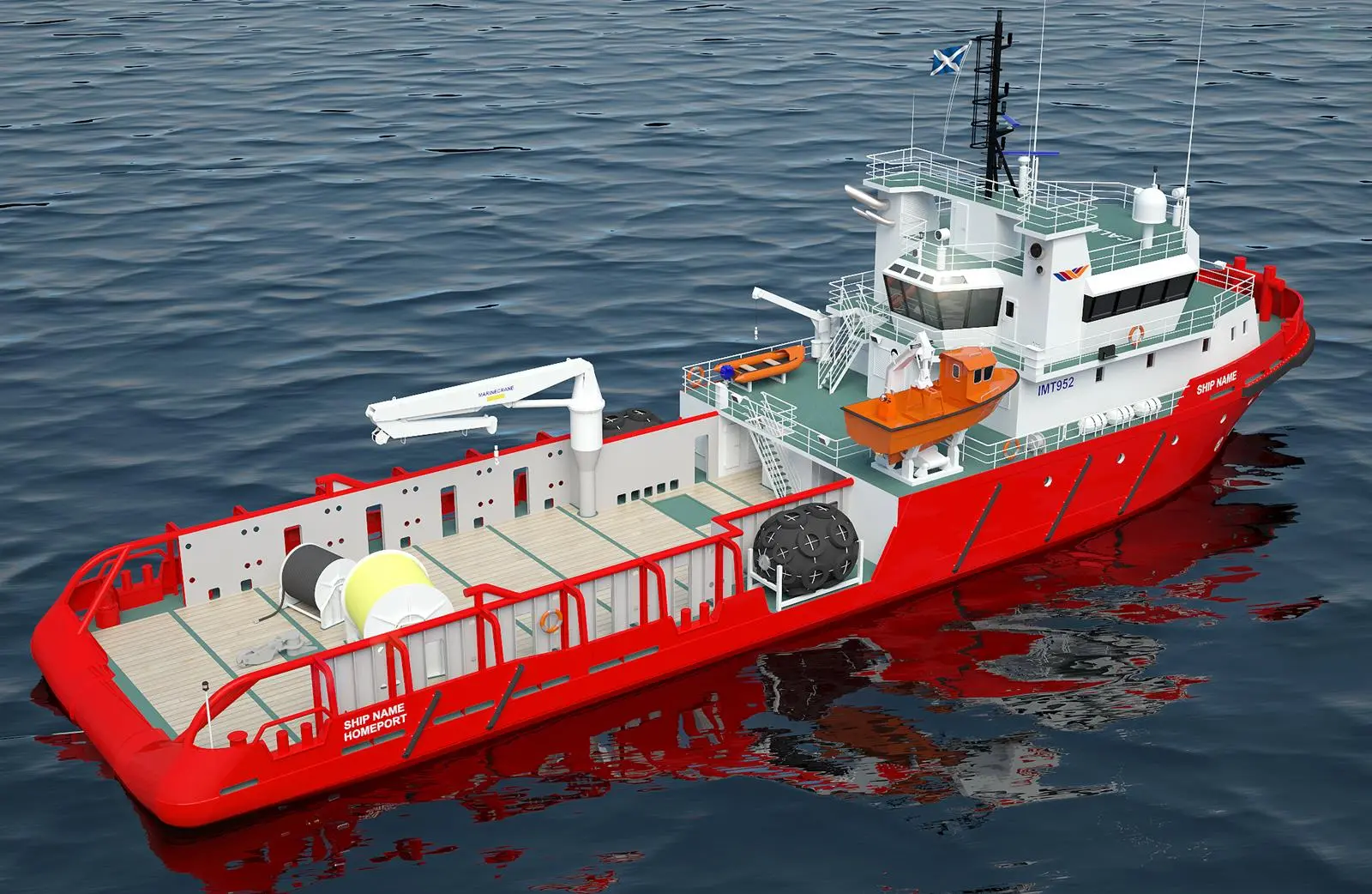
Firstly, they have to be able to get onsite quickly and then escort the stately 5 knot survey vessels as they pull their long streamers behind them, keeping an eye on other craft in the area and sometimes going ahead to give them warning of what’s coming through. During a voyage they also provide cargo supply from port to the mother ship; including refrigerated stores, general cargo, fuel transfer and transfer of crew to and from the mother ship. They perform streamer cable retrieval and some mother ship towing operations.
“Obviously if you have a simple job to do you can configure the engine efficiency around it, but this kind of work isn’t simple. This leaves chase & support craft with a peak at two extremes to account for; one with a large power requirement, the other really quite small,” says Mr Richards.
OSD has developed various Seismic Support Vessel (SSV) designs to meet the needs of charterers. Most are required to be under 54 metres length overall. OSD have variants with conventional diesel propulsion, diesel electric and hybrid propulsion. Design options include CLEAN design and Ice Class Notation.
The first of a series of six of a variant of OSD’s IMT952 SSV design – presently under construction at Dubai’s Grandweld Shipyards for French offshore major Bourbon – has already been launched and named Bourbon Petrel.
To fulfil the diverse propulsion requirements these vessels are fitted with a hybrid propulsion system: the 53.80 m vessels have both conventional diesel propulsion and electric motors to cover the wide range of operating requirements from slow steaming during chase operations through to high speed transit, and bollard pull duty.
This is a true ‘parallel’ hybrid diesel electric configuration, with the main pair of 1,175kW propulsion engines feeding two controllable pitch propellers in nozzles, via vertical offset reduction gearboxes. The gearboxes are fitted with a secondary ‘power take in’ (PTI) input which is coupled to the pair of electric motors.
The electric motors can be used by themselves, drawing power from the three auxiliary generators for slow speeds, or in combination with the main diesels as a boost mode for top speed and maximum bollard pull. For normal steaming, the ship runs on the main diesel engines with the PTI clutched out. Slow steaming forms a large proportion of the vessel operating profile, so the efficiency offered by this solution is significant.
This configuration gives you in excess of 11 knots in the faster diesel mode and, with the help of the electric motors, a bollard pull of 50 tonnes. It also gives you a good 6 knots for the slower escort duties while under electric drive only – plus of course significant fuel savings and an increased level of flexibility and redundancy. Reduced running hours on the main diesel engines can lead to reduced maintenance costs.
However, it’s not just the propulsion that needed attention, the supply side has also caused its own problems and packing it all in under Bureau Veritas rules has given OSD a few knotty design issues.
For example, this latest generation of SSV vessels are also breaking new ground carrying out replenishment-at-sea refuelling operations under Bureau Veritas’ new Supply at Sea Seismic Support notation. This requirement nudges up the capacities onboard: although the support vessel has very similar requirements to a small platform supply vessel with a big 240 square metre open deck area, a deck cargo load of 100 tonnes plus 105 cubic metres of potable water, the oil capacity was what gave the trouble as the amount of deliverable fuel oil was pushed it close to the 1,000 cubic metre mark.
Accommodating this quantity of fuel in a hull restricted to less than 54metres length overall proved a tricky balancing act. The tank arrangement needed to provide sufficient ballast capability to counteract the reduction in weight once fuel has been delivered.
Mr Richards explains: “The tricky part has been keeping this compact design in line with the Supply Vessel notation.”
The BV Notation has strict requirements where fuel is concerned and the amount to be carried created significant design issues such as not being able to carry cargo fuel below the accommodation block or against the bottom shell.
“However, we found some workable ground with Bureau Veritas,” says Mr Richards. Although it meant putting in a few design alterations, for example secondary means of venting and arranging direct to deck access to all cargo tanks and a separate cargo pump room with direct to deck access, it finally led to the vessel gaining a Class BV +1Hull, +Mach + AUT-UMS, Supply Vessel/Tug/ Supply at Sea for Seismic Support, Unrestricted Navigation.
Mr Richards is happy about the result. “Since we have carved a way through the regulations I’m sure others will follow. And when you put out a new type of design, you always gain a bit of interest, simply because you have seen what the pitfalls can be.”
Related Articles
 PROPULSION
 GENERAL NEWS
 HYDROGEN