



A Sea Change In Regional Box Trade
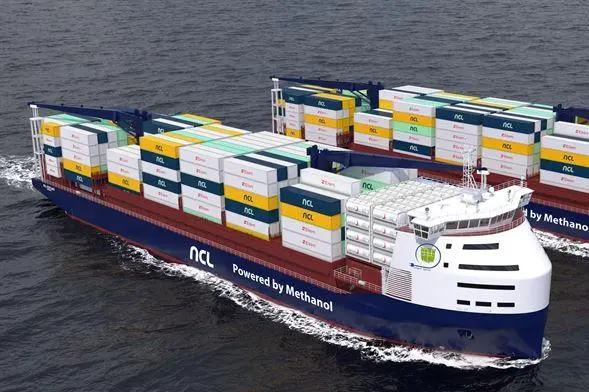
The project for the 1,300TEU-capacity, geared vessels is distinguished by long-term commitments on the part of the multiple interests involved and a common, ultimate goal of decarbonisation.
The shipbuilding contract was awarded to Taizhou Sanfu Ship Engineering of China by Oslo-based MPC Container Ships (MPCC), on the strength of 15-year charters to Norwegian logistics company NCL. The agreement with the container line is in turn backed by contracts of affreightment (COAs) from various parties, including a 15-year deal with Norwegian industrial group Elkem.
The ships have been laid down at Taizhou Sanfu’s facilities on the banks of the Yangtze River and are expected to start shipments originating in Elkem’s Norwegian plants during the first half of 2025. Chinese-owned, Oslo Stock Exchange-listed Elkem has a 40% stake in NCL. Ownership of the two newbuilds will be vested in MPCC to the tune of 90.1%, with the 9.9% balance of shares held by Topeka MPC Maritime. The latter is a joint venture of the Wilhelmsen Group’s zero-emission shipping arm Topeka Holding and MPC Capital.
Configured with bridge and superstructure forward, and affording self-sustaining properties by virtue of two centreline-mounted deck cranes, the new-generation carriers will be technically-husbanded by Wilhelmsen Ahrenkiel Ship Management. Run from Hamburg and also Rhoon, in the Netherlands, and focused on container ships, the company’s shareholders are the Wilhelmsen Group and MPC Capital. The project will place the firm in the vanguard of managers to gain experience and competence running boxships on methanol as the main fuel.
The primary role of the new vessels will be in enhancing the short-sea logistics of Elkem, a leading manufacturer of silicon-based materials, transporting goods on liner-type services linking north, mid and west coast Norwegian outlets with ports in the Netherlands and Germany. With a design dimensioned to carry a maximum of approximately 18,000t of containerised cargo, the newbuild pair will supersede three existing diesel-engined vessels in the NCL fleet.
Each will be powered by an LGIM-series, methanol dual-fuel engine developed by MAN Energy Solutions. The six-cylinder S50ME-C9.6-LGIM type has been specified at an output of 9,540kW. The particular model, at 500mm-bore size, has the longest service record within the methanol-capable two-stroke offering, having provided the first references for LGIM technology by way of installations in chemical/product tankers ordered for worldwide trade in methanol cargoes in 2016.
Although operation on methanol requires a pilot fuel, be it HFO, MGO or MDO, as an ignition enhancer, and while an LGIM engine running on fossil fuel-based methanol achieves a substantial reduction in noxious emissions and a CO2 abatement of at least 10%, the opportunity such a plant offers in meeting decarbonisation goals is a fundamental attraction. “These state-of-the-art vessels will further increase our efficiency through increased capacity and can potentially cut net CO2 emissions from 45% up to 100% through the use of ‘green’ methanol,” stated charterer Elkem’s CEO Helge Aasen.
As part of its climate project portfolio, one avenue of Elkem’s studies is an investigation into the potential for capturing CO2 from its Norwegian production plants and turning the CO2 into methanol for downstream use.
While the two-stroke engine affords flexibility in fuel usage, NCL is unequivocal as to operational intent: “Methanol will be default choice, and if our customers want to go the slightly cheaper route, using diesel, they will have to explicity state that.”
For the selected onboard powering solution, achievement of full CO2-neutrality could feasibly entail substitution of the pilot oil fuel by any renewable alternative, such as biofuel or Power-2-X diesel.
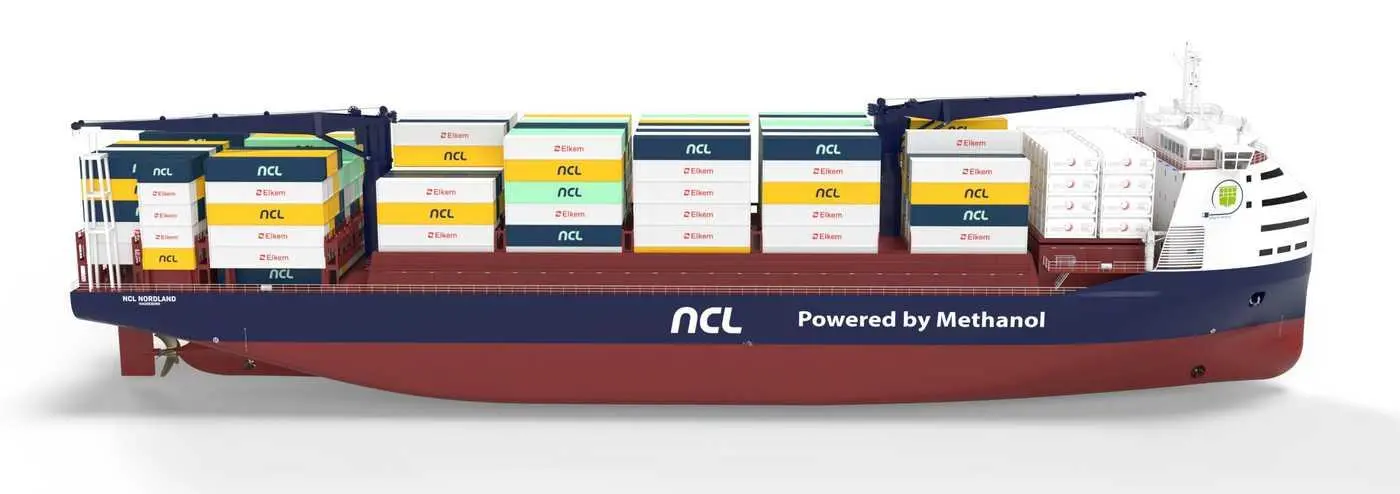
Berg Propulsion of Sweden is supplying each vessel’s directly driven controllable pitch propeller, type MPP 1410, and the interposed PTO/PTH shaft generator. The Berg shipset also comprises an MTT-series 1,200kW fixed-pitch bow thruster and 800kW FP stern thrust unit, a DC hub with a bank of batteries for peak-shaving, and complete electrical package including the energy management system.
The fact that today’s lauded environmental, social and governance(ESG) aims figure prominently in the corporate strategies of the project’s stakeholders has had a signal bearing on grant funding allocations for the fleet investment. An award of NOK13.7m ($1.3m) has been made by the Norwegian Ministry of Climate and Environment agency Enova, and NOK60m ($5.6m) has been forthcoming from the Norwegian business sector’s NOx Fund.
Related Articles
 METHANOL
 METHANOL
 2-STROKE & 4-STROKE