



ABC Engines introduces 100% hydrogen combustion engines
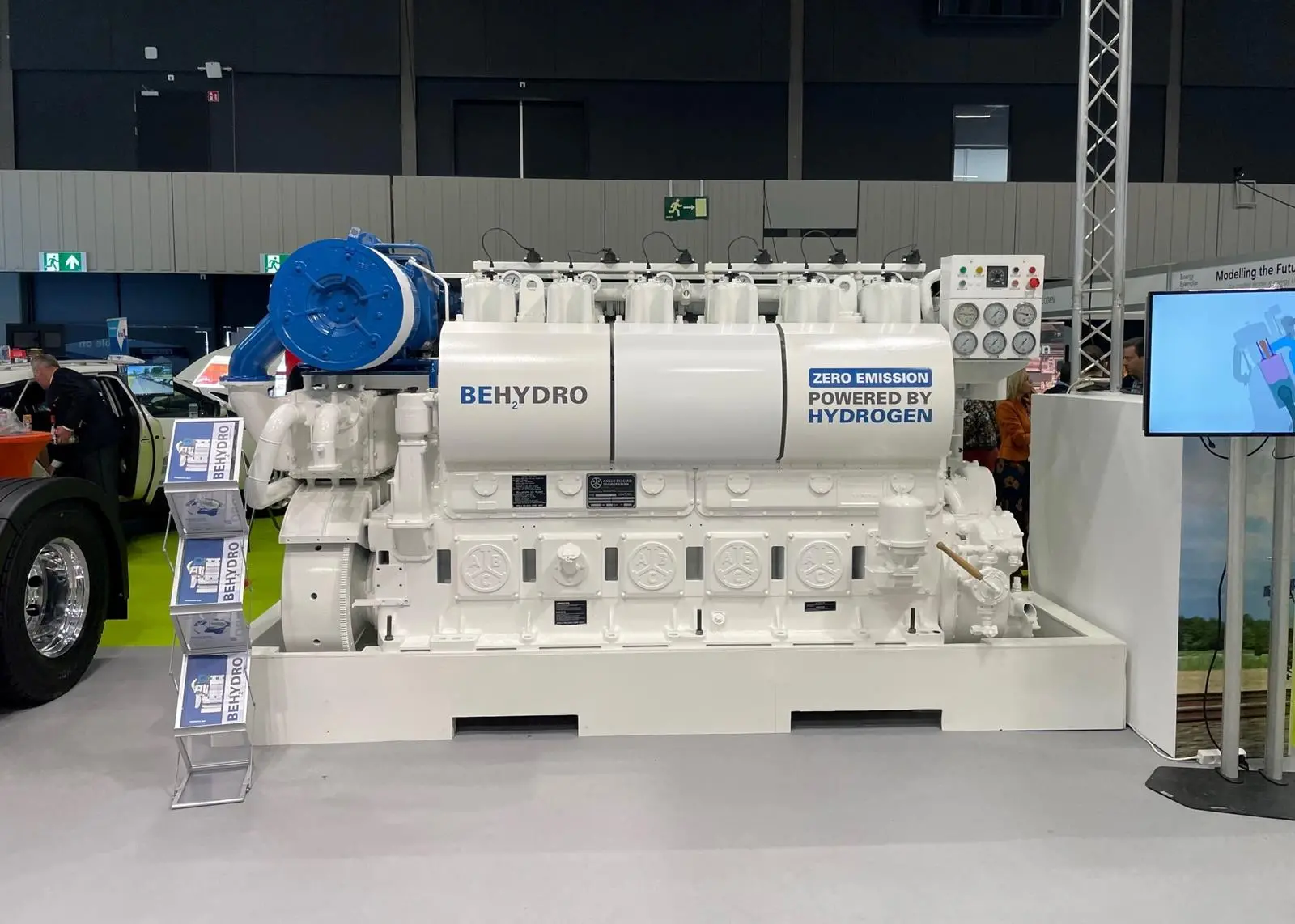
The launch of the 100% hydrogen engine comes after BEHYDRO, a joint venture between ABC and CMB, launch its dual-fuel engines in September 2020. Operating on 85% hydrogen gas and 15% conventional fuel, these engines can be used flexibly when hydrogen is unavailable.
The 100% hydrogen engines have a power range from 1MW to 2.6MW and are available in 6- and 8-cylinder in-line engines and 12- and 16-cylinder V-engines.
A 1MW BeHydro hydrogen-powered engine reduces CO2 emissions by 3.500 tonnes per year (or the equivalent of 300 hectares of forest) and produces as much energy as one 3MW wind turbine or 36.000 solar panels.
BEH2YDRO says these engines emit no harmful emissions such as carbon (CO2), nitrogen (NOx), sulphur oxides (SOx) or soot particles. In addition, they are non-toxic, don’t use scarce raw materials such as lithium, zinc, cobalt, platinum, rare earths, avoid environmental damage caused by the extraction of scarce raw materials and the by-products are completely safe (the emissions consist of water vapour and aspirated air).
They are easy to maintain and have a long service life thanks to an optimised air/gas mixture that reduces component heat-up. In addition, the BEH2YDRO hydrogen engines are extremely versatile because they don’t experience problems if slight impurities are present in the hydrogen.
The engines feature a double-walled hydrogen connector and a cylinder design where the piston head lacks the typical hole used to raise it. Instead, a different raising mechanism is employed and the piston head is uniquely shaped to avoid overheating.
“With the launch of this monofuel hydrogen engine we are taking an important next step in the development of our BEH2YDRO engines. BEH2YDRO can now supply both dual fuel and mono-fuel hydrogen applications for a wide range of heavy industrial applications such as shipping, gensets, locomotives, etc. Thanks to BEH2YDRO we can already green a large part of the off-grid industry today,” said Alexander Saverys, CEO of CMB.
A new breed of cat
In May, CMB.TECH and Windcat Workboats announced that the world’s first hydrogen-powered crew transfer vessel (CTV) Hydrocat 48 had completed sea and bunkering trials. The vessel uses clean fuels to reduce up to 80% of its traditional fuel usage and associated emissions.
The Hydrocat 48 is based on the Windcat MK 3.5 design. These vessels can also be used for a range of activities, supporting both construction and the operation and management of an offshore wind farm, such as emergency response, standby, survey and dive support vessels.
Dual fuel technology has been integrated into the MK3.5 series without compromising on performance and retaining the reliability of a traditionally fuelled vessel, says CMB.TECH.
CTO of CMB.TECH Roy Campe said: “The suitability of this technology for a CTV is mainly because existing diesel engines can be used. No fundamental changes to the main engine are required, which not only means that maintenance and repair remain simple but also that the engine can easily be switched back to diesel fuel without any modifications. Even if hydrogen is not available, the vessel can continue to run on traditional fuel, making it a very robust and reliable solution for the offshore wind industry.”
The base dual-fuel 749kW engine installed on the vessel was manufactured by MAN Energy Solutions and retrofitted by CMB.TECH with a hydrogen injection system which injects hydrogen in front of the intercooler. The operating behaviour, fuel consumption and all other characteristics of the engine correspond exactly to the MAN D2862 LE428, a V12 diesel engine with a displacement of 24 litres.
A precisely measured quantity of hydrogen is added to the charge air. This mixture of hydrogen and air is then ignited with the injected diesel fuel in the combustion chamber of the cylinders. Depending on the engine’s operating point, only a very small amount of diesel fuel is needed. The diesel injection parameters are optimised in dual fuel mode to achieve the lowest emissions and the best consumption values.
Therefore, in dual fuel mode, considerably less CO2 is released in the exhaust gases in circumstances where operating behaviour and full load characteristics remain unchanged. In the event of problems in the hydrogen circuit or a depleted hydrogen supply, a switch back to diesel can be made at any time. This guarantees uninterrupted operation with normal reliability.
CO2 emissions are reduced by up to 85%. The remaining soot particles and nitrogen gases (NOx) are removed by a particulate filter and SCR system so that the latest and strictest emissions standards worldwide are easily achieved. Irrespective of the operating mode, the limit values according to IMO Tier III are complied with.
MAN notes that all hydrogen carrying components are double walled, and a hydrogen monitoring system will detect leaks immediately. The venting system will evacuate the leaked hydrogen, supply to the engine will be cut and the engine will return to diesel mode without interrupting power supply.
CMB.TECH and Windcat Workboats are working on the further optimisation of engine capacities and the increased use of the hydrogen percentage. The two companies have also developed solutions for the supply of hydrogen to the vessel taking into account the early phase of hydrogen bunker fuel development. CMB.TECH has designed a 40ft 500bar trailer for refuelling multiple applications, so all customers can be served by the one system, which can also support the Hydrocat.
Windcat, together with its joint venture partners TSM and FRS, has three more vessels under construction that can be delivered with the hydrogen technology on board. More CTV designs are being developed.
Safety learning curve
CMB.TECH was the first to build a hydrogen-powered passenger shuttle, the Hydroville, in 2017. The 14 metres long vessel has a displacement of 14 tonnes, a top speed of 27 knots and can run on diesel if necessary.
“The Hydroville was an important first step,” says Campe. “It took a lot of pioneering work to get the ship up and running. For example, in close cooperation with a team of engineers from Air Liquide, we developed a system to refuel with hydrogen. There was nothing like it in the port of Antwerp. The hydrogen was initially stored in a tube trailer parked on the quayside, but we’ve since then installed a fully-fledged hydrogen refuelling station on the premises. We use it not only to bunker the Hydroville, but also to refuel our own staff’s hydrogen-powered Toyota and Hyundai cars.”
Next will be the first tugboat in the world with 2.6MW, V12 BEHYDRO engines burning 85% hydrogen in combination with 15% diesel. The 65-tonne bollard pull Hydrotug has been ordered by the Port of Antwerp.
Both the Hydroville and the Hydrocat were built to Lloyd’s Register class, and the Hydrotug will be also. Decarbonisation Business Development Manager, Peter Van de Graaf, has been involved in all three projects and is positive about the development process, even though “the industry is on a steep learning curve with more knowledge gained from each project.” The knowledge is spread around, and it is always important to listen to everyone when considering safe designs.
Hydrocat has its compressed hydrogen fuel stored in tanks on deck. Van de Graaf believes that compressed hydrogen can be cost competitive on certain vessels, compared to liquified hydrogen as it is simpler and cheaper to store, without the need for vacuum insulated tanks and liquification of hydrogen, which is energy intensive. Hydrogen can be used safely onboard, it is very volatile as a gas compared to LNG, therefore new interpretations of ventilation for safety are required. Hydrogen has about a third of the energy density of diesel oil, so if an onboard fuel pipe were to break due to fire, any explosion would be short-lived and not release a lot of energy. A limited amount of hydrogen would remain in the pipe after a shutdown of the hydrogen system.
Van de Graaf is keen for the industry to keep moving forward. “We need significant research to find more specific engineered solutions to ensure safe deployment. Hydroville was delivered in 2017, so it’s taken five years for the delivery of the next vessel, Hydrocat. We are already in 2022, and 2050 is not that far away.” Key to more rapid development, he says, is hydrogen-specific updates to the IGF Code, the use of alternative fuels is regulated but the regulations are not prescriptive. “Moreover, we need collaboration at all levels to advance the industry towards defined requirements, standards, and more commercially viable solutions.”
Related Articles
 2-STROKE & 4-STROKE
 2-STROKE & 4-STROKE
 2-STROKE & 4-STROKE