



ABS verifies design for LH2 carrier
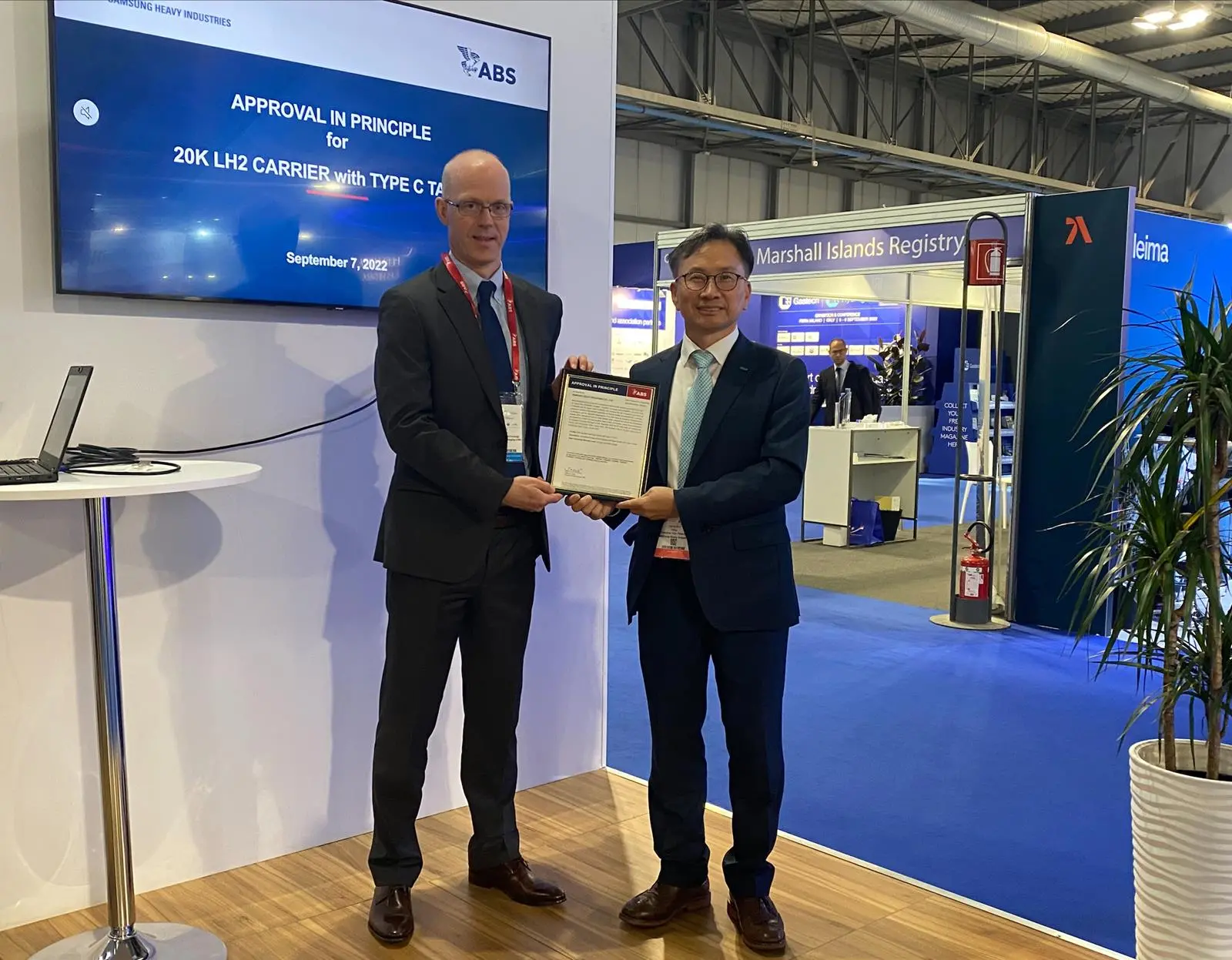
The AiP was the culmination of a joint development project to review various elements of the vessel design including Type C cargo tanks, cargo handling and fuel gas supply systems.
“SHI has secured key technologies for the design of liquefied hydrogen carriers from recent development projects and is preparing for the future liquefied hydrogen carrier market through detailed design development and verifications,” said Young-Gyu Kang, SHI Executive Vice President, CTO.
“As the hydrogen value chain develops, shipping will have a critical role to play. By supporting the safe and efficient transport of hydrogen at sea, ABS is also playing an important part in the energy transition,” said Patrick Ryan, ABS Senior Vice President, Global Engineering and Technology.
ABS recently introduced the Net Zero Navigator, a design for a liquid hydrogen carrier, approximately 80,000 m3 in capacity. The design’s large spherical hydrogen storage tanks were developed by NASA, along with its hydrogen fuel cells and batteries, which were used for power generation on the space shuttle.
In 2021, ABS granted AiP for the design of the world’s first compressed hydrogen ship with a 430-tonne capacity to Australian energy company Global Energy Ventures (GEV), now Provaris. This pilot-scale vessel follows AiP received for a 2,000-tonne capacity design.
ABS has stated that hydrogen should not be seen just as a molecule of the periodic table or only as a single marine fuel. “It is a medium which could be converted into different forms as an energy carrier. Renewable energy via electrolysis can be converted into hydrogen, an energy carrier which could be stored and transported by sea. It can also serve as a medium which can be the building block for green and e-fuels, minimizing the use of fossil fuels.”
Furthermore, the role of hydrogen as a marine fuel is expected to have a significant effect on the emerging energy transition. The ABS publication Setting the Course to Low Carbon Shipping: Pathways to Sustainable Shipping has categorized the available maritime fuel options for decarbonization. Among them, LH2 or gaseous H2 offer ship owners and operators a low-carbon and low-emission fuel option for potential use in internal combustion engines and fuel cells.
Related Articles
 ALTERNATIVE FUELS & LUBRICANTS
 ALTERNATIVE FUELS & LUBRICANTS
 ALTERNATIVE FUELS & LUBRICANTS