



ACCURATE MODELLING FOR HYBRID-SUPERCAPACITOR POWER SYSTEMS

Supercapacitors are suited to applications that require high power and constant cycling. Batteries are typically able to store more energy, but capacitors can release energy more quickly. With near-instant charging and discharging they offer faster reaction time than batteries. As energy is stored in an electric field rather than chemically, supercapacitors have very low internal resistance and work at close to 100% efficiency. They are also highly reliable, can operate in extreme temperatures and can operate for over 15 years without maintenance.
Skeleton Technologies claims the highest specific energy density on the supercapacitor market, achieved using its proprietary Curved Graphene nano-technology. The company says its ultracapacitors are capable of over one million charge cycles, operate at near full efficiency even in extreme temperatures from -40°C to 65°C, achieve up to 60 times the power density of batteries, are 30% more efficient than batteries and contain no lithium, cobalt or other harmful materials.
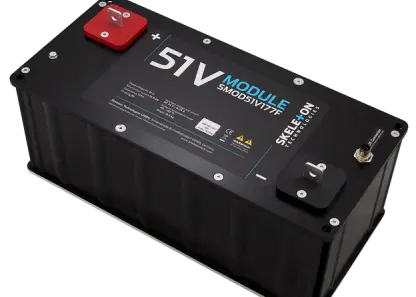
The company’s 51V module can be used in series for applications requiring up to 800V, says Dr. Sebastian Pohlmann, VP Automotive and Business Development. He says the power electronics systems available today are capable of handling capacitors in hybrid power systems, but they need not be complex. A direct parallel connection with a battery can perform functions such as peak shaving. This means the battery lives longer and has reduced risk of thermal runaway. Adding a supercapacitor also means that the battery no longer needs to be oversized to cover such peaks, saving space and money.
Skeleton Technologies and its Norwegian partner NXTech launched a joint project in February aiming to develop marine-certified ultracapacitor modules to be initially used in active wave heave compensation (AHC) systems suited to offshore operations. Batteries have been used to power such systems, but they have a relatively short lifetime, down to a few months, due to their limited cycling. Pack sizes have also been unmanageable due to the power density required to perform AHC functions.
The use of Skeleton’s ultracapacitor technology for AHC can reduce energy demand by 75%. The project aims to develop a marine-industry specific ultracapacitor module that has more than double the power density of ultracapacitors currently on the market, and it is expected to be ready for series production in March 2022.
Next generation supercapacitors
Supercapacitors are suited to supporting other shipboard operations that might require short power peaks or cyclic events, says Pohlmann, including winch operations and engine starts, and alongside development work with this existing technology, Skeleton Technologies is now developing a new system. “Our Curved Graphene technology has already improved energy density by a factor of two to three. With graphene, we are pretty close to the theoretical limit for the surface area of the electrode, so a few years ago we decided to develop a new kind of chemistry. That has now made the jump out of the lab to industrialisation. We call it a superbattery, and it is a combination of energy and power which has never really been seen before.” The superbattery will have 10 times the energy density of current technology. It combines the high energy density of batteries with the high power density of supercapacitors to give a system that has both characteristics and can be charged in as little as 15 seconds. It is expected to reach the market in 2023.
Kawasaki Heavy Industries (KHI) and Corvus Energy have addressed the issues of battery size and life in offshore operations with the development of a lithium-ion capacitor system that the companies say can deliver beyond a million cycles with minimal capacity loss. The system incorporates lithium-ion capacitor cells into an energy storage system with high-efficiency liquid cooling that maintains an optimal temperature range at the system’s very high root means square current and charge/discharge rates. Type approval was obtained from DNV in 2020. Corvus now sells the energy storage system to offshore vessels and platforms globally, while KHI is now in discussion with shipowners of other vessel types.
Sean Puchalski, EVP of Strategy & Business Planning for Corvus Energy, said: “The new cutting-edge technology provides the best of both worlds: current-handling performance nearing a supercapacitor with improved energy density. It will enable our offshore customers to cost-effectively improve efficiency through energy recapture from heave compensation, drilling draw works and payload lowering applications with a lightweight, space-saving footprint.”
Supercapacitors in hybrid systems
Meanwhile, the role of supercapacitors is being evaluated in hybrid power systems. Members of Korean Register (KR)’s System Safety Research Team evaluated the impact of using a battery-supercapacitor hybrid system to replace a diesel generator on a 50,000dwt bulk carrier. The modelled vessel had a diesel main engine and three diesel generators, four electric deck cranes and electric winches. Four operational modes were evaluated: seagoing mode, port in/out mode where the heaviest loads are the mooring winches and ballast pumps, cargo loading/unloading where the heaviest loads are the cranes and ballast pumps and harbour mode where the heaviest loads include the air conditioning compressor.
In their analysis, one generator was replaced by lithium-ion batteries supercapacitors, and another generator was downsized from 700kW to 500kW (to increase fuel efficiency in seagoing mode). The battery was selected for use in port in/out mode, and the supercapacitor was selected for cargo loading/unloading operations. If the supercapacitor pack was discharged, it was assumed to be charged from shore power within about 20 seconds with a high C-rate for the next cargo operation.
“The supercapacitor can be charged from regenerative energy during crane lowering operations (luffing zip down and lowering cargo operation) which occur repeatably for cargo operation modes. However, the regenerative power is not sufficient to charge the supercapacitor fully, so its energy can be supplemented by shore power,” says Kyunghwa Kim, Senior Researcher, System Safety Research Team at Korean Register.
“When it comes to regenerative energy, each electric motor acts as a generator in some cases. For example, when a crane lifts a load, the motor requires energy. However, when the crane lowers the load, the weight of the load makes the motor rotate, and generates electric energy. Conventionally, the energy is consumed as heat by braking resistors. However, as the technology develops, regenerative energy could be stored and reused by using the energy storage system, mostly the lithium-ion battery.” In these operations, Kim says, the lithium-ion battery is not affected by the supercapacitor, because these two systems could be operated independently.
Analysis reveals cost sensitivity
The bulk carrier modelling indicated that the hybrid system could reduce CO2 emissions by 77% during cargo handling and harbour modes, SOx emissions could be reduced by 93% and NOx by 99%. However, the emission reduction rate for seagoing mode and the port in/out mode were under 10%, and the emission reduction rate is variable depending on a ship’s schedule.
Kim describes the potential benefits of having supercapacitors onboard: “The supercapacitor can respond to peak loads under heavy weather conditions. Therefore, the capacity of the lithium-ion battery may be reduced when using the supercapacitor as a sub-power source. Moreover, in the battery-supercapacitor hybrid system, the battery may not face severe load fluctuations, and hence increases its lifetime (measured in charge/discharge cycles), thereby enabling extension of the replacement period of the battery. Further, by integrating the supercapacitor with the battery, thermal management problems may be solved by preventing the battery from reaching high temperatures during operation.”
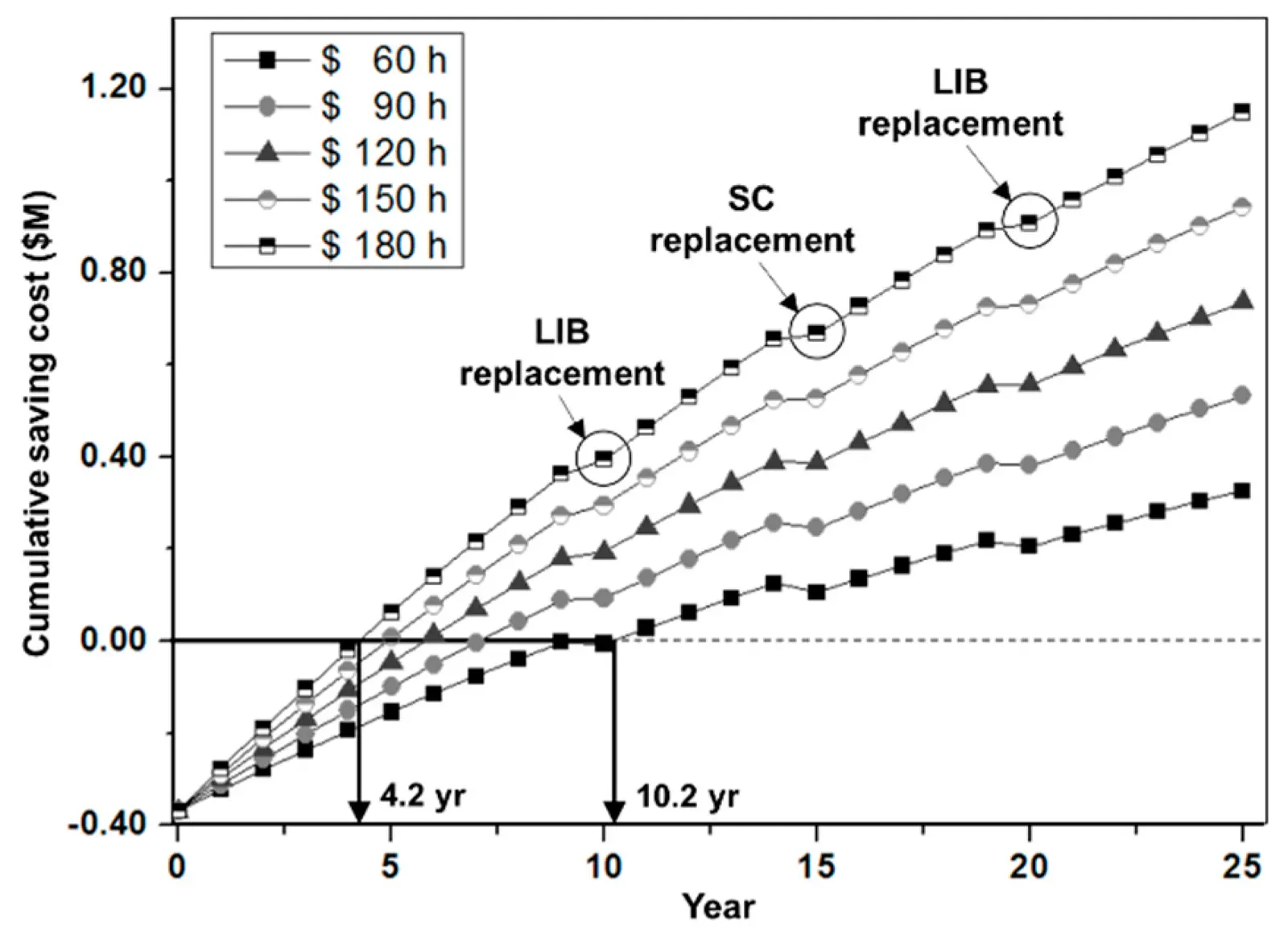
In the case of the bulk carrier, the researchers concluded that battery-supercapacitor hybrid systems can have a short payback time on ships that have long cargo handling time or visit many ports with a short sailing time. Fuel savings of up to 60.2% were achievable, based on some assumptions. However, payback time varied significantly, ranging between four and 10 years depending on electricity and fuel costs. These costs were more critical than the initial investment in the battery and supercapacitor which had a life span of 10 and 15 years respectively.
Kim says the supercapacitors could also be beneficial on drillships, offshore support vessels, crane vessels, and more, for cargo cranes or thrusters used for dynamic positioning. “Typically, ship manufacturers oversize the main power sources (i.e. generators) to compensate for peak loads. However, supercapacitors deliver high-density power to meet the periodic peak requirements, thereby reducing the capacity requirements of onboard generators.”
In addition, lithium-ion batteries have poor performance at low temperatures, however, supercapacitors can maintain excellent performance even when operating at extremely low temperatures, says Kim. Therefore, ships that sail in the Arctic and Antarctic can benefit from the superb operating temperature performances of supercapacitors. Generally, the discharge temperature range of lithium-ion batteries is around -20°C to +60°C, and for supercapacitors it is around -40°C to +65°C.
Supercapacitors can also be used to the start-up of fuel cells more quickly than can be achieved with batteries. “Further, supercapacitors could be used to satisfy dynamic load demands, which may help lengthen the lifespans of the fuel cells.” However, Kim warns that the cost of supercapacitors is much higher than that of lithium-ion batteries. Therefore, comprehensive reviews of a supercapacitor’s characteristics are needed when planning the energy storage needed on a ship.
Non-linear supercapacitor capacitance
Researchers at Leibniz University Hannover in Germany evaluated the economics of a battery and supercapacitor system used to support a solid oxide fuel cells and found simple modelling principles to be lacking in articles with a marine context. Fuel cells have power gradient limitations that require support with fluctuating load profiles, such as manoeuvres involving bow thrusters, and a hybrid system with battery and supercapacitor can fulfil that role, with the supercapacitor proving itself economical over a wide range of model situations. However, the researchers claim that while simple modelling was effective for a lithium-iron-phosphate (LFP) battery, the non-linear behaviour of supercapacitors needs to be considered with care when designing a power system.
“While Lithium-ion batteries tend to have a rather steady voltage plateau for different states of charge (in this case only a slight increase of around 3.3V for each cell between 10-90%), supercapacitors’ voltages increase non-linearly while charging,” says researcher Lukas Kistner. “A state of charge-independent current limitation prohibits high charge/discharge power for lower states of charge. More straight forward storage modelling cannot represent this behaviour, which results in wrong capability estimations.” He proposes that, in addition to the state-dependent power limitations, the changes in the supercapacitor’s capacitance (in Farad) with cell voltage should be included.
A two-step design decision process was undertaken in the study, firstly to decrease the size of the fuel cell power source as its specific power is more expensive than batteries or supercapacitors. Secondly, the evaluation of two optima for a storage hybridization: the optimum where neither power nor capacity are oversized, and the cost optimum, where the configuration depends on the components’ lifetimes. “Increasing the battery storage size influences its degradation more heavily than it is the case for supercapacitors. In this case, larger total storage power in combination with the supercapacitor support leads to the lowest found annual system costs,” says Kistner.
Overall, the study, part of the MultiSchIBZ research project, showed that optimal configurations are heavily dependent on the ship’s load profile characteristics. “Ship power system design is commonly based on rules of thumb and results in oversizing more often than not. We can recognise a trend towards hybrid ships where good design decisions will be even harder to achieve this way. I believe that model-based and time-dependent calculations will become very important to maximize economic advantages.”
For different fuel cell types and fuel combinations, it is important to look at the different maximum power gradient capabilities, says Kistner. A faster reaction time/load shift decreases the required storage capacity, because a load following operation will be easier to accomplish. However, storage support will still be required for the foreseeable future.
Capital and lifetime costs can be important. “Supercapacitor cost increases could come with higher maximum current, specific storage capacities and lifetime guarantees. For example, in the presented cargo ship case, supercapacitors with higher specific power would not really benefit this particular hybrid storage, because in a cost-optimal configuration the total storage power is oversized for the application anyway. On the other hand, a cost decrease could be achieved using a cheaper unit with more strict current limitations.”
In a follow-up investigation, the researchers compared the proposed fuel cell system with hybridised diesel and gas internal combustion engines for a cruise ship. The results indicate that the SOFC technology will drastically decrease emissions and also reduce fuel costs significantly due to its better energy efficiency.
Related Articles
 BATTERIES, SUPERCAPACITORS, FUEL CELLS AND OTHER ENERGY STORAGE TECHNOLOGY
 BATTERY HYBRIDS & FULL-ELECTRIC VESSELS
 BATTERY HYBRIDS & FULL-ELECTRIC VESSELS