



Advanced cable layer for ABB
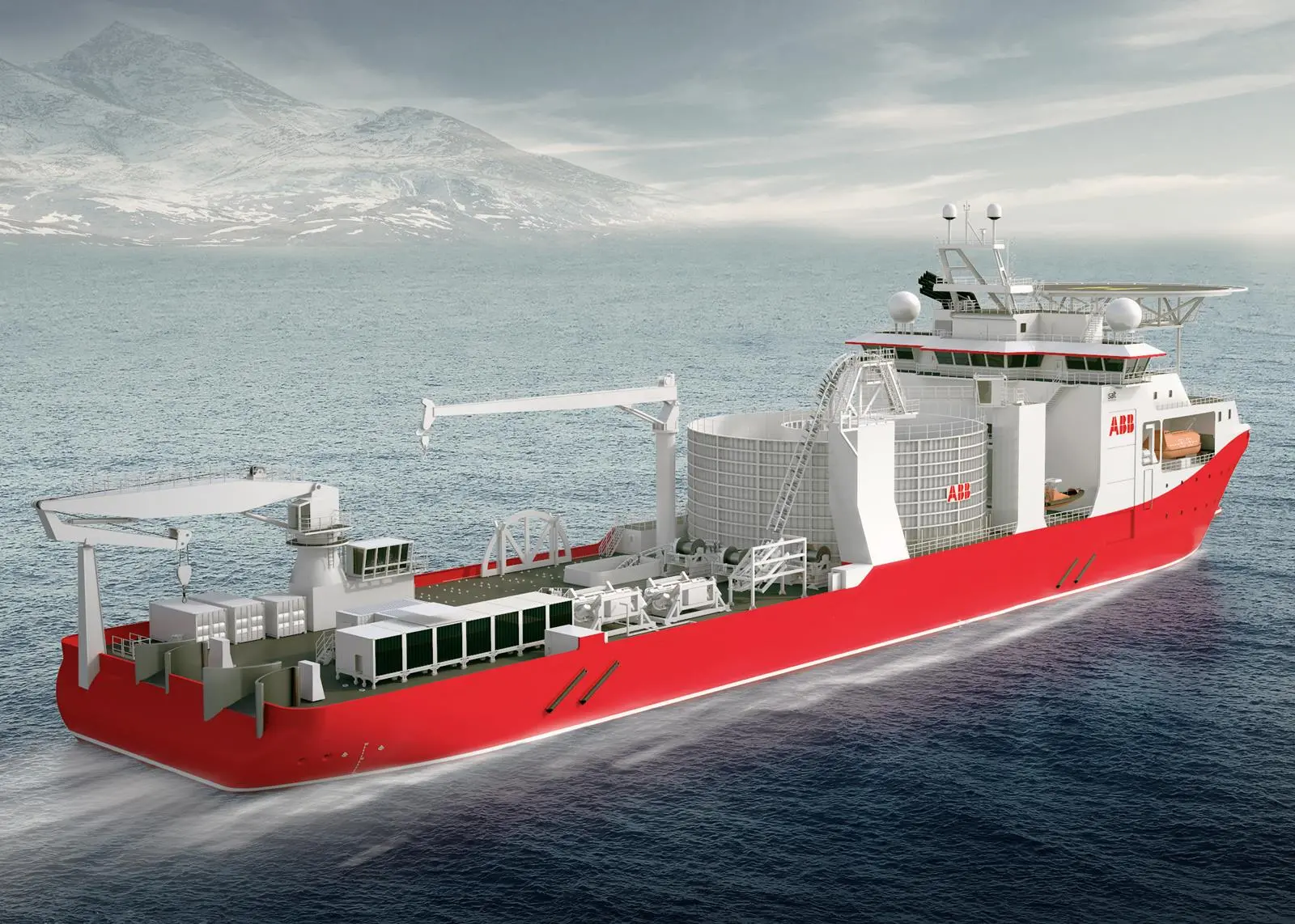
When subsea operator ABB High Voltage Cables wanted a top-of-the-range vessel for its cable laying operations, it discounted two conventional options – there were few cable layers with the capacity it sought, while a converted vessel would not have the optimised, fit-to-purpose performance the company required.
The solution, for the first time in its history, was to become a vessel owner rather than a charterer. The result is an order, due for delivery in 2017, for a high-spec 140m cable laying vessel built to Salt design (306 CLV) by Kleven Maritime. With two carousels of industry-leading capacity, the vessel will be capable of performing AC, DC and fibre optic cable laying and repair anywhere in the world.
Claudio Facchin, president of ABB Power Systems, notes: “This next-generation vessel, incorporating state-of-the-art ABB technologies, will be a key differentiator for our high-voltage cable business. It will also improve operational efficiency and customer focus, supporting profitable growth.”
The fact that ABB High Voltage could rely on the expertise of sister company ABB Marine which will supply propulsion and electrical systems as well as integration, automation and monitoring solutions – was no doubt a major swing point in its decision to build its own vessel. For ABB Marine, the diesel-electric vessel offered another opportunity to deploy its onboard DC grid and power distribution system, a power-saving option that allows propulsion to be driven by a single DC circuit. According to Joar Gjerde, who revealed the technical details of the vessel to press at ABB Marine’s hedquarters in September, it is the onboard DC grid that sits at the heart of the new cable layer.
A diesel-electric propulsion system will drive three Azipod CZ980 thrusters of 1,900kW. The thrusters, each with a thrust of more than 34 tonnes, will enable DP3 operations. Power will be converted into electricity through ABB Marine’s onboard DC grid, which enables variable speed running to optimise engine operation.
The vessel will also feature energy storage in the form of a SAFT VL30Pfe water-cooled lithium-ion battery system, with a maximum continuous rating of 66kW/h. Battery power is intended mainly to assist cable loading operations, which will be primarily driven by shore power (diesel engines must be switched off during loading). In the event of a failure, the battery system’s peak rating of 800kW in 10 seconds is enough to bring the carousels to a controlled stop.
The battery system can also be used for peak shaving (if propulsion power demand meets a temporary surge) and enhanced dynamic response (when propulsion power needs to be increased rapidly). A shore power connection will also be installed, with the vessel’s transformer converting power from a 11kV, 50Hz onshore switchboard to 800V (AC) and then, via the onboard DC grid and an independent rectifier, to 1,000V (DC). The rectifier also allows power to be received either from shore or through the diesel engines.
The vessel will offer around 1,600m2 of deck space, with two large cranes enabling offshore operations if the purpose of the vessel’s work changes. ROV operations, essential for cable laying work, can also be carried out from the new ship.
ABB noted that automation and propulsion systems will be vertically integrated, with the common integration platform provided by its Integrated Automation System 800xA allowing almost every component to be monitored directly or remotely in real time. Other advisory systems include ABB’s Octopus (route planning based on weather forecasting and vessel sensors) and Power Energy Management System to monitor and control battery use. Remote diagnostics, asset optimisation and condition-based monitoring are also enabled.
The DNV GL-classed vessel will feature the same power and propulsion arrangement as installed by ABB on the 90m DP2 light construction vessel Dina Star in April 2013. That vessel, operated by Mycklebusthaug Management, was the first to feature the complete onboard DC grid system.
For Usteinvik-based Kleven, the contract is also an important one, coming in a period of deep uncertainty the offshore vessel market. Ståle Rasmussen, CEO of Kleven, welcomes the deal: “Close cooperation between ABB, Salt Ship Design and Kleven has resulted in a vessel that is future-oriented, competitive and highly innovative. This is a large and very important contract for Kleven, in a time where shipbuilding contracts in general are few. Adding to our order book yet another contract for markets outside the traditional offshore segment is also of great importance.
Steel cutting has commenced at Kleven and it is anticipated that hull modules will be made both in Ulsteinvik and the yard company’s facilities in Poland. Equipment deliveries – including from ABB Marine and fellow Ulsteinvik-based companies Brunvoll and Hareid Group – are expected to begin next year.
Related Articles
 PROPULSION
 GENERAL NEWS
 HYDROGEN