



Advanced propulsion from 1962
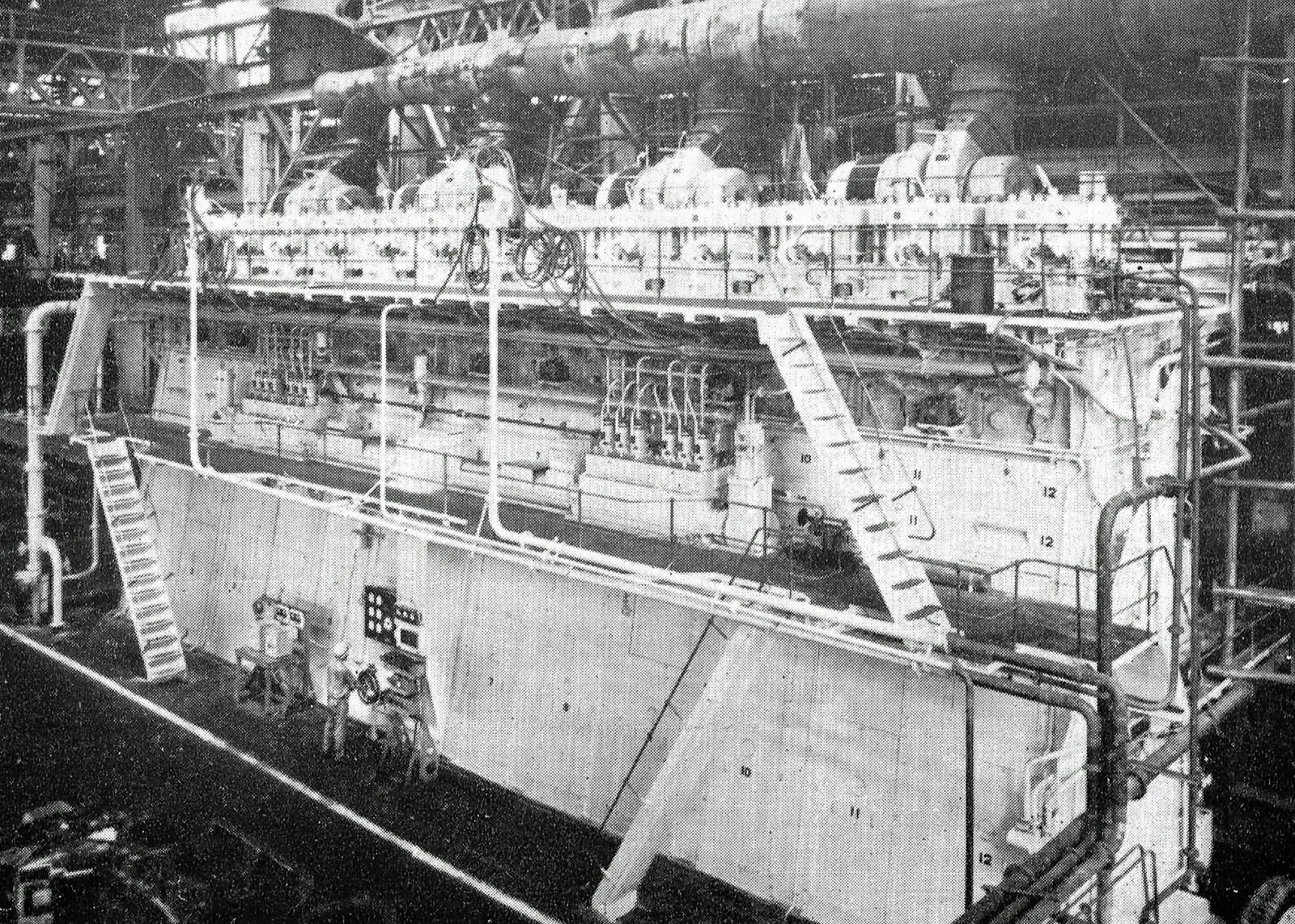
Although the bore diameters, at 840mm to 900mm, were not far off those of today’s large engine, the cylinder output was considerably lower. 1,800 to 2,100bhp/cylinder seemed to be the norm. This was thought to be sufficient to propel the largest tanker then in service or on order – most of which were still employing steam turbine machinery. Only one ship then afloat, a US-owned vessel, had an installed power in excess of 24,000hp; even that ship’s 43,000hp could, it was said, be provided by a twin-screw Diesel installation. Today of course, with the largest Diesel engines capable of MCRs in excess of 100,000bhp, such powers seem modest, though with the drive towards greater efficiency and increased fleet utilisation, they may again become normal. As we now know, it is propeller diameter and draught, rather than engine design, which is the limiting factor.
One so-called large bore engine was described in more detail, being a 760mm bore opposed-piston design from Doxford, which in 9-cylinder form would equal the 20,000bhp output of the competition. Further development over the next decade, said the article, would result in power outputs of 27,000bhp and maybe even up to 30,000bhp.
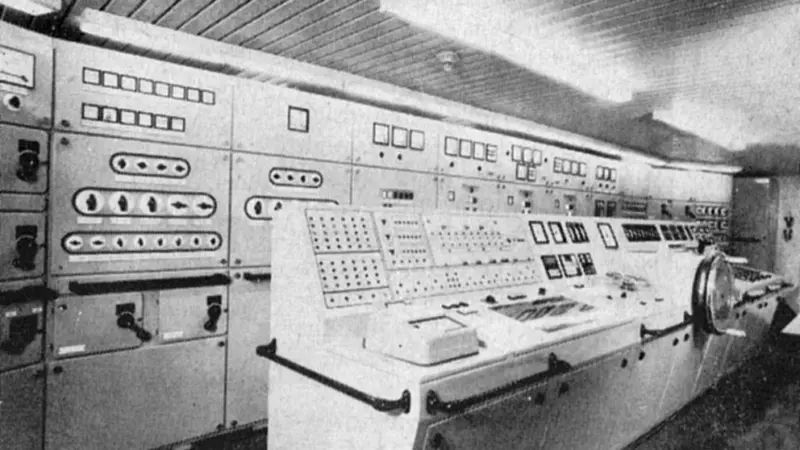
Tanker propulsion was the subject of another article, describing how with the advent of larger engines sufficiently powerful for single-screw installations in the largest cargo ships, the benefits of simplicity, low fuel and oil consumption, use of lowest fuel grades, and low noise, all inherent in direct drive, were now feasible. An exhaust gas boiler, supplemented by oil-fired boilers, could provide steam for the main cargo pumps, tank cleaning and cargo heating, while the electrical needs (and an electric cargo pump) would be met by a turbo-generator and two 670kW diesel gensets. This article provided a familiar note in its penultimate paragraph: “Automation and remote control are questions in which a growing interest will be taken in the future, due to the increasing difficulty in procuring qualified crew on board the ships.” The piece ended by forecasting that manoeuvring and adjustments would, in the future, be performed from a “special cabin either inside or outside the engine room and possibly from the bridge.” And elsewhere the innovation of a machinery control room on an automated Japanese ship was investigated, though the writer showed a degree of scepticism.
A totally different form of propulsion cropped up in a couple of other places. It was reported that Britain and Belgium were to work jointly on the development of nuclear propulsion plant for merchant ships; a measure that was taken as an admission that the British Government was not prepared to invest in the future development of shipping. Although nuclear power was still not proven to be a safe and economic option for ships, a surprisingly hard-hitting editorial said that: “Waiting, Micawber-like, for something better to turn up goes against all earlier traditions in British marine engineering and may well result in Britain having to build under licence from foreign countries.”
Despite the reluctance of the USA to adopt the Diesel engine for ships, America had just undertaken trials on the first-ever nuclear-powered merchant ship, the 22,000-ton NS Savannah, which was propelled by a 20,000shp De Laval geared steam turbine, supplied by a Babcock & Wilcox pressurised water reactor. The ship was intended to carry 10,000 tons of dry cargo and 60 passengers at a cruising speed of 21 knots. The article failed to mention whether or not the trials were considered successful. History shows, though, that technically the ship was a great success. However the combined passenger/cargo concept was economically flawed – although the US authorities insisted her role was primarily as a demonstrator – and throughout her short life she was bedevilled by labour disputes. She was taken out of service in 1972 because her operating costs were far higher than those of a similar oil-fired vessel. But just two years later, oil prices had risen to the level that would have made Savannah a feasible proposition. With the benefit of hindsight, ship propulsion would probably have taken a very different turn.
Related Articles
 50 YEARS AGO
 50 YEARS AGO
 50 YEARS AGO