



All-electric tugs: The future is here
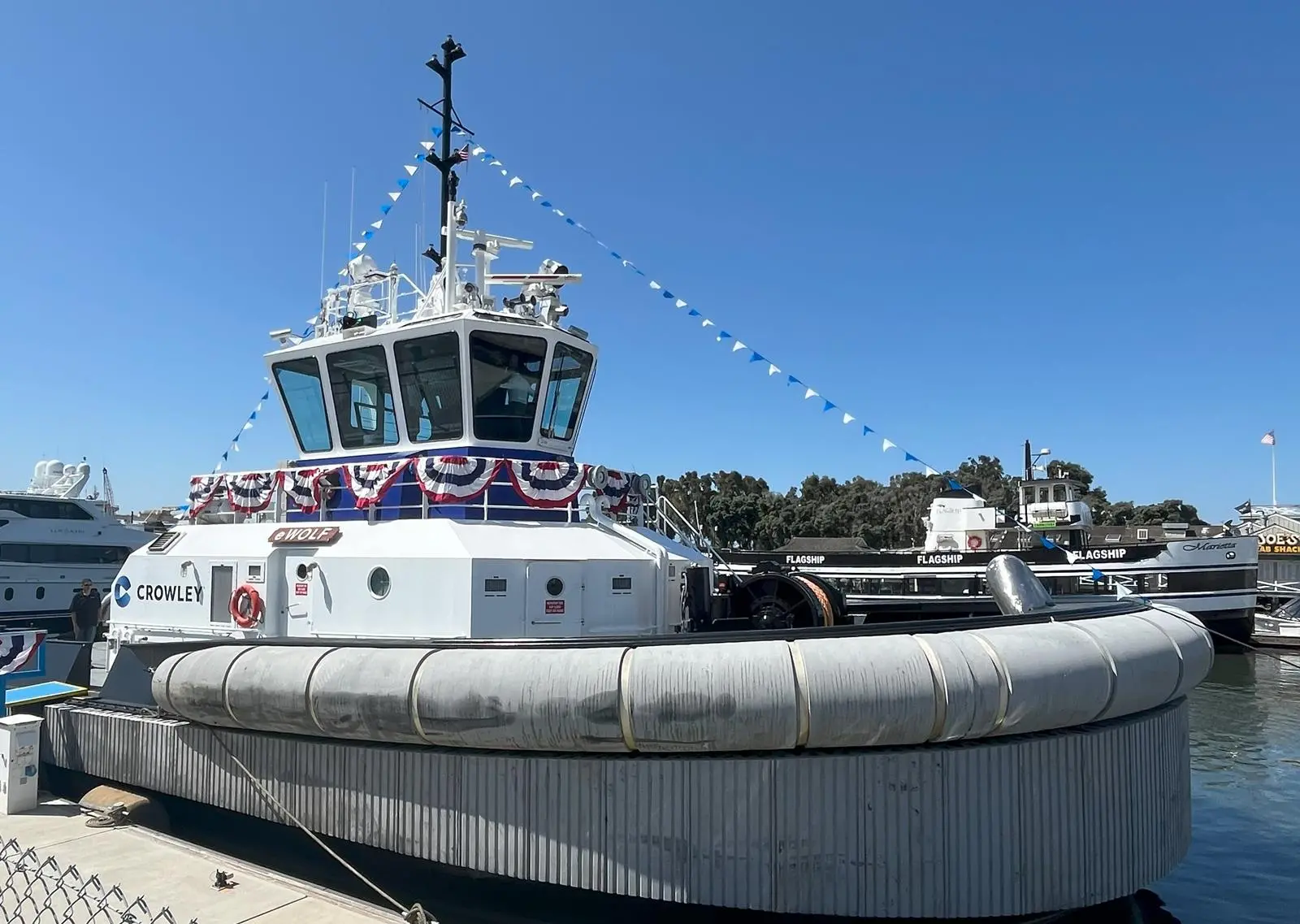
The newly-christened all-electric tug eWolf has 6.2MWh of installed battery power, larger than any of the etugs in service or under construction. “It’s definitely the future, and the future is here,” says Bruce Strupp, ABB Marine & Ports’ VP of marine systems in the US and Canada. A lot of people have been hesitant about the technology, but it’s proven now, and Strupp is fielding project inquiries almost on a weekly basis.
Crowley’s eWolf is the first all-electric, ship assist harbour tugboat in the US, and it will undertake busy eight-hour shifts on a single charge in the Port of San Diego. The tug, built by Master Boat Builders, has a bollard pull of 70 tons.
ABB performed systems integration, engineering and automation on the newbuilding and supplied its Onboard DC Grid™ power distribution system platform, two 2.1MW permanent magnet propulsion motors, low-voltage switchboards, transformers, li-ion batteries from Corvus Energy, Schottel mechanical L-drive thrusters, and the ABB Ability™ Remote Diagnostics System for Marine for continuous equipment monitoring and predictive maintenance.
The energy storage capacity was determined based on the operational profile of existing Port of San Diego tugs. The tug also has backup diesel gensets for range extension.
“A rule of thumb that I have found to be true in most cases is that anytime you can take advantage of electricity that’s produced shoreside, it’s cheaper than electricity that’s produced on the vessel,” says Strupp, and much of the electricity produced on the west coast of the US is hydro, so it’s green.
Space and weight are key design constraint for tugs, but eWolf is very well laid out, says Strupp. “There’s a lot of space to work, to manoeuvre. There’s plenty of overhead space and plenty of room in the two battery spaces as well. Master Boat Builders and Crowley did a really good job making sure the space was used efficiently.”
Compared to traditional power systems involving two diesel engines, all-electric tugs are quieter and cheaper to operate and maintain. Maximum bollard pull is only required for a small portion of operations (around 5-10% for eWolf); most time is spent in transit or on standby. In a purely diesel engine configuration, this means running large engines at low, inefficient loads most of the time. In contrast, battery-electric drivetrains are very efficient across the required power range and can generate maximum thrust quickly when required.
Also entered into service over the last year was the first ElectRA 2800 series of battery-electric tugs designed by Robert Allan Ltd and built by Sanmar Shipyards. To date, three HaiSea all-electric tugboats, the Wamis, Wee’git, and the Brave, have arrived in Vancouver to provide ship-assist and escort towing services to LNG carriers at LNG Canada’s new export facility in Kitimat.
With 65+ tonnes bollard pull and 6.1MWh of Corvus Energy battery capacity each, the tugs will perform all their ship-berthing and unberthing missions on battery power alone, using the ample clean hydroelectric power available in Kitimat to recharge. Like the eWolf, the vessels have diesel backup generators for range extension.
When the energy storage levels in a fully electric tug drop too low, the vessel may be unable to perform certain duties. To manage this, operators rely on real-time monitoring systems that continuously track battery status and issue alerts when levels drop below safe thresholds. Operations are planned according to the battery’s state of charge, with energy budgets assigned to each task to ensure completion within available power limits. Load shedding and throttling can reduce power consumption, while maintaining a reserve capacity and having backup systems like auxiliary generators provide additional security.
Efficient management also involves strategically placed charging stations for energy replenishment and the use of predictive analytics to optimize battery usage. Safe operating protocols dictate minimum battery levels, and crew members are trained to follow procedures that prioritize critical operations and safely return the tug to a charging base when necessary. By integrating these strategies, operators can maintain the tug’s operational efficiency and safety, even when energy levels are low.
Sanmar is delivering a further four ElectRA Series tugs: two to SAAM Towage in South America, one to Bukser og Berging in Norway, and one will also join Sanmar’s own fleet in Türkiye
Related Articles
 BATTERIES, SUPERCAPACITORS, FUEL CELLS AND OTHER ENERGY STORAGE TECHNOLOGY
 BATTERY HYBRIDS & FULL-ELECTRIC VESSELS
 BATTERY HYBRIDS & FULL-ELECTRIC VESSELS