



Ammonia combustion without ignition improver demonstrated on single cylinder test engine
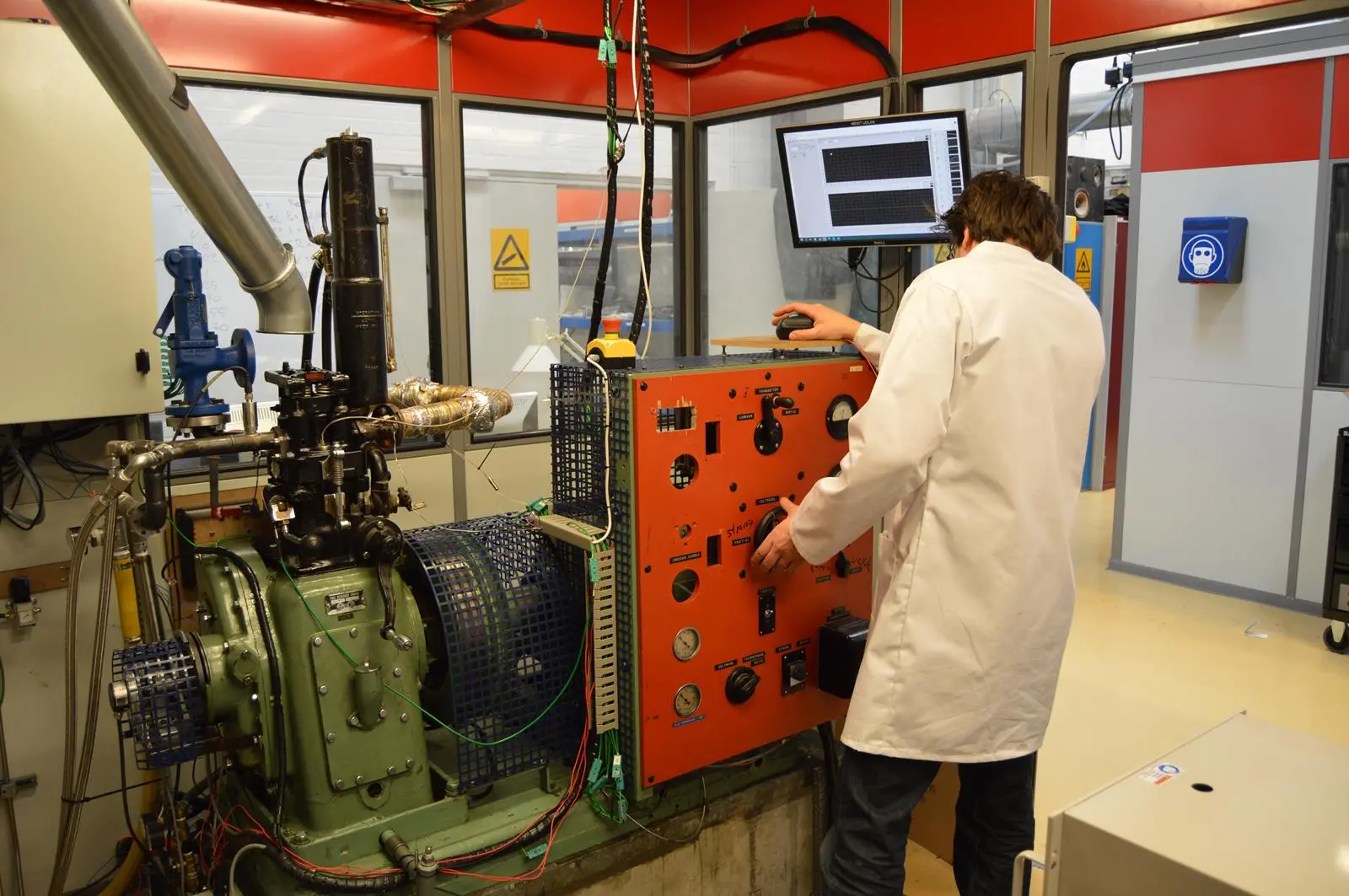
While most previous studies have involved the addition of 5% hydrogen as an ignition improver for ammonia combustion, DTU researchers have shown that the safety and complexity challenges associated with this use of hydrogen can be avoided by optimising the spark ignition system.
Their research was undertaken on a single cylinder, spark ignition CFR engine and examined combustion system parameters given ammonia’s low auto-ignite and high latent heat properties. These properties enable a high compression ratio, and they found that using a high boost pressure facilitates combustion quality and potentially increases power density.
The researchers achieved a combustion efficiency of over 95%, and the ammonia slip that occurred was believed to be the result of entrapment in crevices and ringpack. As ammonia has a much higher oxidation temperature than conventional hydrocarbon fuels, the trapped component did not post-oxidise as much as occurs with other fuels. The issue of crevices would be similar for all premixed ammonia engines regardless of ignition system, says Jespersen.
“The bowl configuration required for good diesel combustion in typical 4-stroke engines will be unsuited for premixed ammonia combustion because of the large squish volume that will be squeezed into the ring crevice.” This indicates that it would be difficult to develop an engine that performed well with diesel and ammonia, state the researchers.
Efficiency was relatively constant over a range of tested intake pressures, indicating the potential to downsize the engine and minimise mechanical losses. The optimal air-fuel ratio was found to be 1.25. The researchers also found that advancing ignition time was an effective way of reducing this slip. While the ammonia slip does reduce, the NOx increases to a level corresponding to the ammonia. This this makes it possible to remove both the ammonia and NOx in a SCR catalyst.
The researchers continue to investigate the influence of temperature and engine speed on the premixed ammonia fuel. “We are also investigating high pressure direct injection of ammonia,” says Jespersen. “We are still working on the injection system, but hope soon to inject into a constant volume combustion chamber. In another project, we are investigating the effect of mixing ammonia and DME for direct injection, and we are testing different pilot fuels and concepts.”
Related Articles
 2-STROKE & 4-STROKE
 2-STROKE & 4-STROKE
 2-STROKE & 4-STROKE