



Ammonia fuel: mounting ship operator interest is eclipsing other alternatives
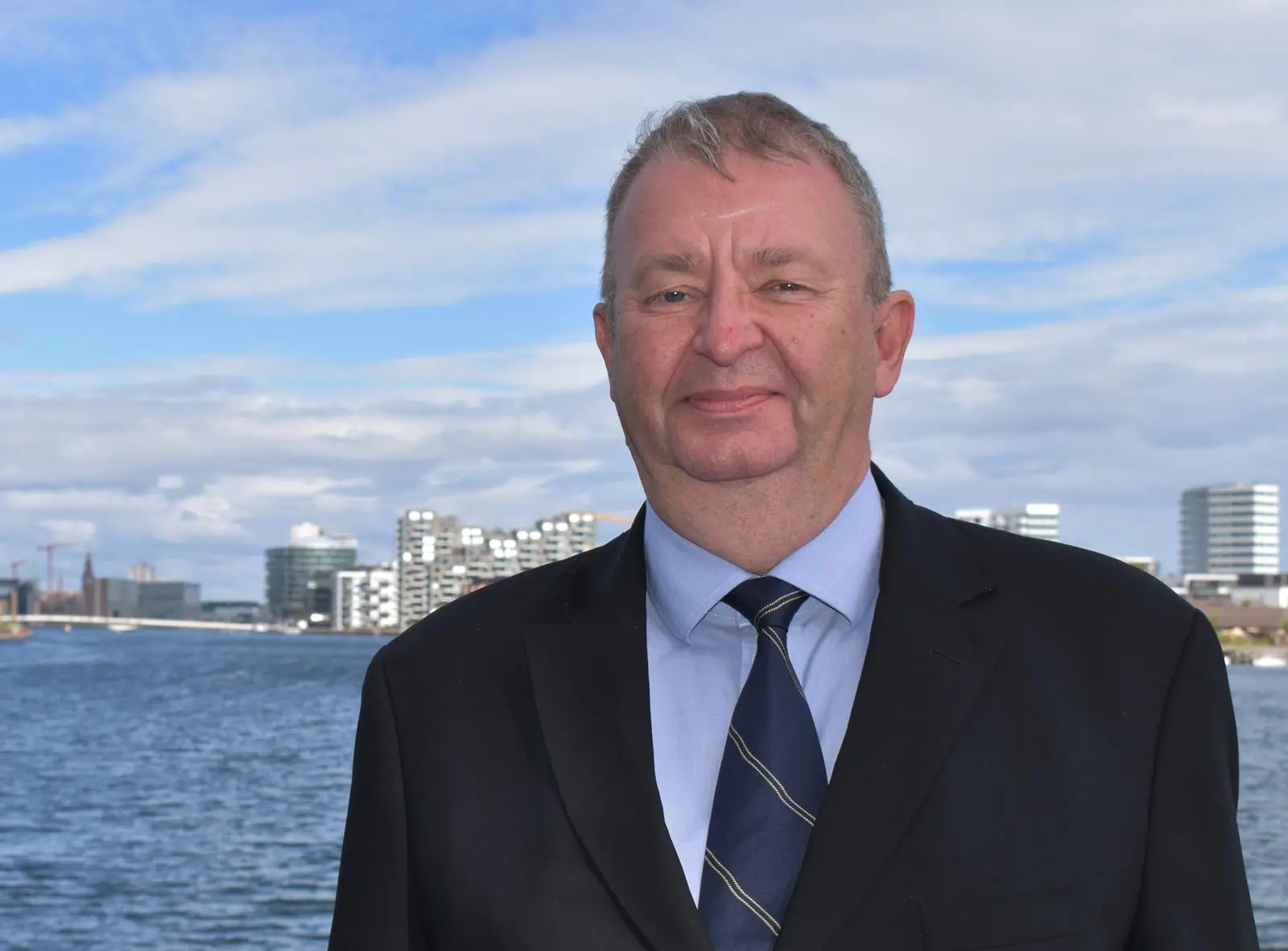
Developing an ammonia-fuelled engine is not straightforward, and Kjeld Aabo – director, new technology, two-stroke promotion at MAN Energy Solutions (MAN ES) – knows it. One challenge is to ensure the engine will be in compliance with emission standards, he told The Motorship. “We don’t want to have a surplus of ammonia slip in the exhaust gas and we don’t want to have N2O, laughing gas; that will be strictly forbidden.”
The Motorship has previously reported, in August 2020, that MAN ES plans to deliver an ammonia-fuelled two-stroke engine in 2024, if full-scale engine tests scheduled for 2023 are successful, but Aabo underlined the long-term importance of ammonia-based technology during a webinar in early May hosted by the Clean Ship Alliance (CSA) in which he predicted that it will be the dominant fuel by 2050.
Asked by the event’s chair, CSA executive director Ian Adams, which alternative fuel he would “put money on”, Aabo said that, based on interest shown by the shipping industry, “my money would definitely go to ammonia.” That interest is not only related to new engines, he indicated: “a lot of operators ask us if it’s possible to retrofit to ammonia and that is definitely the plan.”
Speaking later to The Motorship, Aabo stressed that his comments did not imply any view on whether ammonia was the right fuel for the future – “we don’t want to go into [that] discussion” – only that it is the one attracting the most interest. “We talk about what is possible [and] there will be a variety of different fuels, such as methanol and E-LNG … depending on the technologies that will be developed [but] we have meetings every day regarding ammonia.”
Those meetings are not only with shipowners: MAN ES has also been approached by some Norwegian hydropower station owners who are planning to use excess power to generate hydrogen and are exploring whether to then convert it to ammonia to simplify its storage and transport.
Ammonia or hydrogen in 2050?
Not everyone agrees with his outlook. At class society Bureau Veritas, its global technology leader in sustainable shipping Martial Claudepierre believes that gaseous hydrogen will be the predominant fuel in 2050, although he acknowledges ammonia’s value as a carbon-free hydrogen carrier. Apart from that benefit, however, ammonia is a very difficult fluid: “it’s very toxic, difficult to burn and not easy to store,” he told The Motorship.
But it has an important role to play and will be the main carbon-free fuel in 2030, Claudepierre said, followed by a shift in focus as hydrogen-based technology develops. “In 30 years, we can make huge progress in terms of internal combustion engines burning hydrogen,” he said, citing work done by engine maker ABC and shipowner CMB, who announced a dual-fuel four-stroke hydrogen engine in September 2020 and hope to have a mono-fuel hydrogen engine running this year.
“There will be also huge progress for hydrogen storage as a cryogenic liquid” and its distribution, Claudepierre predicted, “but we have 30 years ahead [of us] so, we can make it.”
Trial expectations
Meanwhile, Aabo provided an exclusive overview of the intended outcomes of next year’s two-stroke ammonia engine trials. Two research engine are already installed at its Copenhagen premises and tests will begin on a single cylinder and then progress to four, with a particular interest in its combustion properties.
As well as avoiding the risk of emitting N2O, ammonia slip and compliance with Marpol Annex 6, Tier II and III NOx standards must be met. All these will have to be confirmed before the engine’s injection system can be designed and a key parameter in that design will be the amount of pilot fuel needed, which is not yet known, he said. Ammonia “is quite hard to ignite but we know we can do it; it’s a matter of how.”
That confidence may be based on earlier work in 2019, which was mentioned in The Motorship article referenced above. At that time, MAN ES’ promotion manager for dual-fuelled engines, René Sejer Laursen, said that ammonia’s comparatively slow flame velocity and slower heat release and combustion characteristics were no obstacle to combustion.
That article also mentioned a hazard identification (HAZID) workshop held at its Copenhagen offices in early 2020 that formed the start of the engine development project. It was chaired by Bureau Veritas with Aabo acting as host to a group of 32 people representing suppliers, yards and others with an interest in ammonia-fuelled propulsion.
Out of that came a number of parallel work streams, with MAN ES developing an ammonia fuel supply system, which will be essential for its engine trials.
For its part, Bureau Veritas announced an ‘ammonia-prepared’ class notation in early May and is planning to release a Rule Note (NR 671) about using ammonia as fuel, something that Aabo welcomes.
That will be published in late June, Claudepierre said, who described last year’s meeting as taking a risk-based approach to assessing ammonia’s use, modelled around a VLCC concept involving Shell. It was, he said, “a first milestone in engaging safety and the combustion process for ammonia.”
From HAZID to HAZOP
A second gathering will take place in September by which time work will have progressed from HAZID discussions to HAZOP (hazard and operability) considerations. It will again be chaired by BV and will hear updates from all the participants but in particular from MAN ES, which is expected to present a concept engine design.
As before, the VLCC concept will focus the discussions, Claudepierre said, with the various participants each having different interests. Some will want to take away a better understanding of ammonia’s safety challenges, others will seek more information about its combustion properties and another group will look for environmental outcomes, such as whether a scrubber will be needed to eliminate N2O.
Ammonia class notations
BV takes a safety-based approach in its rules, particularly in relation to preventing emissions and leakages on board and how to tackle any that occur so as to protect crew and passengers, Claudepierre said. And with so many details about ammonia’s fuel use still unclear, “we are aware that we will need to frequently revise the rules,” he added.
This is reflected in its choice of words in naming it an ‘ammonia-prepared’, rather than ‘ammonia-ready’, notation. It is made up of modules for different equipment types, including an engine module aimed at retrofitting projects. By allowing users to select those modules relevant to thir situation will avoid unrealistic expectations, he suggested.
BV is not the only class society to offer ammonia-related notations. On 10 May, for example, ABS published its notes on alternative fuel options which noted that although ammonia is “considered a leading contender for fuel options … there are also several challenges [and] a lack of prescriptive requirements.” Because of this lack of requirements, in February it issued a revised version of its Guide for Gas and Other Low-Flashpoint Fuel Ready Vessels, which has many references to ammonia and offers an ‘Ammonia Fuel Ready’ notation.
As The Motorship reported in January, ABS is classing the world’s first ammonia-fuel-ready ship, a Suezmax tanker, plus two options, for Greek shipowner Avin International. The vessel is under construction at New Times Shipbuilding in Jiangsu, China, and will meet both ABS’ Ammonia Ready Level 1 and its LNG Fuel Ready Level 1 requirements.
Then, in April, The Motorship reported another ammonia-ready ship project, this time the first to be built to DNV rules. This 9,100CEU battery-hybrid PCTC will be built for Höegh Autoliners at China’s Xiamen Shipbuilding Industry and is expected to be delivered by the end of 2023 and to be the lead vessel in its new Aurora class of such ships. It will run on various biofuels and conventional fuels but could be converted to future zero-carbon fuels, including green ammonia, Höegh Autoliners’ CEO Andreas Enger said in a statement.
Four-stroke ammonia engines
Four-stroke engines are also being developed for ammonia use. MAN ES is involved with other partners in a three-year project, dubbed AmmoniaMot and backed by the German Federal Ministry of Economics and Technology, to produce a dual-fuel medium-speed engine able to run on diesel and ammonia; details were published in The Motorship in April.
Like its two stroke development project, this will also have to establish how much pilot oil is required for combustion and that earlier report said that one of the consortium members, the University of Munich, will use “a rapid-compression expansion machine” to and work with MAN ES to develop the combustion models needed.
Although this may appear a similar task as for the two-stroke engines, MAN ES’ Augsburg R&D team reminded The Motorship that “significantly shorter combustion events are required in medium and high speed four-stroke engines.” In some other respects – in particular, classification and regulatory requirements – the two research streams can learn from each other, so no class society is involved in this four-stroke work.
This project’s goal is to “define the steps necessary” to produce an ammonia engine and manufacturing will depend on market demand but “MAN ES will be ready to offer ammonia-ready four-stroke engines in the next couple of years,” the R&D team said.
Last June, Wärtsilä announced plans to start long term full-scale tests of ammonia as a fuel on a marine four-stroke engine at the Sustainable Energy Catapult Centre in Stord, Norway, in cooperation with Knutsen OAS Shipping AS and Repsol, backed by a NOK20M (US$2M) grant from the Norwegian Research Council.
As The Motorship reported at the time, these are said to be the world`s first full-scale four-stroke combustion engine test with ammonia.
The Motorship also understands that another ammonia-fuelled engine project is in progress that includes Bureau Veritas, but Claudepierre was not able to confirm which engine manufacturer is involved or any other details of that activity.
Despite the enthusiasm for ammonia-fuelled engines, Aabo urged a sense of proportion. It is easy to assume, he said, that all the engine models in a catalogue could be supplied in all sizes for all fuels, but “that’s not the reality and not the way that engines are designed and developed,” he said. MAN ES’ methanol engine, for example, is only available in one bore size.
Engine development is planned so as to remain competitive and on the basis of market feedback, he explained, “and here, ammonia is Number One.”
Related Articles
 ALTERNATIVE FUELS & LUBRICANTS
 ALTERNATIVE FUELS & LUBRICANTS
 ALTERNATIVE FUELS & LUBRICANTS