



Ammonia-fuelled gas turbine planned for LNG carrier
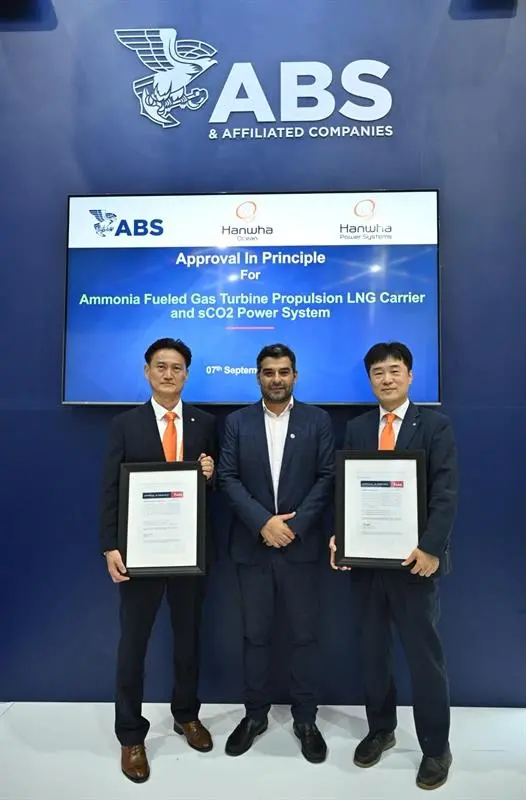
ABS has issued two approvals in principle (AiP) related to the design of an LNG carrier equipped with an ammonia-fuelled gas turbine. Along with an AiP for the vessel design itself to Hanwha Ocean, ABS also issued an AiP to Hanwha Power Systems for its supercritical carbon dioxide (sCO2) power system.
The 174,000 cbm vessel would be the world’s first carbon emission free LNG carrier. The vessel can use ammonia and natural gas separately or simultaneously as fuel. If only ammonia is used as fuel, no carbon gas is emitted.
The design, which is smaller than a diesel engine, also incorporates Hanwha Power Systems’ exhaust gas waste heat recovery system – the sCO2 power system. Hanwha Ocean says the system meets the NOx requirement without selective catalytic reduction (SCR) regardless of fuel and has significantly reduced methane slip.
René Sejer Laursen, ABS Director – Fuels & Technology, Global Sustainability, notes that using turbines in ships has by many been seen as almost an ideal solution. “Turbines do not take up much space, and they do not require much maintenance. Furthermore, turbines can in a combined cycle achieve very high efficiency.
“Traditionally gas turbines have required high quality fuel, so they have never been well suited for HFO. But with the introduction of ammonia as a marine fuel, gas turbines could potentially become an attractive alternative, as they can achieve high thermal efficiencies, potentially surpassing those of traditional combustion engines. The engine room can be sized significantly smaller which leaves more space for cargo, which also benefits the business case.”
Gas turbines also have some challenges, he says. They have a poor efficiency at part-load, but with new battery systems becoming available for peak shaving, those types of battery systems could potentially be used to maximize propulsion efficiency.
Using ammonia in gas turbines also poses some challenges, as ammonia burns very slowly, and ammonia develops a high amount of NOx. “For gas turbines it is required to have a new design of a combustor, and the turbines need to be combined with a SCR system to remove NOx from the exhaust gas,” says Laursen.
“Japan has launched a serious action plan for ammonia use to produce electricity. This program has however been underway since 2017 and the test with gas turbines operating on ammonia was initiated at the same time. So, this development is well underway, and we should expect to see the first gas turbine power plant operating on ammonia in the near coming years.”
Compared to diesel engines, that require a high amount of pilot fuel (5-20%) to ignite the ammonia fuel, gas turbines are only expected to use pilot fuel during start up. So, with a gas turbine operating on ammonia, then almost zero carbon emissions are something which could become realistic very soon, says Laursen.
“The fuel handling system for ammonia going into to a gas turbine or going into an engine is very similar in design and requirements, so it is not expected that there is going to be the big difference in the safety level between those two fuel supply systems. But if we look at the gas turbines themselves, then they are traditionally operating with high RPM. This can from time-to-time lead to mechanical failures, like turbine blades that self-destruct.”
Such failures can potentially lead to loss of containment, mechanical damage to components, and heavy leaks of toxic ammonia to the surrounding enclosed space – and in worst case lead to an explosion of the ammonia. Surface temperature on gas turbines is significantly higher than on an engine so the likelihood for an ignition in case of an ammonia leak is significantly higher than for an ammonia leak from an engine system.
ABS has a long tradition and experience in examining hazards arising from complex systems. “Our assessment will be according to IGF Code guidelines as well as ABS guidelines, and it must be demonstrated that the same or a better safety level can be achieved when compared to the use of natural gas. This means that for an ABS-approved ammonia gas turbine solution implemented in a ship design, we will see the same or similar safety as for an ammonia engine system.”
Related Articles
 AMMONIA
 AMMONIA
 AMMONIA