



An alternative to the alternative
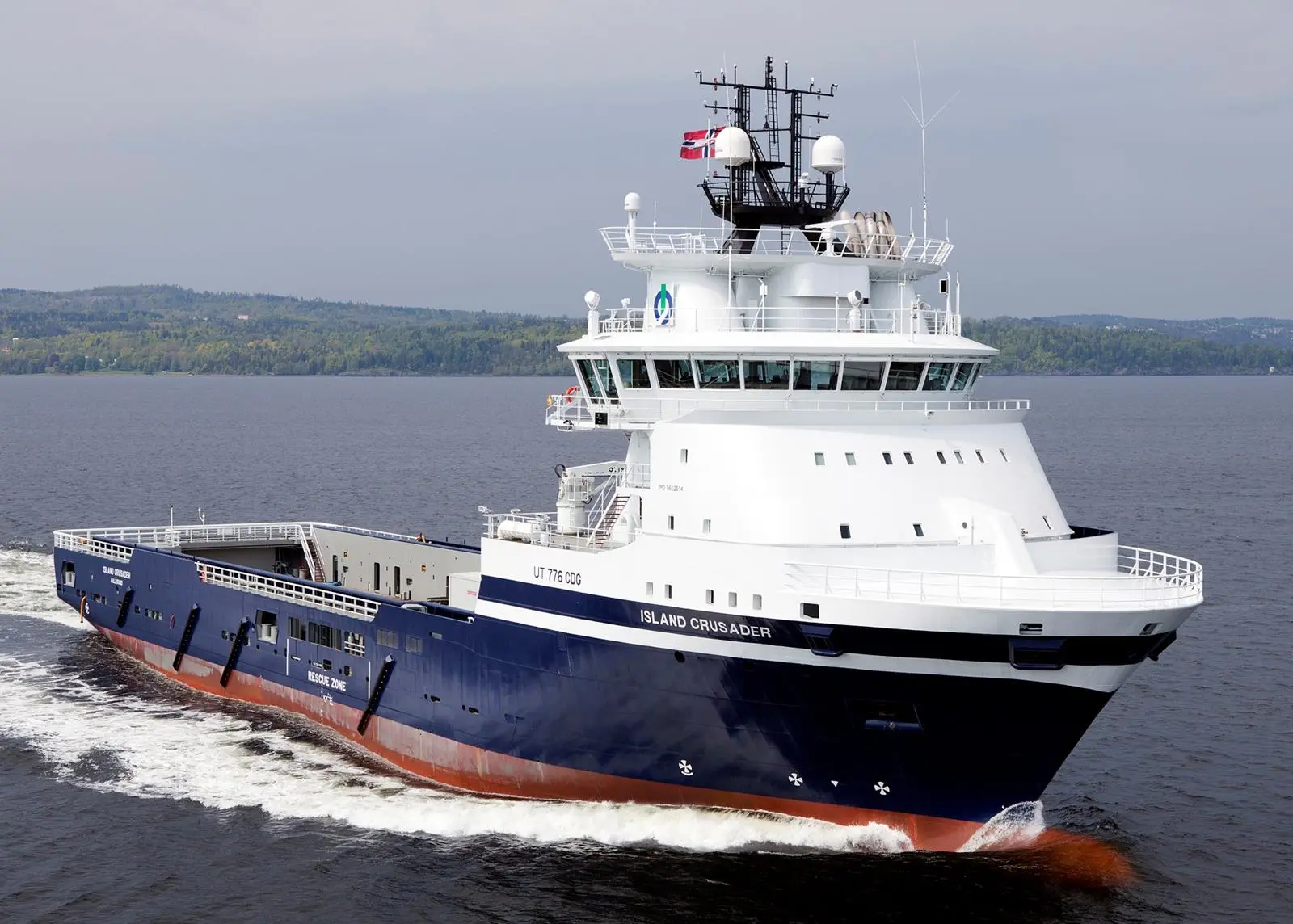
Havard Ulstein of IO, who recently received Island Crusader from the STX OSV yard in Brevik, Norway admits that this power option goes a little against IO’s approach of standardising all the packages to the point where everything is easily interchangeable. He says “LNG options do mean more work for the engineers – but actually at the moment LNG is sexy – well, for engineers anyway…”
The new UT776 CDG Crusader is a development of a good, proven design already built for IO. It is 96m long with a beam of 20m, and will transport all normal offshore supplies as well as being equipped for oil recovery. The effective capacity of the gas tanks is about 250m³, corresponding to two or three weeks of running on LNG alone depending on operation.
However, to look in more detail means to give some background to the power choices, Svein Kleven of Rolls-Royce explains that there are four main drivers that impact on LNG take up. One is the promise of an emissions solution – along with the push and pull of ‘green’ tax and incentives such as the Norwegian NOx fund.
The second is the risk associated with bunkering and how long it will take to come on line. The third and fourth are CAPEX (capital investment) and OPEX (running costs).
The fact that though LNG promises much in the way of reduced emissions and easier compliance with the oncoming raft of legislation, “there isn’t yet the infrastructure in place – bunkering is still an issue outside Northern Europe, the US and places like Japan. So long transits still have to rely on other fuels”, says Mr Kleven.
However, it takes careful consideration – and possibly a crystal ball. Mr Kleven points out – how you decide to shape your propulsion and power; depending, partly, on how quickly you think the world is going to commit itself to supporting LNG.
“Firstly to take one extreme, if you had reason to believe LNG bunkering will be in place in the area you are going to be running your craft in five years, you might just take the bold step of developing LNG as a single source of fuel onboard. If, like most offshore support operations, you don’t know where you will end up in five years, you’d be wise to have a diesel backup.” However, how these two fuels should be handled is another matter and should be considered with the market possibilities in mind.
“Although duel fuel options have opened up the people’s eyes and taken a lot of market share, it is not necessarily the best approach.”
This is because the efficiency is lost on having a combined engine, as you can’t optimise an engine for either fuel, since the other side has to be taken into consideration.
So Mr Kleven points out that the answer is simply to have a vessel with not one set engines but two, running side by side in the engine room. Rolls-Royce has used a pair of the new C26:33 gas series alongside a pair of C-series diesel units.
“This way you don’t have to try to model the engine’s compression across two types of fuel,” says Mr Kleven. “Likewise, you don’t have an introduction of a diesel ‘pilot’ ignition into the LNG, which is needed for the dual fuel option.” The C26:33 LNG engines have a new spark ignition area at the top of the engine.
Mr Kleven points out that this LNG-engine is in, he says, “a separate league” compared to other LNG engines when it comes to methane slip. The greenhouse gas effect of methane is a stunning 21 times as high as CO2, so low slip was noted as special, competitive criteria right from the start. “Older LNG-engines from our competitors as well as our own LNG K-engine model have significantly higher methane slip values as this was not on the agenda in the past,” he says.
Mr Kleven also notes that this kind of twin engine solution should be able take on widely variable loads in both modes – an engine rated 3,000kW needs to be able to adapt to a load one tenth of this, and still run happily at 300kW. Given the separation, the diesel side will inevitably be better at this low load scenario, and the new gas units have been modelled to be able to run both at a constant genset load and variable speeds for direct transmission.
So, what you actually get is two sets of engines that burn much more efficiently, with a lower output overall of NOX and CO2 with particulates on the LNG side coming down to almost nothing and reduced on the diesel side – plus importantly, a greater degree of redundancy in the system.
Therefore part of the equation has to be that while there is a balance in the market, dual fuel engines do have a place. But as LNG gets more available and the prices tip over toward cheaper LNG, the present dual fuel engines lose a large part of the pull. That is, if you do the math, an engine that is able to optimise either diesel or LNG wins out as it can take emissions and running costs down much further – especially if it has to spend a greater proportion of its time in either mode but still needs the flexibility of having the other fuel option.
This, says Mr Kleven, is where the difference in the world’s markets has a part to play. He explains that at the moment, the US is ahead in cheap LNG since it has found a domestic source from it’s fairly recently tapped shale deposits. Other places like Asia have a higher price – but still, LNG promises to gain a greater and greater margin. Europe at the moment lands somewhere in between, but it may be able to find its own domestic source.
So for the third and fourth drivers – although CAPEX is definitely higher, the OPEX side of the balance sheet is predictably lower. Mr Ulstein adds that the pure LNG and diesel systems have around 8% lower fuel consumption over the dual fuel option.
But there are the green financial incentives which help to seal the case.“Yes,” Mr Ulstein goes on to say, “this solution does add around 10% more to the total build – which actually makes it something like NOK45million more expensive than a standard engine, but we gained a refund of 80% of this amount from the NOx fund.”
On the whole, however, Mr Kleven thinks that the market is only going to go in one direction. “It’s rather like the debate over the changeover between coal and diesel engines – it was a chicken and egg situation, but it inevitably went the way of diesel. I believe the same thing will happen again.”
By Stevie Knight
Related Articles
 PROPULSION
 GENERAL NEWS
 HYDROGEN