



Are PAGs the perfect environmental hydraulic oils?
The first major criterion for an EAL is that the product has to have a biodegradability rating of 60% or more in 28 days in order to be considered an EAL. Some current products marketed as ‘inherently biodegradable’ or ‘environmentally friendly’ are mineral oils or white oils and are not included in this category. They are generally hydraulic oils with the zinc/phosphorous (ZDDP) anti-wear additives removed to eliminate heavy metals and reduce aquatic toxicity, but they fall short of the required 60% biodegradability in 28 days, and they are still refined petroleum products. As a result, they possess reduced anti-wear capabilities and will not meet the standards of some component manufacturers and equipment OEMS.
Even the label ‘biodegradable’ might not tell the whole story. Not all biodegradable lubricants are plant based, in fact plant based bio-lubes and plant based synthetic esters are, in reality, outdated technology.
The second requirement is that the product has to meet or exceed very low aquatic toxicity criteria in order to have the lightest possible impact to the marine environment, and the third is that it must not be bio-accumulative to any organism or any part of the food chain.
EPA has determined that four major types of lubricants meet all the necessary required criteria to be classified as an ‘approved EAL’.
They are as follows:
- Vegetable Oils (such as canola or soy oil based);
- Synthetic Esters (esters derived from bio-based sources);
- Polyalkykene Glycols (can be either water soluble or water insoluble);
- Water (referring to water lubricated and cooled stern tubes).
Most approved EAL products are still oils of some type, with the exception of water soluble polyalkylene glycols (PAGs). While readily biodegradable ‘oils’ may degrade rapidly and are considered not bio-accumulative and very low in toxicity, they are, nevertheless, still oil and will float, causing a slick or sheen on the surface of the water in the event of a spill or discharge. The reality of marine oil spill cleanup attempts and the amount of actual oil recovered generally represent a very small percentage of the oil spilled, quite apart from the time delay in identification of the spill, reaction to it, and deployment of the appropriate cleanup apparatus and procedures.
Biodegradable hydraulic oils will not leave bio-accumulative toxins and will disappear much faster than petroleum-based oil, but it is the actual oil itself, regardless of the environmental profile, that does the majority of the damage to marine life.
Vegetable based oils are often preferred by environmentalists as, being crop-derived, they are regarded as renewable. Although they appear to have very good lubricity, they are temperature-sensitive and exhibit poor thermal and oxidative stability. They can oxidize rapidly at higher temperatures normally tolerated by mineral or synthetic oils, leading to varnish and solid deposits, thus offering a short fluid life span. Another problem is hydrolytic stability, i.e. the reactive nature when it comes in contact with water, leading to formation of acids and sludge. These acids can be very corrosive to components, seals and can soften hydraulic hoses. Converting to vegetable oil involves draining and purging the system, and disposal of the purge fluid.
Synthetic esters are man-made lubricants developed from bio-based, plant esters and offer a significant improvement in performance over vegetable oils. Because of the high production cost, these can be significantly more expensive than other EALs, so they are often blended with vegetable oils. They are regarded as a renewable resource, but because they require large amounts of base material, the sustainability of using arable resources to manufacture lubricants rather than produce food has proved controversial.
PAG too offers rapid biodegradation and low toxicity levels, and can outperform conventional mineral and synthetic oils in basically every category.PAG fluids are listed by the US EPA as approved EALs and are not classified as marine pollutants, oils, or hazardous substances, so spills cannot be regarded as violation of clean water laws.
PAG offers:
- Total environmental compliance;
- Superior lubricity;
- Superior load carrying capability;
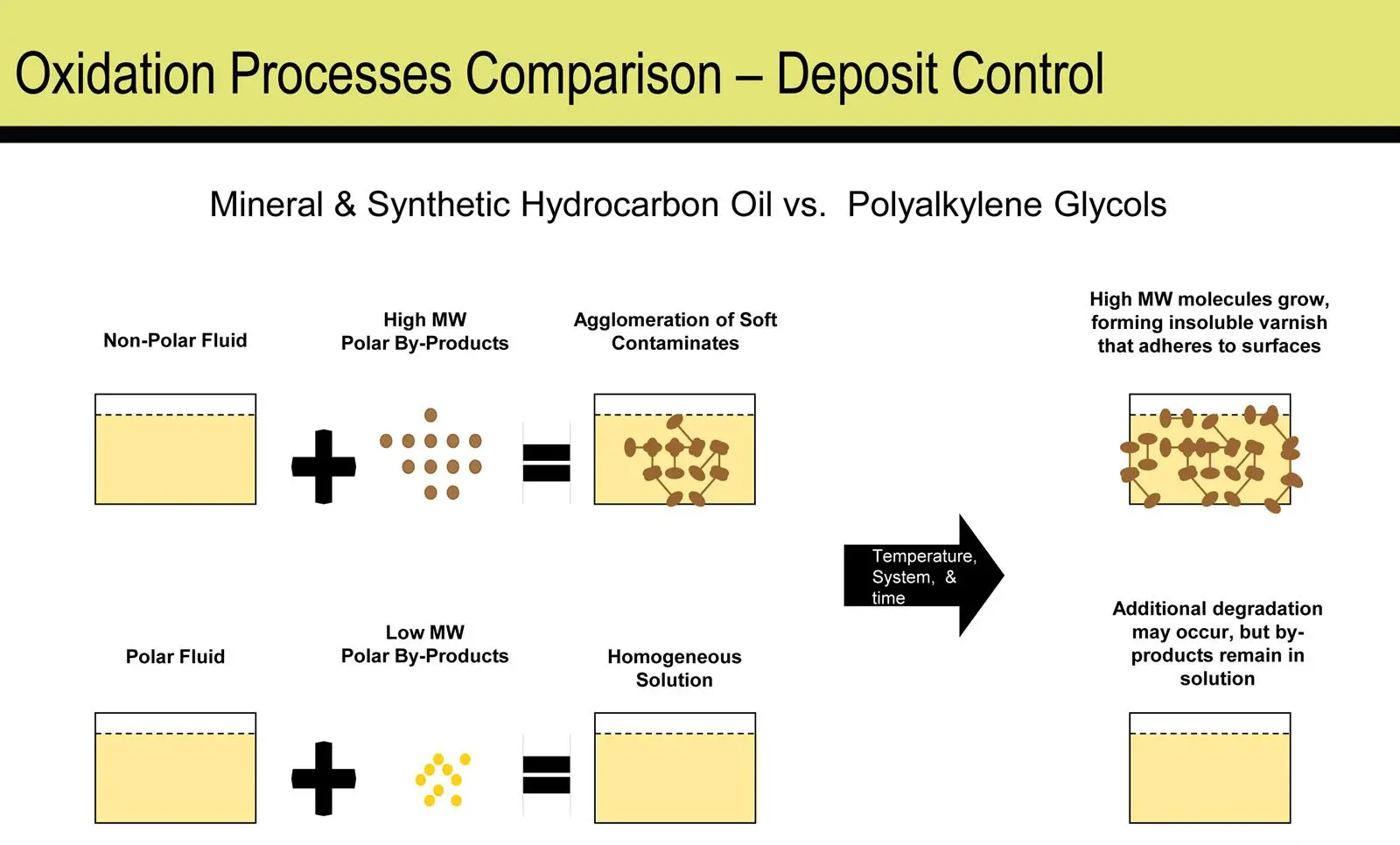
- Superior oxidation resistance – incapable of forming varnish and offering the longest fluid life span of any lubricant type;
- Will not turn acidic in presence of moisture and will not turn acidic or form gummy deposits.
In addition, PAGs display excellent corrosion resistance, even with significant seawater content. They are able to handle more water contamination than oil based products as there is no total saturation point. Viscosity and lubricating ability will slowly decrease as water content increases, and they do not contaminate sea-life as they create no oil slick.
Conversion to PAG costs less than with other EALs, as it is possible to separate flushed material from old oil, and, contrary to popular belief, PAGs are compatible with all common seals.
The use of PAGs in hydraulic systems is approved by many OEMs, and PAG products such as Dow Chemical UCON Trident AW and American Chemical Technologies Neptune lubricants cost about the same, or slightly less, than typical biodegradable synthetic esters.
Related Articles
 ALTERNATIVE FUELS & LUBRICANTS
 FUELS & LUBRICANTS