



Assessing the viability of nuclear power systems in design of future LNG carriers
Nuclear power has the potential to make a transformational impact on carbon emissions reduction across the electricity, industrial and transportation sectors. Its ability to provide clean alternative power generation options in shipping has already attracted attention and the journey to cleaner maritime energy is gaining momentum.
From the perspective of achieving IMO’s 2050 net-zero ambitions, it would be a mistake to ignore nuclear as a part of the fuel mix. However, progress will not happen without regulations that provide a foundational basis to how nuclear-powered systems in maritime could look.
Nuclear energy has the potential to be a disruptor for the maritime sector. Enabling it to be successfully and safely integrated into the shipping industry requires a new kind of collaboration.
Nuclear power for ships holds out the prospect of using advanced small modular nuclear reactors as propulsion, while nuclear for future fuels includes scenarios where small modular nuclear reactors are positioned near shore to produce power for ports and support the production of alternative fuels.
Developing the systems that could power merchant vessels, provide shore power and generate clean fuels, means bringing together players in marine and offshore design with builders of nuclear systems to fill knowledge gaps and exchange ideas.
ABS is playing a leading role in helping government and industry work toward the adoption of advanced nuclear technology in commercial maritime, including key research with the U.S. Department of Energy and multiple New Technology Qualification and Approval-in-Principal projects with industry.
Both marine and offshore sectors represent high potential demand, sharing as they do an increased focus on clean energy usage. The offshore market exhibits immediate demand due to the power requirement created by ports and other industrial users.
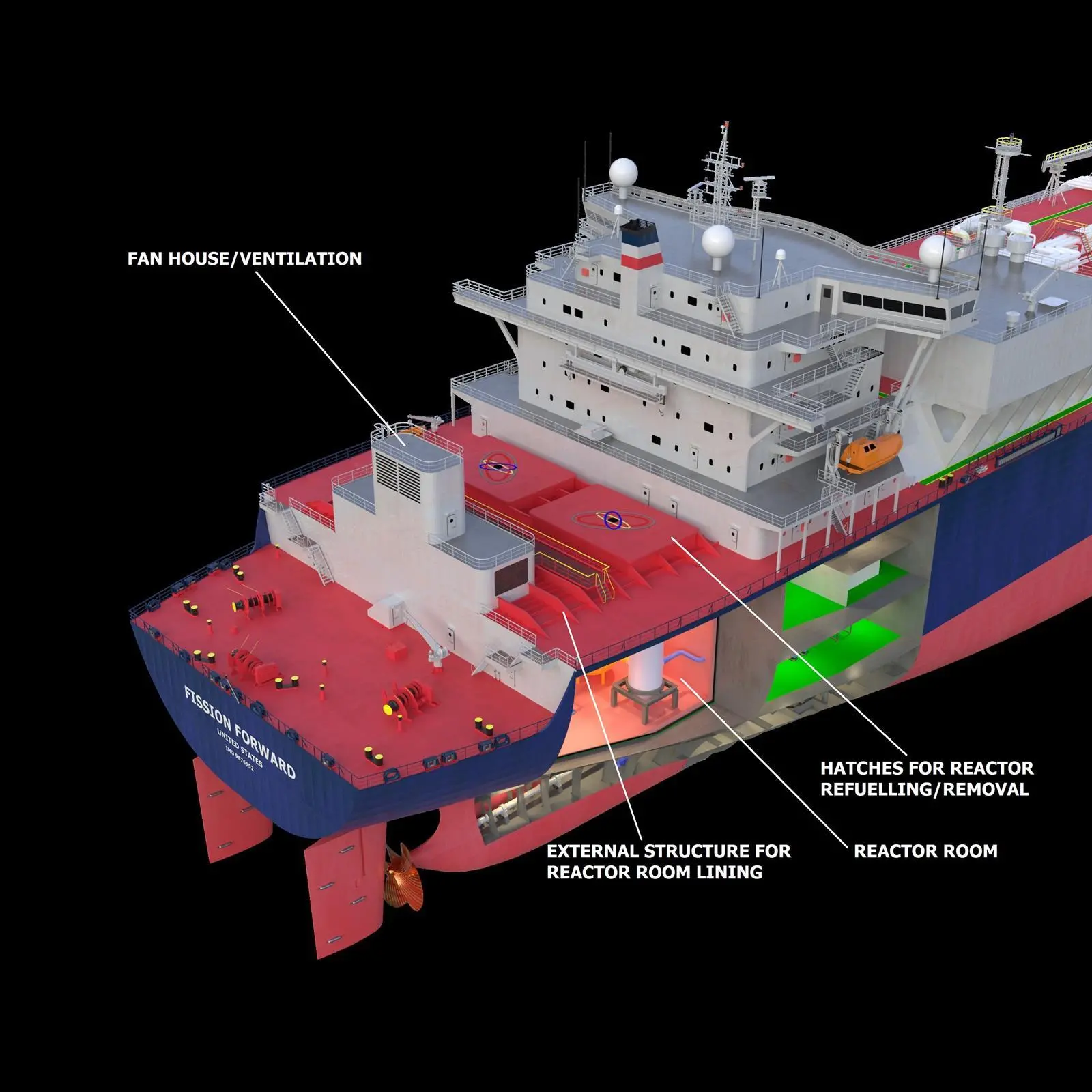
ABS worked with Herbert Engineering Corporation (HEC) on the high-level design of a standard liquefied natural gas (LNG) carrier to illustrate how one type of advanced nuclear fission technology could be applied for shipboard power in the future, with an emphasis on what aspects of ship and reactor design may require further investigation to guide the development of the integrated technology and regulatory framework.
ABS unveiled the industry’s first comprehensive rules for floating nuclear power plants at a forum for nuclear industry leaders held jointly with Idaho National Laboratory (INL). The event saw presentations on the latest reactor technologies from leading companies and publication of a detailed study from ABS and HEC modelling the design, operation and emissions of a floating nuclear power plant.
The ABS Requirements for Nuclear Power Systems for Marine and Offshore Applications, provides the first classification notation for nuclear power service assets such as floating nuclear power plants or nuclear-powered floating production, offloading and storage units.
Uniquely, the requirements are agnostic to specific reactor technologies technology and propose a framework for nuclear regulators to collaborate with Flag administrations and ABS for complete regulatory oversight and license.
Feasibility Study for an LNG Carrier
With advancements in nuclear engineering and the development of many types of advanced nuclear reactors, there are many opportunities to implement the technology for commercial ship propulsion.
ABS and Herbert Engineering Corporation often collaborate to investigate the application of new technologies for commercial vessels. The work leverages Herbert Engineering’s expertise in naval architecture to incorporate novel arrangements and equipment into conventional vessel types. With insights from ABS on classification and regulatory requirements, the concept vessel designs are first looks at novel arrangements.
In addition to previous studies researching a nuclear-powered containership and a Suezmax tanker, there was interest in studying a nuclear-powered LNG carrier. These large vessels are increasing in demand as the international LNG trade remains important for global energy security.
LNG is stored on board in large cryogenic tanks that maintain natural gas (primarily methane) in a liquid state around -165° C (-265° F). Benefits from nuclear propulsion include decarbonized high-power availability, reduced or eliminated bunker costs, and associated reduced bunker time in port. The typical energy demand for LNG carriers is between 30 to 75 MW.
Technical specifications of advanced nuclear reactors under development today, often referred to as small modular reactors (SMRs) for their scaled-down designs, are not widely available, or are not specifically designed for ship propulsion applications.
The intended scope of this study is to consider and discuss a standard LNG carrier design using nuclear power for propulsion and other primary energy needs.
Driven by the current ambiguous regulatory environment, market concerns and typical nuclear reactor designers’ experience base and background, state-of-the-art advanced reactors are not yet designed for commercial marine use.
On this basis, the high-level design of a standard LNG carrier is presented to illustrate how one type of advanced nuclear fission technology may be applied for shipboard power in the future, with an emphasis on what aspects of ship and reactor design may require further investigation to guide the development of the integrated technology and regulatory framework.
To conceptualize the possible design, the design team invited a reputable small reactor designer to provide information regarding the use of their reactor design for ship propulsion. This reactor design has been supported by the U.S. Department of Energy’s Advanced Reactor Demonstration Program (DOE ARDP) to demonstrate the commercial viability of SMRs.
The main conclusions of this study of nuclear-powered commercial vessel designs are that nuclear power would be a supportive means of drastically abating shipping emissions, but significant hurdles remain in public perception and international regulations before this can be achieved.
However, the maturity of advanced nuclear technologies that could be implemented for ship propulsion is low. Therefore, the level of detail provided in this study was limited to engineering information available from the design of terrestrial applications for engineering postulation and recommendations for future design optimization.
The modular reactor philosophy imposes significant restrictions on ship design. The modularity concept imposes a fixed maximum SMR power output per reactor, corresponding to a set lifespan of its core.
It is advantageous if the nuclear power plant equipment and fueling lifecycles align with the vessel’s life. Challenges with access to suitable shipyards or other support facilities and the physical removal of the reactors are challenges, which would be simplest to avoid by addressing the issues in the design stages.
Although it is possible to operate an SMR at a lower constant power level, its core will last longer. This may cause the reactor end-of-life to not line up with the ship’s standard drydocking schedule, thus imposing significant additional operational costs.
This means that SMRs would be better suited for just a few sizes per ship type (mostly larger ships). In the design presented in the study, the SMR is considered to have an output capacity of 17.5 MWe associated with a core lifespan of five years.
This matches well the total power requirement of a 147k m3 LNG carrier, imposing the use of two reactors and a core switch at each special survey. However, if the same SMR were considered for a QMax LNG Carrier (262k m3) with a total energy need of approximately 56 MW, four SMRs would be needed, operating at around 80% of their maximum power.
This would imply a core switch approximately every six years and three months, which would represent the primary driver for service scheduling. This SMR feature may impose limits to ship capacity that can be offered to the market.
The ability of nuclear power plants to tolerate higher accelerations due to ship motions and vibrations can allow for flexibility in the overall design. While there are significant weight balance and arrangement benefits to keeping the plants at midships, for specific vessel types like oil tankers and LNG carriers, the midships location would not be feasible or would significantly penalize cargo capacity.
The degree of redundancy required by a nuclear-powered vessel may be higher than a more conventionally powered vessel for safety, which causes a decrease in performance. The presented nuclear vessel design has two separate power, propulsion and steering plants, which provide a high level of redundancy compared to no redundancy typically accepted of single screw vessels driven by marine diesel engines. Opportunities for optimization exist on many levels for future design iterations.
Conclusion
The ABS focus is on bringing together major players in marine and offshore design with designers of nuclear systems. ABS can help facilitate filling knowledge gaps that nuclear power companies may have around marine and offshore and vice versa.
With the feasibility demonstrated for small nuclear reactor onboard large containerships and gas carriers and offshore platforms, it is likely that regulation and reactor licensing will prove the primary driving force in realising full scale projects.
With renewed interest in building new technologies that are feasible for the marine sector, it will likely be up to lawmakers to support the ambition of reducing carbon emissions by enough to meet 2050 targets.
While the regulatory landscape continues to develop, ABS is encouraging both modular system providers and vessel designers to establish further joint industry projects that can explore challenges and opportunities.
Related Articles
 ALTERNATIVE FUELS & LUBRICANTS
 ALTERNATIVE FUELS & LUBRICANTS
 ALTERNATIVE FUELS & LUBRICANTS