



Babcock LGE discusses multi-fuel future for shipping industry

Since we interviewed [Babcock LGE’s Technical and Sales Director] Alan Duckett in 2019, we have seen significant developments in market for alternative liquid and gaseous cargoes. Could you share your perspective on how you expect the changing composition of energy generation to lead to changes in types of cargoes transported by sea?
While investment in the production of renewable energy has risen significantly over the past few years, action must be taken before we reach 100% renewable energy, which will require huge investment and could be perhaps decades away.
Demand for ‘cleaner’ fuels like LPG, LNG and ethane has increased, requiring many newbuild liquefied gas carriers to meet global transportation requirements. We also expect to see an increase in the transportation of both hydrogen and ammonia over the next few years, driven by increased demand for zero carbon fuels across the market.
Separately, but linked, is LCO2 shipping, which is required to ship CO2 captured at emission source, liquefied and transported to depleted offshore oil fields for long-term storage. As more Carbon Capture and Storage (CCS) projects come into operation, there will be growing demand for this kind of carrier. These may be dedicated LCO2 carriers, or multi-gas carriers – with LPG or ethylene capability for example – dependent on the project specifications. Zero carbon emission targets will inevitably limit the growth of the LCO2 shipping market over the long term, but as previously mentioned, immediate action is necessary to limit the growth of global carbon emissions, meaning these vessels will serve an important role in the mid-term.
Do you have any expectations about increased demand for LPG, or hydrogen carriers such as ammonia and methanol?
Ammonia, LPG and methanol will each have an important role to play in the short to medium term fuel mix, however, ammonia, especially ammonia produced from renewable energy, is the only one which can deliver zero carbon emissions. It is therefore likely to see the most investment and growth over the next 10-20 years.
In terms of the demand evolution for ammonia, LPG and methanol, it is useful to take LNG as an example. LNG has been used as fuel on LNG carriers for many years and its use as a transition fuel on a number of other ship types has been a big step in the right direction. While LPG and ammonia differ from LNG in that they are utilised as liquid fuels, as opposed to vapour, and bring additional ‘challenges’ – LPG is heavier than air and will settle to the bottom of an engine room or machinery space, ammonia is toxic – they are likely to experience a similar evolution process. Their technical issues are not insurmountable and are already being addressed for gas carriers burning LPG or ammonia as fuel but, as with the expansion of LNG into non-LNG carriers, the education and training processes for operators of other ship types cannot be ignored.
Could you discuss how you see the prospects for novel fuels, such as hydrogen, or new trades such as liquid CO2? Do you think the expansion of LCO2 will depend upon the introduction of an international carbon price?
Whilst hydrogen is – on paper – a great option as an alternative fuel, in practice it is much more complex. Today, there are limited quantities of renewable hydrogen (also known as Green Hydrogen) available, with almost all hydrogen currently produced by Steam Methane Reforming (SMR), which creates H2 during methane production – therefore still utilising fossil fuels. To obtain quantities of Green Hydrogen sufficient to meet global energy demand – and at an affordable price – will be a monumental task. Existing global infrastructure would require upgrading to handle hydrogen in the energy grid and supply chains will have to be established.
Shipping hydrogen, as would be required due to the nature of global supply and demand centres often being separated by thousands of miles, is another issue, as it is currently difficult to contain and transport as a liquid economically due to its physical properties – namely the requirement to be stored at ‑253°C – as well as low density, wide flammability range and small molecular size.
However, hydrogen is high on the agenda of many governments worldwide and with their financial backing – as well as from financiers with a green agenda – multiple projects are working towards solutions for the above mentioned problems.
LCO2 shipping is forecast by many to be a market set to ‘boom’. The number of Carbon Capture and Storage (CCS) projects is growing at a rapid rate, driven by the required decarbonisation of hard to abate industries like steel and cement manufacture. CCS is also high on the agenda of many governments – similarly to hydrogen – and is therefore seeing significant investment from both public and private sector finance.
A low carbon price has been a major factor causing the lack of progress in the Carbon Capture and Storage (CCS) market, as it is simply uneconomical for companies to pay for the infrastructure required when the price for emissions is so low. However, the carbon price of the EU Emission Trading Scheme (ETS) is now up over EUR50/tonne, and only likely to increase. Therefore, it is safe to assume that, with growing pressure from governments and the general public, many of the larger carbon emitters will turn to CCS in the not so distant future.
Turning to Babcock LGE’s work in developing Fuel Gas Supply Systems for alternative fuels, you have been at the forefront of such developments. Could you share any details about your research into the development of systems for the new fuels, noting the fuel-specific technical challenges each poses for product developers.
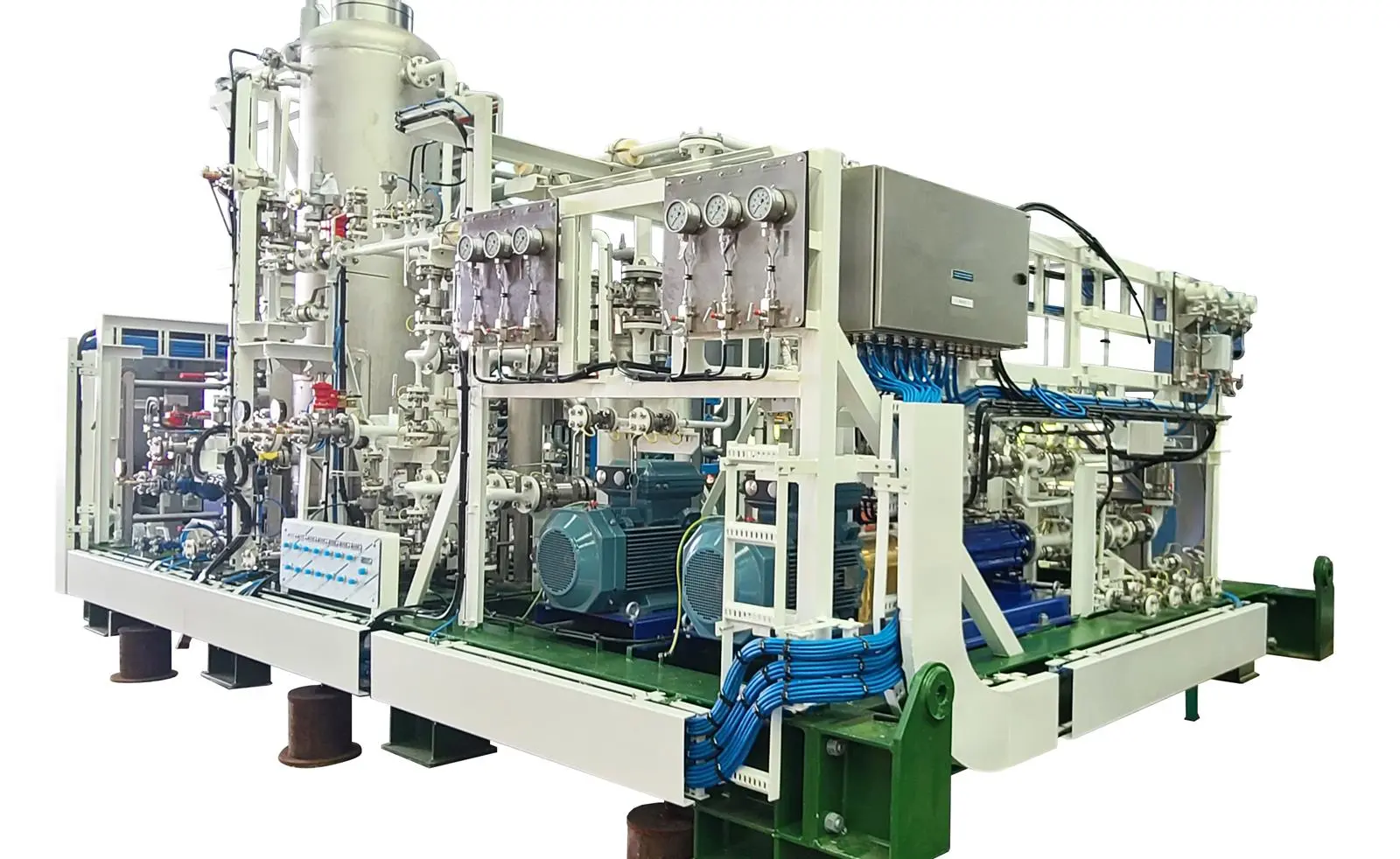
With more than 50 years’ experience in liquefied gas and a record of consistently securing over 50 percent of the market share in LPG cargo handling systems, it was a natural extension of LGE’s capabilities to design and deliver the world’s first newbuild LPG Fuel Gas Supply System, ecoFGSS™. LGE’s system has been market leading ever since and we have secured more than 20 contracts, with six now in service, operating worldwide.
As always with designing a brand new system, there were some technical challenges, but with co‑operation between all the parties involved, these were resolved. Working closely with the engine manufacturers as they ‘fine-tuned’ their designs for the new fuels was vital, from the initial design phase though to commissioning and sea trials. The gas shipping industry has an enviable safety record and the development of ecoFGSS™ maintained this as a core objective.
In addition, LGE has also been contracted to deliver ethane fuel gas supply systems for four Very Large Ethane Carriers (VLEC)s, the first of which will deliver in November 2021. This system – named ecoETHN® – enables the carriage of higher methane content commercial ethane cargoes by integrating the vessel’s reliquefaction system with the fuel gas supply system. ecoETHN® provides condensation of ethane/methane Boil-Off Gas (BOG) from the reliquefaction system to the fuel gas supply system, with up to 2.0 mol% methane in the liquid phase. By harnessing the methane component specifically as an energy/fuel source, the methane content of the cargo is reduced during the voyage, resulting in a ‘purer’ cargo on delivery.
As a next stage of development, LGE is considering ammonia as a fuel for shipowners and making the necessary design adjustments to allow ammonia as a fuel on-board both gas carriers and other ship types. Toxicity is a key consideration, but these challenges can be overcome, as we have been designing systems for ammonia carriage for many years. ecoFGSS™, which has been designed for LPG, will be ‘upgraded’ to ecoFGSS-FLEX®, allowing owners to utilise LPG, ammonia, methanol or DME as their fuel of choice.
One issue that all alternative fuels face is that their energy density is less than conventional fuels, resulting in a greater volume being carried for the same energy output – but that is an inevitable consequence of the change. As the use of alternative fuels increases, the bunkering infrastructure to support this growth has to be addressed – the industry cannot face the same ‘chicken and egg’ scenario that the uptake of LNG as a fuel experienced.
Could you share any details about research or newbuilding projects in which you are active?
In addition to internal development projects, LGE has been involved in a number of alternative fuel projects involving shipyards, shipowners, engine manufacturers, Classification societies and flag states. The two projects that are in the public domain are AiP from ABS for an ammonia fuel gas supply system and AiP from DNV for a dedicated ammonia carrier utilising ammonia as fuel. The latter was a joint development project with a number of key industry players, including Navigator Gas, MAN, DNV, and the Norwegian Maritime Authority (NMA), to develop a fully ammonia optimised mid-sized gas carrier, ready for the ammonia revolution.
Turning to your existing product portfolio, you have established a leading position as a supplier to the LPG market. Your Vent Gas Cooler (VGC) solution is widely used among LPG carriers. Are you looking at upgrading the solution’s performance? Separately, you are seeing increasing uptake of your new LPG FGSS for vessels operating on LPG. Are there possible areas where you can improve the performance of two systems through integrating the two systems?
In terms of the VGC™, we are looking at new ways to improve/upgrade the system, either by increasing the efficiency or reducing the cost, and ideally a combination of both. However, we are, as is everyone in the business, constrained by the laws of thermodynamics in terms of increasing efficiency. Our ecoETHN® design for ethane already integrates the reliquefaction and fuel gas systems, and a similar development for LPG is under investigation. Of course, whatever comes out of this will be applied to ammonia and other fuels. The uptake of LPG fuel gas supply systems is likely to increase as owners future-proof their assets, but the use of LPG as the primary fuel will, of course, be influenced by the market price for LPG compared to conventional fuels.
Turning to LNG, you have established solutions for LNG carriers. The ecoSMRT reliquefaction system is particularly competitive in terms of energy consumption and space requirements, reflecting the integrated pre-cooling step, for example, when it launched. Are you looking at further product refinements?
ecoSMRT® is always being looked at from the perspective of refining/improving the initial objectives of reduced CAPEX, reduced OPEX and deck space required, with a view to maintaining the competitive advantage. Of particular importance is operational feedback from the many systems in operation and incorporating these into future designs, ranging from software tweaks to changes to items of equipment.
The refined/improved design is also being stretched to provide units with larger capacities than the current 60+ off 1.9 tph units that we have supplied to date.
The expansion of the LNG market is creating new opportunities, with increased demand for smaller sized bunker vessels. Are you looking at products that address the different requirements of smaller LNG carriers, for example?
We are focusing on where our reliquefaction technology – ecoSMRT® – offers the most significant benefit to customers, which at this stage, is the very busy 174,000m3 LNGC market and not attempting to fit a square peg into a round hole.
Whilst the small-scale LNG bunkering sector is not something we are actively pursuing at the moment, it is still on our radar as and when suitable opportunities arise.
We expect the efficiency of cargo containment systems to become increasingly important as LNG suppliers seek to reduce GHG emissions from their supply chains. How does your system’s Coefficient of Performance (CoP) compare with competing designs?
We prefer to allow our systems to speak for themselves rather than benchmark against competitors’ systems but, for comparative purposes, please see the table below which shows that ecoSMRT® delivers more for your money. The efficiency of cargo containment systems is already very high, and new systems coming into the market, but at some point, it will get to the point of diminishing returns, so any incremental advantage that can be gained from reliquefaction will become more significant.
| ecoSMRT® | Competitor 1 | Competitor 2 | Competitor 3 | |
|---|---|---|---|---|
|
Specific power consumption (kWh/kg) |
0.656 |
1.040 |
0.952 |
0.937 |
|
Relative efficiency |
100% |
63% |
69% |
70% |
|
Reliquefaction rate at 100% capacity (tonne/hr) |
1.900 |
1.700 |
1.600 |
1.700 |
Related Articles
 ALTERNATIVE FUELS & LUBRICANTS
 ALTERNATIVE FUELS & LUBRICANTS
 ALTERNATIVE FUELS & LUBRICANTS