



BELGIUM INVESTS IN NEW RESEARCH PLATFORM
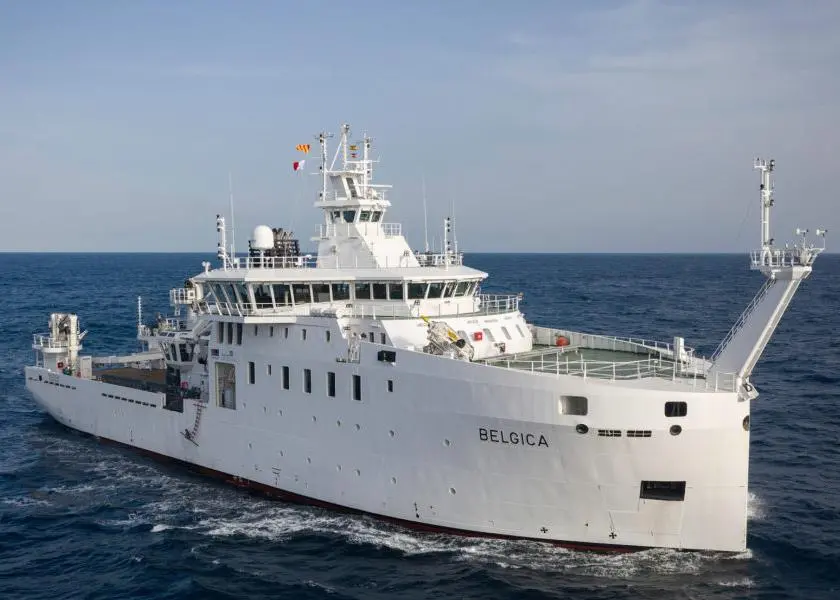
Expected to take up duties by the autumn of this year, when she will supersede her 37 year-old, smaller (51m) namesake, Belgica completed sea trials during March with Galician shipbuilding contractor Construcciones Navales Paulino Freire.
Employing a diesel-electric installation based on IMO Tier III-compliant medium-speed engines, the vessel will offer multidisciplinary research capabilities and facilities in excess of those provided by the current main platform for Belgian marine science.
Ownership will be vested in the Belgian Science Policy Office(BELSPO), an agency of the Belgian State, with responsibility for management assigned to the Royal Belgian Institute of Natural Sciences (RBINS) in collaboration with the Ministry of Defence and a private operator.
Equipped to undertake scientific research in a wide variety of fields, including fisheries, biology, chemistry, oceanography, hydrography, geology and sedimentology, the new Belgica has greater provision for scientists in terms of laboratories and accommodation than her predecessor. She has also been designed to spend more time at sea per annum (about 300 days per year) and cover a wider research area, encompassing the North Sea, eastern Atlantic, and Mediterranean, and also Arctic waters during the summer navigation season.
Vigo shipbuilder P.Freire’s contract was valued at EUR54 million (US$65.7m), and it was estimated at the time of the order that the ship’s annual operating costs, including that entailed with a two-crew system, would be at least EUR4.3 million (US$5.2m).
The project has yielded a further reference for Belgium’s bastion of medium-speed engine development and production, the Ghent factory of ABC Engines. The main gensets in the twin-screw Belgica are driven by three of the company’s DZC-series engines, two in eight-cylinder configuration plus a single six-cylinder model, representing a mechanical power concentration of 5,155kW.
The diesel machinery has integral catalytic converters, curbing NOx emissions to below the Tier III threshold, and double-elastic mountings and acoustic dampening have been applied so as to minimise or obviate vibration and underwater radiated noise and consequent impact on hypersensitive research procedures. The effectiveness is implicit in receipt of the DNV Silent-R class notation. Using two bow thrusters plus the two aft thrusters, Belgica has been engineered for a DP2 level of dynamic-positioning.
The vessel will undertake research missions typically of five- to 20-day duration, and scope for high-latitude deployments is reflected in the hull’s reinforcement to 1C ice class standard. As well as sustaining national efforts, Belgica will also serve as a platform for European cooperation, by way of the Eurofleets network, which provides access to a common marine research infrastructure.
Over 400m2 of laboratory space is incorporated in the newbuild, which is equipped with an acoustic underwater instrumentation suite and positioning systems supplied by Kongsberg Maritime. The working scope extends to surveys carried out by AUVs and UAVs as well as large ROVs, especially pertinent to future participation in EU projects.
The new ship is due to be baptised in Ghent during September, after an inauguration trip from Zeebrugge.
PRINCIPAL PARTICULARS – Belgica
|
Length overall |
71.4m |
|
Length bp |
68.7m |
|
Breadth |
16.8m |
|
Depth, to Deck 3 |
5.8m |
|
Draught, scantling |
5.0m |
|
Propulsion system |
Diesel-electric |
|
Main genset engines |
2 x 1,875kW + 1 x 1,405kW |
|
Speed, trials |
13kts+ |
|
Endurance |
30 days |
|
Complement |
12 crew + 28 scientists |
|
Flag |
Belgian |
Related Articles
 PROPULSION
 GENERAL NEWS
 HYDROGEN