



Britannia bolsters UK cruise fleet
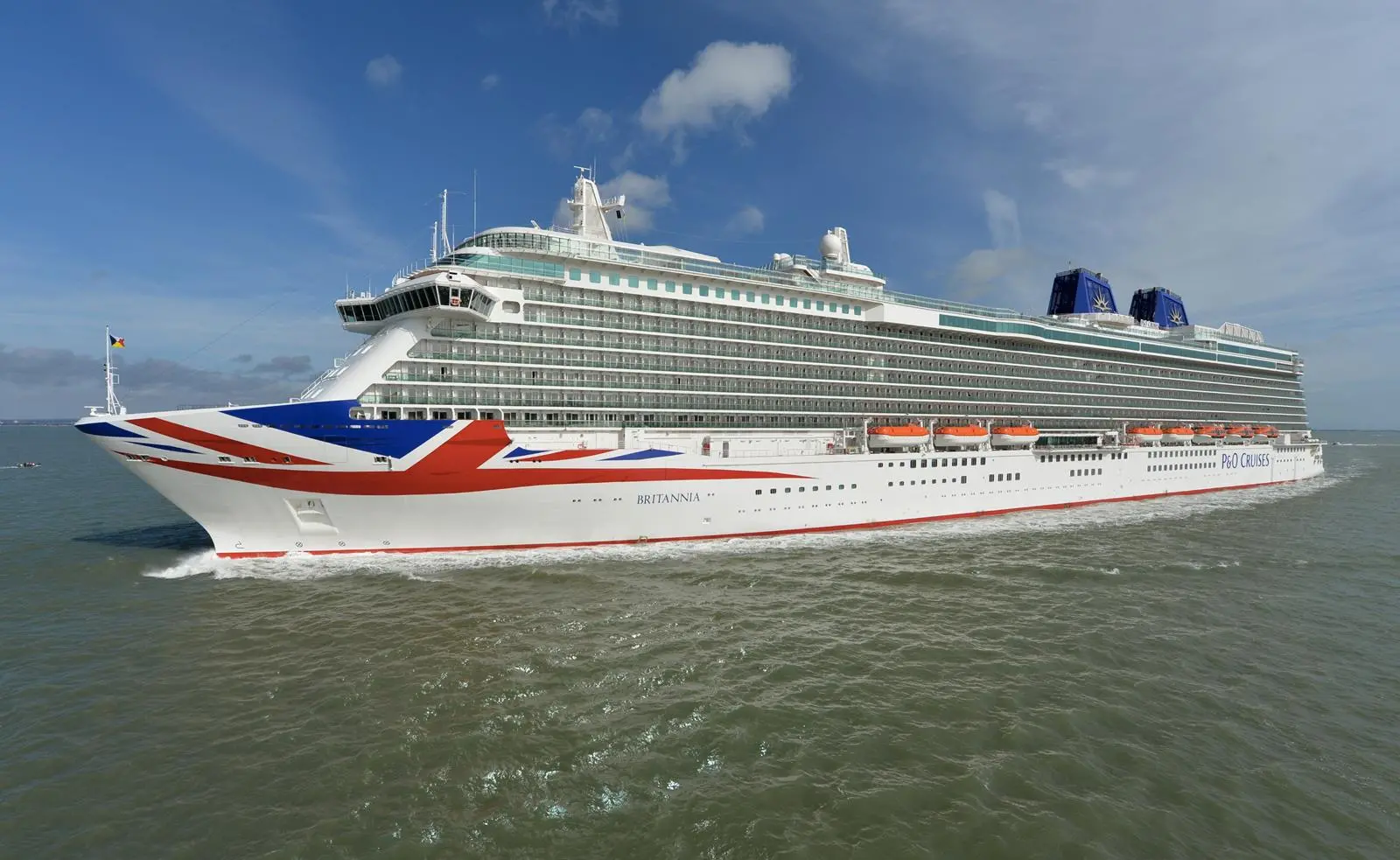
Using the technical template provided by Princess Cruises’ Royal Princess and Regal Princess, the third ship in the series from Fincantieri has been crafted to P&O Cruises’ specific requirements.
Some 20 years after the former P&O Steam Navigation Co took delivery of the 69,000gt Oriana, ranked as the first modern cruise liner to have been conceived specifically for the British market, the diesel-electric Britannia signals a new stage in the development of the fleet operated by P&O Cruises. Like Princess Cruises, the Southampton-based line is today one of the brands of Miami-headquartered Carnival Corporation, but its distinct identity is reinforced by the new ship, described as a ‘modern classic‘.
The name and adornment of the hull with the Union flag is intended to reinforce the pivotal objective of creating a vessel of quintessentially British character in terms of onboard ambience, facilities and service. The Southampton-registered ship is testament to the verve and vision of Carnival and its UK arm and is a showcase for home-grown interior design skills. However, her Italian construction, and largely German, Finnish and Italian engineering, are pointers to leading contemporary sources of maritime industrial capabilities for the production of large, luxury passenger ships.
Nonetheless, the investment in Britannia constitutes a major commitment to UK shipping, and a new tool of long-term revenue generation for the country’s maritime sector. Against the backcloth of a robust UK cruise market, the latest fleet addition underscores the international cruise shipping industry’s propensity for expanding business through continual investment in vessels, service level and itineraries.
While based on the same technical platform as that of the Royal Princess and Regal Princess, delivered to Carnival’s Princess Cruises brand in 2013 and 2014, respectively, Britannia incorporates fundamental differences as regards interior design and configuration and exterior styling.
As with the preceding pair, the latest vessel was built by Fincantieri’s Monfalcone yard, near Trieste, consolidating the versatile Italian group’s ranking among the global shipbuilding elite in cruise ship construction. A distinguishing feature of Britannia in profile is the adoption of two funnels, located along the centreline aft. Royal Princess and Regal Princess have just a single, latticed funnel casing.
Britannia was officially named by Her Majesty The Queen on March 10 at Southampton’s Ocean Terminal, having made the delivery voyage from the north Adriatic with a call at Gibraltar.
The vessel began her revenue-earning career on March 14, departing Southampton for a cruise taking in Spain, Italy and France. The initial season out of the UK south coast port will entail mainly 14-night cruises to the eastern and western Mediterranean, the Iberian peninsula, the Canary Islands, the Norwegian fjords, and the Baltic Sea. The schedule also includes a number of short-break voyages and a special round-Britain cruise. During the autumn, the vessel will reposition to the Caribbean for the winter period, to operate 14-night round-trip itineraries from Barbados.
Britannia is larger than any other vessels in the P&O Cruises fleet, the biggest units hitherto having been the Fincantieri-built 116,000gt Ventura and 115,000gt Azura, introduced in 2008 and 2010, respectively.
On the basis of lower berth capacity, the latest ship accommodates 3,647 passengers, plus around 2,000 crew. Out of a total 1,837 passenger cabins, 75% incorporate balconies, maximising revenue-earning capabilities, and 27 are single-occupancy. The latter denotes the continuation of the practice of offering single cabins that P&O Cruises began with the Ventura.
Britannia provides a further technological showcase for the ‘power station‘-type configuration whereby four main diesel generators serve the ship’s entire energy network as well as propulsion drives. The high voltage propulsion and distribution system has been developed and supplied by Hamburg-based SAM Electronics, while the genset prime movers are Wartsila medium-speed diesels, produced at the Finnish-owned company’s huge factory near Trieste. Before long, both marques will fall under the same parent organisation, as Wartsila is expecting to complete the acquisition of L-3 Marine Systems International, proprietor of SAM Electronics, during the second quarter of 2015.
The plant is based on two 18,000kVA and two 21,000kVA synchronous generators, driven by 12- and 14-cylinder Wartsila 46F-series medium-speed engines, respectively. The maximum, aggregate power output is 62,400kW with the diesels running at 600rpm. The main machinery is divided between two separate engine rooms, each housing one 12-cylinder and one 14-cylinder prime mover plus alternator.
The four diesel alternators feed the two 11kV main bus bars connected via bus tie breakers. Electrical energy for the hotel load is supplied via the 11kV/690V and 230V transformers to the relevant substations of each fire zone. The six tunnel thruster drives are directly fed by the 11kV switchboards.
The two 18MW elastically-mounted propulsion motors are speed-controlled via synchro-converter drives. For each shaft line, the system comprises two thyristor-controlled rectifier/inverter sets linked to the ship’s electrical power network via two oil-immersed propulsion transformers, each with two secondary windings. Each of the two independent power systems feeds one of the two windings of the synchronous propulsion motor, conferring a very high level of redundancy.
This effectively results in a 12-pulse arrangement for the machine side and a 24-pulse solution for the supply network. Both shaft lines act together in a 48-pulse configuration comprising fully redundant control electronics. In the event of a fault in any part of the control electronics, 100% of rated power remains available.
SAM Electronics subcontracted the major items of electrical machinery to VEM Sachsenwerk, which manufactured the main alternators, the propulsion motors, and the tunnel thruster motors at its Dresden factory.
The working partnership between SAM and VEM has ensured continuous improvement in the design of electrical machines, not least in meeting demanding criteria as regards structure-borne noise levels aboard cruise ships. In the case of Britannia, as with the Royal Princess and Regal Princess, spring disks were used in the elastic mounting of the synchronous propulsion motors.
The modular decoupling system located between the stator housing and motor base frame has proved effective in reducing vibration, and the solution was preferred by the shipbuilder compared to a conventional approach using rubber elements. The modular nature of the arrangements also allows a straightforward exchange of spring disks in the event of a need for renewal or adaptation.
The two propulsion motors turn the six-bladed propellers at a maximum 142rpm, conferring a service speed capability approaching 22 knots. The propeller shafts in the Britannia use Thordon Bearings’ Compac system, which employs seawater as the lubrication medium in place of oil. Seawater is pumped through non-metallic propeller shaft bearings and returned to the sea following removal of any abrasives. Use of seawater eliminates the aft seal, as well as the storage, sampling and disposal of oil.
A very high degree of manoeuvrability is required so as to rotate the large, high-sided vessel in restricted harbours and at tight berths, and with no or minimal recourse to tugs unless circumstances or regulations demand. To that end, Britannia is equipped with three tunnel thrusters at the bow and three at the stern, each rated for 2,500kW at 900rpm. The combined output of the thrusters is in excess of the propulsion power of many deep-sea merchant ships.
So as to better prepare bridge personnel for handling Britannia, recourse was made to the state-of-the-art simulator complex at the Carnival Group’s training facility in the Netherlands. Located at Almere, near Amsterdam, the Center for Simulator Maritime Training(C-SMART) is equipped with two full mission bridge simulators, six part-task bridge simulators and the means of simulating fixed propeller and podded propulsor operation.
C-SMART is also vested with multiple part-task engine room simulators, two full mission engine control rooms and four machinery outstations. As well as serving Carnival’s various fleets, the facilities are available to the industry at large.
Britannia employs Wartsila Hamworthy’s membrane bioreactor(MBR) technology for the treatment of grey and black water. Through biological degradation and membrane separation processes, the two MBR24 systems exceed the most stringent pollution standards without requiring the addition or generation of chemicals hazardous to the maritime or shipboard environment. Global and regional criteria for wastewater discharge are becoming ever-tougher, and have particular implications for the cruise vessel sector, such that the system installed in Britannia is intended to be ‘future proof’.
The styling and interiors of Britannia have been influenced by the Peninsular & Oriental (P&O) heritage, with spaces, forms and furnishings used to create a quintessentially but contemporary British theme. Richmond International, the London-based architectural consultancy that has made its name largely through the design of luxury, prestigious hotels around the world, was engaged by P&O Cruises for Britannia.
By drawing on the expertise of a company which has built its reputation on the landside rather than in the marine field, the shipowner demonstrated its particular intent as regards the vessel’s interiors. Moreover, P&O’s award of the entire architectural design and styling to a single firm represented a most unusual step, since conventional practice in the cruise ship domain is to assign various spaces to individual architects.
P&O Cruises gave Richmond International responsibility for every interior design duty, encompassing all public spaces and accommodation. It was felt that an overall, integrated design vision and direction would ensure that the public areas throughout the ship would complement and flow into each other.
Richmond worked in tandem with Maurice Brill Lighting Design to enhance the interiors. The centrepiece of the impressive, three-tier atrium is Maurice Brill’s Star Burst multi-mirror, chandelier lighting sculpture, inspired by the stellar constellations once used by all navigators.
Among other key features, the Oasis Spa complex is the largest of all spa facilities in the P&O Cruises fleet, and includes an open deck area known as The Retreat. The Studio is a multi-purpose venue, serving as both cinema and conference room, and used for lectures by guest speakers, cookery demonstrations, game shows, music recitals and plays. The three main restaurants have been designed to feel more intimate than traditional dining areas.
An extensive Italian network of contractors and specialists contributes to Italian shipbuilding’s leading position in the cruise vessel stakes. Indicative of the cluster’s contribution to the Britannia project, Treviso-based Somec Marine & Architectural supplied the balcony doors and windows, balustrades and partitions, glass walls, skylights and wheelhouse glazing.
Alongside the interior advancement, Britannia also heralds a development in exterior motif to be rolled out across the P&O Cruises fleet. Whereas the brand’s colours have hitherto been a purely white hull and all-yellow funnel, the bow and forward section of the hull of the new ship is emblazoned with a stylised, 97m-long Union Jack, while her two funnels are in royal blue blue with an overlaid with an illuminated rising sun motif.
Although evocative of an earlier era of ocean travel, a number of ships built in recent years incorporate twin stacks, notably Holland America Line’s Vista-class and subsequent Signature-type, Royal Caribbean’s Solstice-class and the four vessels of Disney Cruise Line.
The blend of quality design and outfitting, advanced technology and exacting vessel performance standards encapsulated by Britannia is testament to the retained critical mass and enduring competitiveness of the European shipbuilders and wider maritime industrial sector in the field of luxury passengership construction. Fincantieri’s track record is outstanding. Since 1990, the organisation has delivered 68 cruise ships from its Italian yards, and the orderbook on April 1 this year included a further 16 cruise vessels.
The Royal-class from which the latest ship is derived will have a further representative in 2017, as a consequence of Carnival’s decision last year to order a third vessel based on the original design platform for operation with Princess Cruises. Successful contractor Fincantieri has assigned the project to the Monfalcone yard. The 143,000gt newbuild will have a lower-berth passenger capacity of 3,560, and will entail an all-in cost for the shipowner of approximately EUR 600m($647m).
PRINCIPAL PARTICULARS-BRITANNIA
Length overall 330.00m
Length bp 306.07m
Breadth, moulded 38.38m
Draught, design 8.30m
Draught, maximum 8.55m
Air draught(from design waterline) 68.30m
Gross tonnage 143,730gt
Displacement @8.30m draught 68,155t
Passenger capacity, lower berth 3,647
Passenger capacity, maximum 4,324
No. of decks 17
Crew, maximum 1,398
Propulsion system Diesel-electric
Main genset engines 2 x 14,400kW + 2 x 16,800kW
Main alternators 2 x 18,000kVA + 2 x 21,000kVA
Main engine power, total 62,400kW
Propulsion motors 2 x 18,000kW
Bow thrusters 3 x 2,500kW
Stern thrusters 3 x 2,500kW
Emergency genset 1 x 1,700kW
Speed, @2x 15.3MW 22 knots
Speed, maximum @2 x 18MW Abt. 23 knots
Class Lloyd’s Register
Related Articles
 PROPULSION
 GENERAL NEWS
 HYDROGEN