



BUILDING BLOCK FOR CLIMATE-NEUTRAL LOGISTICS
The technical specification laid down for the ships embraced an across-the-board approach to emissions reduction, driven by the eco agenda of the prospective charterer, the Volkswagen Group. Siem Confucius is the first of two sisters constructed by Xiamen Shipbuilding Industry in eastern China’s Fujian province. She ushers in the use of LNG as primary fuel in the deepsea pure car/truck carrier (PCTC) category. Second-of-class Siem Aristotle is expected to follow within the spring.
While ever-more stringent emissions legislation and the inter-relationship between energy efficiency and carbon footprint bears directly on newbuild vehicle carrier design and engineering, the increasing sensitivity of manufacturers to environmental issues influences logistic strategies. Significantly, the Volkswagen Group, heavily fined by the US in 2017 for emission violations with diesel-engined vehicles off its production lines, has a strategy in place to improve the environmental impact of its transport operations. This has already found expression in a number of spheres, not least European intra-regional and shortsea operations.
The organisation’s logistics arm is now rolling-out the policy in application to long-haul trade, by way of the specific attributes of the two Chinese newbuilds, for which Siem Car Carriers had submitted an economically and environmentally convincing proposal. The ship operator is a member of the Siem Industries Group, headquartered in Kristiansand, Norway.
The car-equivalent unit (CEU) capacity of the design is 7,700. The 13 cargo decks of various heights and loading strength provide the requisite flexibility as well as scale to serve a diverse vehicle production range. The layout will enable typically mixed payloads of around 4,700 vehicles of different VW models and types on any single voyage. Siem Confucius and Siem Aristotle will replace two of the nine heavy fuel oil (HSFO)-burning, diesel-engined PCTCs currently deployed in the VW traffic on the North Atlantic. The round-trip itinerary links markets and plants in Europe, Mexico, the USA and Canada.
The hull breadth of 38m is some 6m greater than that of ships built to the constraints governed by the Panama Canal prior to its expansion, while the length overall length has been retained to just under 200m so as to better ensure long-term, global trading versatility. The 200m limit is dictated by restrictions at many Japanese terminals.
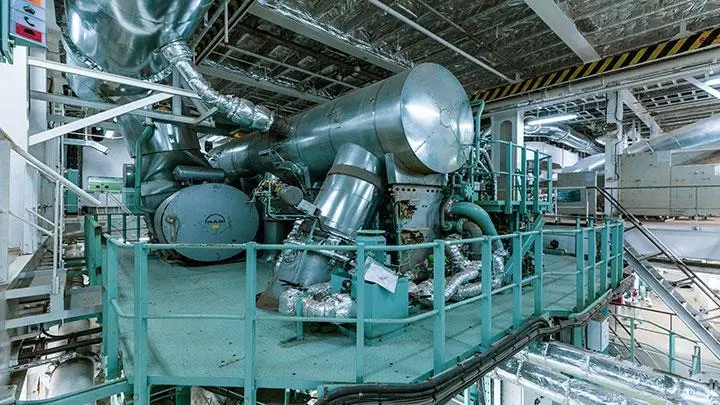
LNG will be the primary fuel for both main and auxiliary machinery. Besides the high-pressure, low-speed two-stroke dual-fuel main engine, entailing a fuel supply pressure of 300bar, the genset drives and principal boiler are also of dual-fuel type.
The Siem vessels will make an important contribution to the automotive group’s bid to cut emissions in the supply chain from manufacturing to final product delivery, under a strategy dubbed ‘goTOzero’. Compared to the PCTCs that will be superseded, each newbuild is expected to cut CO2 emissions by up to 25%, NOx by up to 30%, and particulate matter by up to 60%, as well as virtually eliminating SOx.
Thomas Zemechel, head of VW Group Logistics, stated “We are entering a new field here to reduce emissions. Both ships are the first overseas car freighters in the world to be LNG-powered. In addition to the increasing use of LNG(-fuelled) trucks, conversion of our many rail transports to green electricity, and the use of biofuel in the shortsea segment, the two new LNG(-fuelled) ships represent an important building block for our strategic goal of climate-neutral logistics.”
Hitherto, the industry’s use of LNG in sea-going vehicle transportation has been confined to the short-haul and intra-regional field.
The propulsive power installation is an S60ME-GI gas-injected, dual-fuel two-stroke from the MAN stable, rated at 12,600kW, and incorporates exhaust gas treatment. The machinery offers still greater long-term flexibility through suitability for operation on biogas or potentially on synthetic natural gas, so-called e-gas produced by Power-to-X technology using renewable energy.
“We believe that the switch to LNG as marine fuel is the most important basis for a maritime energy revolution,” observed MAN Energy Solutions’ CEO Uwe Lauber. “In a second step, gas-capable ships can be operated with synthetically produced, climate-neutral fuels and are therefore future-proof. With this project, VW is pioneering the decarbonisation of global trade flows.”
Direct drive is made to an MAN Alpha four-bladed, fixed pitch propeller of the fuel-saving Kappel design. The 6.95m-diameter screw, with its distinctive, smoothly curved tips to the suction side of the blades, was manufactured in China by licensee Dalian Marine Propeller.
In eco-speed mode, the main engine provides for a speed of 16.5 knots under fair conditions, with the scope to make up to 19 knots should the need for a faster cargo placement, schedule recovery or other circumstances so demand.
The auxiliary outfit is based on three aggregates featuring MAN L28/32DF dual-fuel, four-stroke engines, comprising two nine-cylinder models and one in seven-cylinder configuration. At maximum continuous output, each of the 9L28/32DF gensets yields 1,800kW, and the 7L28/32DF produces 1,400kW.
MAN said that the engines are the first-ever from the L28/32DF series to have been approved for IMO Tier III operation without recourse to selective catalytic reduction (SCR), and the first such units manufactured by licensee CSSC Marine Power (CMP). All the gensets are equipped with turbochargers of the TCR type, and each engine is overseen by MAN’s proprietary SaCoS control system.
The complete fuel gas supply and storage wherewithal has been provided by Chinese designer and manufacturer Gloryholder Liquefied Gas Machinery. For each ship, the Dalian-based company’s contract encompassed two 1,800m3-capacity Type C LNG fuel tanks for underdeck placement, two LNG bunkering stations, a high pressure/low pressure gas supply unit, boil-off gas (BOG) handling and reliquefaction systems, water/glycol system, gas detection and LNG fuel safety and control arrangements.
The 3,600m3 of LNG storage capacity ensures that the new PCTCs have a similar range to that of HFO-powered vessels, while the broader beam allows the below-deck accommodation of the fuel tanks without penalising cargo payload relative to earlier Panamax-size ships.
LNG bunkering will be accomplished on both sides of the Atlantic, in Jacksonville and Emden, the latter, northeast German port being Volkswagen’s principal interface for vehicle shipments. Fuel supplies in the USA will be effected using a newly-built articulated tug/barge (ATB) unit. Constructed at Pascagoula by VT Halter Marine, the ATB combination comprises a 4,000m3-capacity LNG tank barge and dedicated, 39m push tug. Contractual owner Quality LNG Transport (Q-LNG) has entered into a 15-year agreement with Shell Trading (US) for deployment of the ATB along the southeast US eastern seaboard and Gulf of Mexico.
Besides the Siem PCTCs, regular recipients will include two LNG dual-fuel cruise ships ordered in Germany by Carnival Cruise Line. Based at Port Canaveral in Florida, Q-LNG Transport will draw loads from the Elba Island LNG terminal in Savannah, Georgia.
Volkswagen, which is the majority owner of MAN Energy Solutions’ Augsburg-based parent MAN, is also considering diesel to dual-fuel repowering schemes for existing tonnage, and is looking into the possibilities of fostering LNG usage on other routes.
Total worldwide marine shipment volume organised and controlled by VW’s logistics arm is in the region of 2.8 million vehicles per annum. In addition, constructional parts, componentry and spares accounts for some 250,000 container loads each year. Within the European domain, the group has taken steps in recent years to effect a modal shift in favour of shortsea transport where viable, one example being inter-plant transfers from Turkey to Portugal.
Volkswagen joined the Clean Shipping Network (CSN) at the beginning of 2014 and was the first German auto maker to use CSN’s Clean Shipping Index to assess the environmental impact of its marine transport activities.
PRINCIPAL PARTICULARS – Siem Confucius
|
Length overall |
200.0m |
|
Breadth |
38.0m |
|
Draught |
7.5m |
|
Capacity |
7,700CEU |
|
Main engine power |
12,600kW |
|
Auxiliaries |
2 x 1,800kW + 1 x 1,400kW |
|
Speed, maximum/efficient |
19/16.5kts |
|
Class |
LR |
|
Flag |
Liberia |
Related Articles
 PROPULSION
 GENERAL NEWS
 HYDROGEN