



Bulk carrier design aims for 40-year lifetime
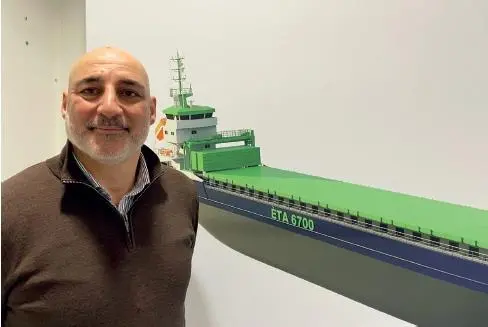
The idea is for the ships to have a 40-year lifetime, meeting the increasingly stringent requirements on GHG emissions along the way to ultimately become zero-emission vessels.
The joint venture will see the construction of six initial (and another 10 optional) vessels built by Taizhou Sanfu Ship Engineering. The vessels will be owned by Mare Balticum, a subsidiary of Mercuria, with ÈTA Shipping acting as a minority shareholder. The maiden voyage of the first vessel is planned for the second half of 2025.
The investment in ÈTA Shipping and the new series of ÈTA 6700 vessels gives Mercuria a platform to accelerate its transition to zero carbon as fast as new technologies become commercially available.
“Three features make these vessels truly unique: future-proof design, efficiency, and automation. Designed with the efficiency in mind, ÈTA vessels are already 30% more efficient than a conventional newbuild and about 50% more efficient than the average ship in the legacy fleet,” said Mindaugas Gogelis, Energy Transition Director of Mercuria.
The design was developed in collaboration with engineering firm Western Baltic Engineering in Klaipèda, Lithuania, and is being tested in the basin at HSVA in Germany. Lloyd’s Register granted Approval in Principle for the design earlier this year, and Netherlands-based Eekels will act as system integrator.
The 109-metre design has been achieved without compromising speed or cargo carrying capacity, and at a comparable capex and significantly lower opex than conventional vessels, says ÈTA Shipping co-founder Sam Gombra. It has a cargo carrying capacity of 7,400dwt but is just under 5,000 gross tonnage and can achieve 10.5 knots fully laden at under 900KW of power. This makes it the most efficient Ice 1A vessel in its peer group, he says.
A unique element of the design is that bow has no flair and a 25-degree angle, meaning the ship will not ride on the waves. Testing of the seakeeping qualities of the ice-strengthened hull has shown that it will be able to keep green water from traveling over the hatches.
An electric motor powers the propeller directly, enabling the installation of a large, 4.7-metre fixed pitch propeller that operates at 72rpm at cruising speed. “We get a lot of efficiency there, and for the whole electric train, the conversion from diesel to electric, is optimised in every sense. We lose less than 6% between the generator actual power on the propeller,” says Gombra.
The electricity is provided by three 600kW Mitsubishi generators, each installed in its own container and capable of plug-and-play installation onboard. The containers are redundant, so that if one fails, the ship can continue sailing – it can sail on just one if needed. The generators can be fuelled by conventional or low carbon fuels.
It is also possible to connect any sustainable power source, such as batteries or fuel cells, to replace the generators. These new power sources could run for example on green hydrogen, methanol or ammonia. Containerised, they can be added along with new fuel containment systems that would also be containerised. Gombra estimates that it will take less than a day to remove the existing power generation system and replace it, fully or partially, without the need for a shipyard.
There is space for five containers under deck at the stern of the vessel to house the generators and other equipment as well as another eight slots where containers can be stacked three-high for fuel storage.
Automation plays a big part in the efficiency gains achieved, and the result is that the ship can be safely managed with a reduced crew size of four, instead of six. ÈTA Shipping and TechBinder have spent several years developing the Holistic Operational Management Platform (HOMP) that will be rolled out for all ships.
By automatically keeping track of key performance indicators and validating changes in operation and technical design, ÈTA Shipping will be able to determine the impact of their decisions and compare vessel and asset performance over time. ÈTA Shipping can then directly analyse any technical developments and develop them further each time they are installed on new vessels. This offers a major step towards the ambition of being climate neutral with all cargo ships within 30 years.
“The vessel’s 3D management tool that uses over 1,300 sensors, enables virtual navigation, equipment data access, and historical trend analysis for crew and technical staff,” said Walter van Gruijthuijsen, naval architect and co-founder of ÈTA Shipping.
When there is an alarm that pops up, the system will display a 3D visualisation of the vessel. “Every system and every machine can be viewed via a single screen. Whether it is the generators, the electric motors, the ballast system or the ballast water treatment system, it is all shown on that one screen. In the event of a malfunction, the crew can quickly see what is going on. All manuals have also been entered into the system, so there is no need to look for hard copy manuals. And if it is not yet clear, the manufacturer also has insight via the digital model,” says van Gruijthuijsen.
Maintenance schedules have been entered into the system and will be automatically updated, as will inventories, when tasks are completed. “So at a certain point the message ‘replace filter’ appears. This will indicate where it is located and what type it is. It also shows which safety measures must be taken in accordance with the ISM safety code: which installation must be switched off, which valve or valve must be closed, and whether a room needs to be ventilated before starting work. It will also show which personal protective equipment should be worn.”
The system employs machine learning using input from the large number of sensors installed. This makes it possible to determine the behaviour of the ship in wind and wave conditions and to register changes to the propulsion system, so that the ship itself adjusts the propulsion as well as notifying the crew of the option to reduce or increase speed to meet the schedule set in the voyage plan.
Another automated system that Gombra expects a lot from is the automatic opening and closing of the hold hatches. “We know that is one of the most dangerous actions on a ship. Due to strict regulations, three people now have to be present. By automating that system, the crew is no longer at risk.
“Mooring will also soon be partially automated. The bunches are stored in drums and the winches keep the tension equal. So once the mooring lines have been tackled on shore and placed around the bollard, there is no need to worry about it anymore. The same applies to ballasting the ship. All these systems ensure that the ship can sail with four crew members. That makes a difference in operating costs.”
The first six ships will be deployed to sail from the Baltic Sea to the Mediterranean Sea. On the southbound voyage, wood or wood products will be on board, and for the return journey, mainly bulk goods such as metallic ore or split cargoes will be loaded. “But it could be anything, because they are multipurpose ships,” says Gombra.
Ultimately, he anticipates 30 vessels will be built, with some sold to competitors. With this many vessels sailing, they are likely to figure in the design of new terminals and in the cargo volumes sold by shippers. Further designs with larger and smaller capacity are already being planned.
According to Gombra, out of the more than 550 vessels registered primarily in the Netherlands and Germany, less than 4% of the short sea fleet is less than six years old, and 19% are more than 20 years old, demonstrating the need for fleet renewal. As this process goes forward, he believes there is a strong opportunity to incorporate high efficiency, low emission technologies.
“We are actually prepared for all the issues that we are talking about and thinking about in the maritime world or actually worldwide,” says Gombra. “We have developed a platform solution, and this makes it very flexible and very attractive for owners and cargo owners. It enables them to adapt to legislation, regulations, and commercial demands.”
Related Articles
 2-STROKE & 4-STROKE
 2-STROKE & 4-STROKE
 2-STROKE & 4-STROKE