



Can shipyard capacity match surging demand for energy efficiency retrofits?
The ship repair industry faces a critical question: can global shipyard capacity meet the accelerating demand for engine retrofits and energy efficiency technology installations? Both are essential to achieving the targets of maritime decarbonisation.
In addition, while shipowners have historically relied on a global network of repair facilities to absorb cyclical peaks, new evidence from market tracking and scenario analysis suggests that yard capacity could become a binding constraint before 2030.
Under the right conditions, this could lengthen lead times, raise costs and shift competitive advantage toward those who act early to secure their slots.
Current investment in retrofits is limited to low-risk, low-cost options that have limited effectiveness in terms of decarbonization and the IMO trajectories.
This hesitation is driven mainly by uncertainty around regulatory timelines, the implications on costs and subsidies.
For Onboard Carbon Capture and Storage, a significant breakthrough in the number of retrofits will depend on upcoming regulations to provide mechanisms for considering the CO2 reduction on board.
Finally, dual fuel retrofits are expensive and complex, requiring engine, tanks, fuel (gas) supply systems, suitable piping modifications and the safety systems associated with the new alternative fuel selected.
Nonetheless, the annual IMO NZF Tier 1 and Tier 2 reduction factors beyond 2035 have not been decided, making it difficult for ship managers to decide on which is the alternative fuel of choice for the retrofit.
In most cases, ship managers may prefer to wait and postpone the investment for a DF retrofit or even to sell a vessel and invest in a DF newbuild. Conversely, future lack of availability of new DF tonnage, due to newbuild yard bottlenecks, may force ship managers to undertake these complex retrofits to adhere to the decarbonization trajectory.
While adoption of energy efficiency technologies has surged, with over one-third of the fleet now having at least one system installed, yard throughput growth remains moderate. This reflects the fact that many EETs can be installed without extending dry-dock time.
Manufacturers of wind propulsion technologies, for example, report that, with sufficient preparation, installation can be completed in a week outsourcing the task to specialist staff supplied by the manufacturer working along with the yard. Rudder modifications and other common EETs can also be fitted relatively quickly.
As a result, progress in retrofitting certain technologies may be less constrained by yard time than previously assumed. By contrast, complex retrofits such as engine conversions and air lubrication systems are mainly suited for large flat bottom vessels such as LNG carriers, cruise vessels and Ro/Ros, while engine retrofits have broader applicability and are central to long-term decarbonisation.
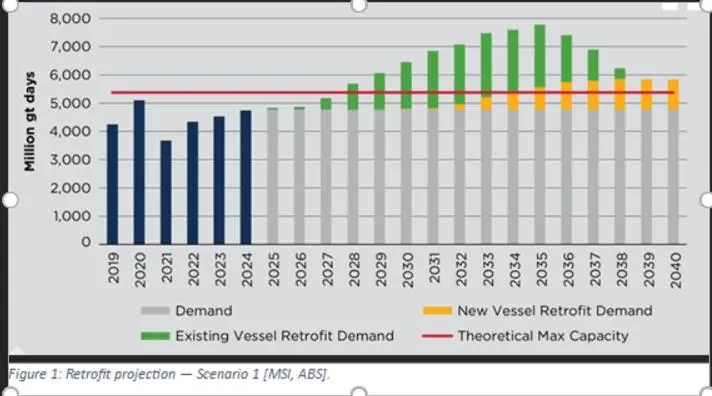
For our 2025 publication ‘Beyond the Horizon: Vision Meets Reality’, two retrofit demand scenarios were developed by ABS and Maritime Strategies International (MSI). Scenario 1 – Full Conversion, assumes all eligible oil-fuelled vessels are converted due to escalating oil costs. It would require yard capacity expansion before 2030.
In Scenario 2 – Base Case, which is deemed the more likely, around half of the existing eligible tonnage and 80 percent of relevant newbuilds are converted. This would place demand within the range of existing and planned capacity, especially if lead times can be reduced from the current 18 months to a target of 14 months.
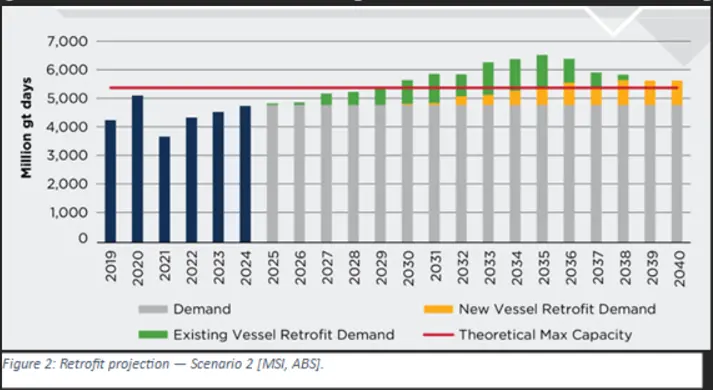
The steepest climb comes in the late 2020s, as regulatory compliance deadlines, fuel-switch strategies and decarbonization commitments converge. The figures below illustrate the retrofit constraints under the two scenarios investigated.
Comparing total yard demand against the theoretical maximum capacity reveals the crunch point. With only modest capacity growth assumed (+1.5% per year after 2030), the moderate scenario turns negative in 2029, with a 43 million gt-day shortfall, a gap widening to over 400 million by 2031.
In the aggressive retrofitting case, the deficit emerges a year earlier (2028), reaching over 1 billion gt/days by 2030. For owners, this means that the shoulder years just before the deficit (2027 and 2028) will be critical for locking in yard time on favourable terms.
Related Articles
 PROPULSION
 GENERAL NEWS
 HYDROGEN