



CANADIAN FLEET GAINS NEW ARCTIC BULKER
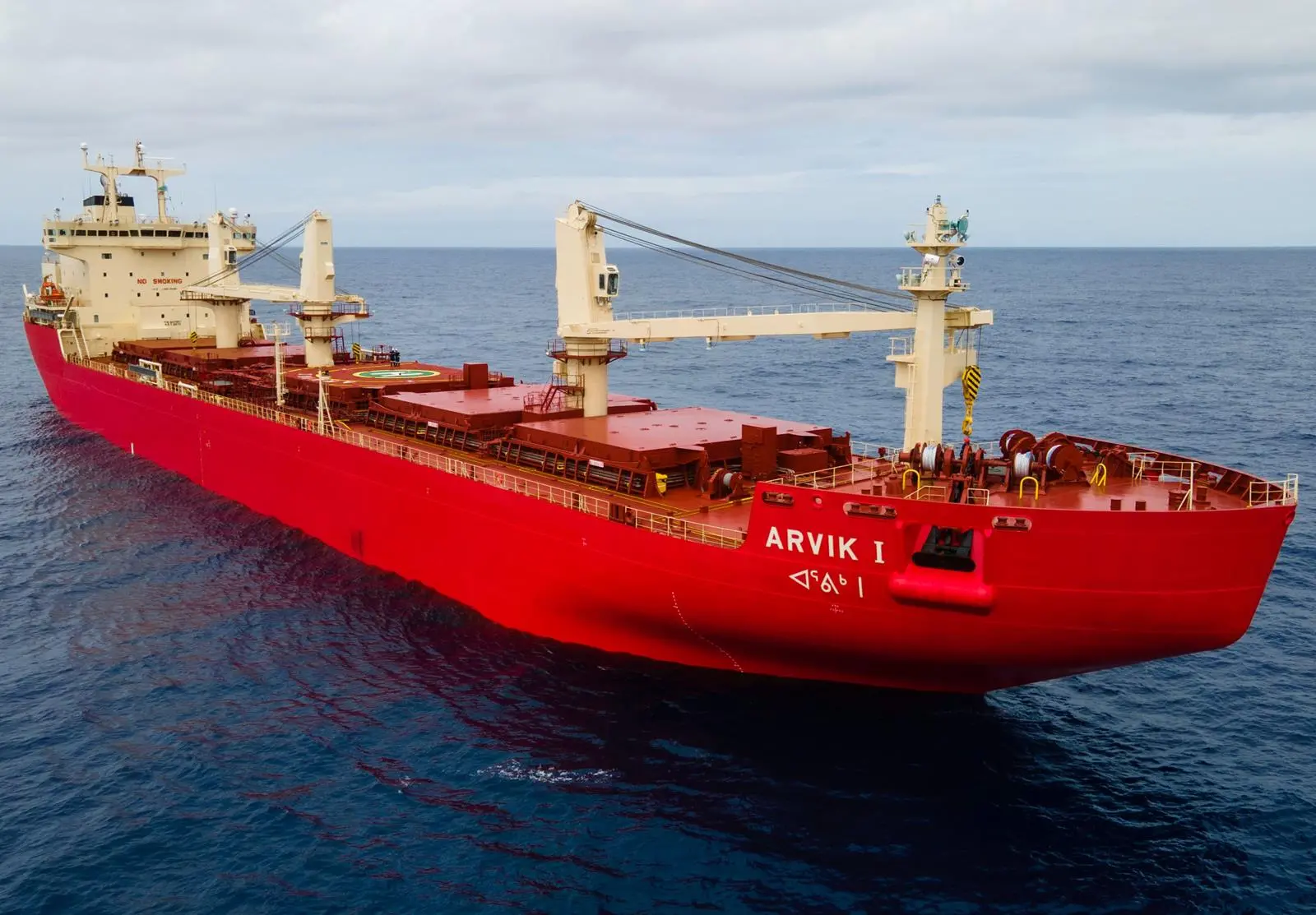
Ordered by Montreal-based Fednav through Sumitomo Corporation and constructed by Japan Marine United (JMU) Corporation’s Yokohama yard, the 30,300dwt Arvik I is expected to make her first service voyage before the end of May 2021. Nickel concentrates brought aboard at the Deception Bay loading terminal, in remote Nunavik, will be transported to the St Lawrence River, and supplies and consumables for the mining complex will be carried on return northbound passages.
Arvik I constitutes a design progression on Fednav’s two other Polar Class 4 bulkers, the 31,750dwt Nunavik, claimed to be the world’s most power icebreaking bulker when completed in 2014 by JMU’s Tsu yard, and the 32,000dwt Umiak I, delivered in 2006 by JMU predecessor Universal Shipbuilding.
The latest project is the outcome of a 20-year partnership agreement with Glencore embracing the construction and operation of a newbuild to supersede the 28,400dwt Arctic. Dating from 1978, and used in the Raglan shipping contract for decades, Arctic has been sold for demolition in Turkey.
The hull form of the Arvik I, including its special, spoon-shaped icebreaking bow, reflects experience with the design adopted for the Nunavik and Umiak I, which also embodied a bow washing system for reducing friction between ice and the hull, a heeling system using ballast water, and an ice knife in the stern.
The new ship maintains a five-hold layout, whereby the midbody, No3 hold is the largest, with a tanktop length and width of 24m X 22.5m and special provision for transporting Arctic-grade fuel for the mine on northbound sailings. Tanktop length in the four other cargo spaces varies from 18m to 20.4m, with a maximum width of 22.5m. Access is through hatchways of a common breadth (15.8m). No3 hatch, serving the biggest underdeck volume, is significantly longer (19.2m) than the 13.6m-13.8m openings to the other holds.
The entire cargo section is protected by a double-hull configuration, and affords a total grain-equivalent capacity of 30,221m3. The whole is served by three centreline-mounted deck cranes. The unit fitted between Nos 1 and 2 holds is rated for a 65t lift, while two cranes of 30.5t-capacity are positioned between Nos 3 and 4, and Nos 4 and 5 holds, respectively.
The three-crane arrangement is the same as on the previous Arctic bulker, but the lifting capability of the forward unit is 15t greater aboard the latest ship.
Arvik I is powered by an IMO Tier III-compliant installation based on a seven-cylinder model of the MAN S70ME-C engine. The electronically-controlled diesel provides the flexibility and efficiency to cover a demanding and mixed operating profile. This calls for widely differing operating modes, including ice ramming, slow steaming in narrow leads and fairways, and open-water service, entailing both high- and low-load scenarios. Year-round navigation means contending with rugged Arctic conditions, including hard-packed sheer ice and icebergs.
The driveline perpetuates the robust characteristics of the Nunavik, wherein a high-strength nickel-aluminium-bronze, Rolls-Royce (now Kongsberg) controllable pitch propeller is mounted in a nozzle to give protection against floating blocks of ice while optimising thrust for ice forcing and manoeuvring.
The use of a controllable pitch propeller in conjunction with the special, optimised hull form, is pivotal in negotiating thick ice and ice ridges, enabling ramming through the repeated application of ahead and astern power to be accomplished within short time cycles and to maximum effect.
The three gensets use Daihatsu six-cylinder DE-23 series engines in a Tier III-adherent auxiliary outfit. This signifies a change from the Nunavik, wherein the MAN marque was specified for the auxiliaries as well as the main engine. Fednav’s all-encompassing attention to emissions performance reflects not only the development of regulatory requirements, but also heightened societal and community expectations as to shipping activity in the ecologically-sensitive northern waters.
Open-water sea passages at 13 knots are expected to entail a 35t per day consumption of intermediate fuel oil (IFO), while the fuel burn when working the ship in port, using the electro-hydraulic cranes for cargo handling, is estimated at some 5t of IFO or MDO per 24 hours.
As with Fednav’s other high-latitude traders, Arvik I is fitted with the proprietary IceNav navigation system originally developed by Enfotec for vessels operating in ice-covered waters.
Registered in Montreal under the Canadian flag, Arvik I gives further expression to Fednav’s longstanding relationship with Anglo-Eastern of Hong Kong as shipmanagement contractor.
Nickel concentrate from the Raglan mining site is transferred 100km by truck to the Deception Bay marine terminal, located at the eastern end of the Hudson Strait, near Salluit, on the vast Ungava Peninsula, within the Nunavik region. Buffer storage is available in a special dome-like warehouse at the port.
Fednav’s icebreaking bulkers take the concentrate on the 2,600km voyage down the Labrador coast and up the St Lawrence to Quebec City, from where the ore is then carried by rail to the Glencore smelter in Sudbury, Ontario. The nickel is melted and cast into matte, returned to Quebec port by rail and shipped to the Nikkelverk refinery in the southern Norwegian town of Kristiansand for processing into high-quality metals.
The versatile design encapsulated by Arvik I and her forbears enables return passages to Nunavik to cater to the complete logistic requirements of the mining operation, encompassing equipment, machinery, and dry and liquid consumables.
The recently decommissioned Arctic had an impressive career and will be remembered by generations of Canadian seafarers for her role in opening up the Canadian Arctic to year-round shipping, including over 20 years sustaining the Raglan mine.
PRINCIPAL PARTICULARS – Arvik I
|
Length overall |
188.0m |
|
Length, load line |
181.8m |
|
Length bp |
178.0m |
|
Breadth |
26.6m |
|
Depth |
15.7m |
|
Draught |
11.7m |
|
Gross tonnage |
22,615t |
|
Deadweight |
30,323t |
|
Cargo capacity(grain) |
30,221m3 |
|
Cargo holds |
5 |
|
Deck cranes |
2 x 30.5t + 1 x 65t |
|
Ballast capacity |
25,659m3 |
|
Main engine |
MAN 7S70ME-C |
|
Speed |
13kts |
|
Class |
DNV |
|
Class notations |
1A Bulk Carrier, BIS, BWM(T), Clean, COAT-PSPC(B), DAT(-30degC), DG(B, P), ECO, ESP, Grab(3-20t), HC(A), Holds(2, 4 or 3) may be empty, Inert LCS, PC(4), Safelash, Strengthened(DK, HA), TMON |
|
Flag |
Canada |
Related Articles
 PROPULSION
 GENERAL NEWS
 HYDROGEN